



The Affirm lawsuit is not one case. It is three separate legal fights, each at a different stage, each affecting a different group of people. One has already paid money to affected customers. The other two are still working through federal court with no settlement yet.
- Is There an Affirm Lawsuit Settlement Right Now?
- Is Affirm Being Sued Right Now?
- What Is the Affirm Lawsuit Actually About?
- The Affirm Data Breach Lawsuit (Evolve Bank)
- What Was the Affirm Data Breach Settlement Amount and Payout?
- The Affirm Consumer Lawsuit: Hidden Fees and BNPL Deception
- What Judith Shepard Alleges
- Real-World Example: Paying for Boots You Already Returned
- Case Status and the 2026 Mediation Timeline
- The Affirm Securities Fraud Lawsuit: What Investors Are Claiming
- What Kusnier Alleges
- Case Timeline: Dismissals, Amendments, and 2026 Status
- Real-World Example: The Shareholder Who Bought In During 2021
- Is There a Real Affirm Class Action Settlement to Claim in 2026?
- How to Claim the Affirm Settlement (If You Qualify)
- Can Affirm’s Arbitration Clause Stop You From Suing?
- Myth vs Fact: Common Affirm Lawsuit Misconceptions
- How to Spot a Fake Affirm Settlement Scam
- Do You Need a Lawyer for an Affirm Lawsuit?
- Affirm Lawsuit FAQ
- What You Should Do Next
If you use Affirm to split up purchases, or you once owned Affirm Holdings stock, you might be wondering whether any of this touches you. Here’s the honest, current answer, sorted case by case.
Is There an Affirm Lawsuit Settlement Right Now?
Yes, but only partly. The Evolve Bank data breach case already settled and paid claimants in early 2026. The consumer fee lawsuit and the investor fraud lawsuit are both still active, and neither has reached a settlement yet.
Here’s the full picture in one table.
| Case | What It Covers | Status | Money Paid Out? |
|---|---|---|---|
| Evolve Bank data breach | Customer data exposed in a 2024 cyberattack on Affirm’s banking partner | Final approval granted, payments issued | Yes, checks and electronic payments went out March 30, 2026 |
| Shepard v. Affirm (consumer BNPL) | Hidden fees, no dispute rights, billing after returns | Active, court-supervised mediation | No settlement yet |
| Kusnier v. Affirm (securities fraud) | Alleged misleading statements to investors | Active, second amended complaint | No settlement yet |
If you have seen ads promising a big “Affirm class action settlement” payout just for being a customer, be careful. The only case that has actually paid anyone closed its claim window months ago.
Is Affirm Being Sued Right Now?
Yes. Affirm Holdings is currently facing two active lawsuits, one from consumers over fees and disclosures, and one from investors over allegedly misleading statements. A third case, tied to a 2024 data breach at a banking partner, has already settled.
Courts dismissed the investor case more than once before letting it move forward again. That is normal in this kind of litigation. A dismissal usually means the judge wants sharper, more specific claims, not that the case is over for good.
What Is the Affirm Lawsuit Actually About?
People search “Affirm lawsuit” expecting one story, but it covers three unrelated legal actions: a data breach at a partner bank, allegedly deceptive buy now, pay later marketing, and alleged securities fraud toward shareholders. Each has its own court, its own plaintiffs, and its own facts.
Affirm Holdings runs one of the best known buy now, pay later platforms in the country. Shoppers use it at checkout with retailers like Amazon and Walmart to split a purchase into smaller payments. That business model is what all three lawsuits circle back to, just from three completely different angles.
Real-World Example: Why One Company Can Face Three Lawsuits at Once
Picture three neighbors. One had her Social Security number exposed when Affirm’s banking partner got hacked. Another kept paying installments on a pair of boots she had already returned. The third bought Affirm stock in 2021 and watched it drop after a regulatory investigation became public.
All three neighbors could reasonably say “I have an Affirm lawsuit.” None of them are talking about the same case.
The Affirm Data Breach Lawsuit (Evolve Bank)
Affirm does not issue every loan itself. It partners with banks to handle parts of the lending process, and one of those partners was Evolve Bank & Trust. In 2024, Evolve was hit with a cyberattack that exposed personal data belonging to millions of people, including a large number of Affirm customers.
What Happened in the Evolve Bank Breach
Hackers gained access to Evolve’s systems between February and May 2024. According to Evolve’s own statement, an employee clicked a malicious link, and the LockBit ransomware group later leaked the stolen files after the bank refused to pay a ransom.
The exposed information included names, dates of birth, Social Security numbers, driver’s license numbers, bank account numbers, and contact details. That is close to a complete identity kit for anyone looking to commit fraud.

Real-World Example: Getting the Breach Notice Letter
Imagine opening your mailbox to a letter saying your Social Security number was part of a bank hack you never even knew you were connected to, because you only ever interacted with Affirm, not Evolve directly. That confusion was common. Many affected people had no idea Evolve even existed until this letter arrived.
See also: if you have dealt with a similar consumer notification mix-up, our guide on class actions that require no proof of purchase explains how flat-payment claims work without documentation.
What Was the Affirm Data Breach Settlement Amount and Payout?
Evolve Bank & Trust agreed to pay $11,858,259.98 to resolve the consolidated data breach litigation. Court records reported by American Banker show attorneys were separately awarded up to one third of that fund in fees, which is likely why several other articles mistakenly describe the total settlement as $3.78 million instead of the full $11.9 million figure.
The case, formally In re Evolve Bank & Trust Customer Data Security Breach Litigation, was consolidated into multidistrict litigation in the Western District of Tennessee under case number 2:24-md-03127. Here is how the actual payout structure worked, according to the official court-authorized settlement website.
| Benefit | Amount | Proof Needed |
|---|---|---|
| Cash Payment A | Up to $3,000 | Yes, receipts, bank statements, or similar records |
| Cash Payment B | Roughly $20, adjusted based on total claims | No |
| Credit monitoring | One year, plus up to $1,000,000 in identity theft insurance | No |
Claim Deadline and Payment Timeline
The claim deadline was October 30, 2025, and it has passed. The court granted final approval on December 15, 2025, following a hearing on November 14. Kroll Settlement Administration, the court-appointed administrator, issued payments to approved claimants on March 30, 2026.
If you filed a claim and received a check, cash it soon. According to the settlement’s own FAQ page, any uncashed checks become void after September 28, 2026.
What If You Never Filed a Claim
The window is closed, which is genuinely frustrating if you qualified and missed it. Your realistic options now are limited. You can call the settlement administrator to ask whether late claims are ever accepted, though there is no guarantee, or you can speak with a consumer protection attorney if your actual losses were serious enough to justify an individual claim outside the settlement.
The Affirm Consumer Lawsuit: Hidden Fees and BNPL Deception
This is the case most everyday Affirm shoppers actually care about, because it has nothing to do with a hack. It is about how the product is marketed and how Affirm treats you when something goes wrong.
Jurisdiction note: This case is built on New York consumer protection law and general business law. As it currently stands, eligibility centers on New York consumers, not the entire country. That could change if the class is certified more broadly, but do not assume nationwide coverage yet.
What Judith Shepard Alleges
The case is Shepard v. Affirm Holdings, Inc., filed June 14, 2021 in the U.S. District Court for the Southern District of New York, case number 7:21-cv-05241. Lead plaintiff Judith Shepard says Affirm markets its installment plans as a clear, no hidden fee alternative to credit cards, but the real cost is harder to track once fees stack up across multiple purchases.
The complaint also raises a specific, very relatable problem, as first reported when the case was filed. It alleges that when a customer returns an item to a retailer, Affirm still expects installment payments to continue while the refund makes its way back, and that customers do not get the same dispute rights they would with a credit card.
Real-World Example: Paying for Boots You Already Returned
Say you bought a $300 pair of boots through Affirm and returned them a week later. The store confirms the return. Under this lawsuit’s allegations, Affirm’s payment schedule does not pause just because the item is gone, so the next installment could still come out of your account.
Case Status and the 2026 Mediation Timeline
This case has been active since 2021, and it is currently in court-supervised mediation. Class certification, the step where a judge decides whether this can proceed as a group case, has not yet been finalized as of 2026. No settlement fund exists, so there is nothing to file a claim for at this stage.
The Affirm Securities Fraud Lawsuit: What Investors Are Claiming
This third track has nothing to do with regular Affirm shoppers. It is an investor lawsuit, brought by people who bought Affirm Holdings stock, ticker AFRM, and say they lost money because the company was not straight with them.
What Kusnier Alleges
Kusnier v. Affirm Holdings, Inc. was filed December 8, 2022 in the U.S. District Court for the Northern District of California, naming Affirm along with CEO Max Levchin and then-CFO Michael Linford. The complaint alleges the company made materially false or misleading statements by failing to disclose that its buy now, pay later business allegedly fueled excessive consumer debt, involved regulatory arbitrage, and relied on data harvesting practices, all of which allegedly raised the company’s risk of regulatory action.
Investors who purchased AFRM securities between February 12, 2021 and December 15, 2021 are the group tied to this specific case. A short disclaimer worth knowing: there was also a separate, earlier securities suit over a mischaracterized 2022 earnings tweet, covering a slightly different window ending February 10, 2022. That one is a distinct case, not Kusnier, and the two get blended together in some other coverage of this topic.
The trigger event tied to the Kusnier case was the Consumer Financial Protection Bureau’s December 16, 2021 announcement that it was opening an inquiry into Affirm and four competitors. CFPB Director Rohit Chopra described the industry at the time as “the new version of the old layaway plan, but with modern, faster twists.” Affirm’s stock reportedly dropped more than 10 percent the day after that announcement.
Case Timeline: Dismissals, Amendments, and 2026 Status
The court dismissed earlier versions of the complaint more than once, most recently in August 2024, but each time gave plaintiffs a chance to file an amended version rather than closing the case for good. As of 2026, the case remains active in the Northern District of California without a settlement, and two related shareholder derivative suits have been paused while it plays out.
Real-World Example: The Shareholder Who Bought In During 2021
Picture an investor who bought AFRM stock in the spring of 2021, drawn in by the company’s growth story. By December, the stock had dropped sharply following the CFPB announcement. Under this lawsuit’s theory, that investor was misled about risks the company allegedly already knew about.
See also: for another case built around disclosure gaps in the financial services industry, see our coverage of the Edward Jones and Kingsview Advisors lawsuit.
Is There a Real Affirm Class Action Settlement to Claim in 2026?
Only for the data breach case, and only if you filed before the October 2025 deadline. The consumer fee case and the investor fraud case have not settled, so there is no fund to claim from for either one right now.
That does not mean nothing will happen going forward. Both remaining cases could eventually settle or go to trial. If either one does, courts require formal notice to class members by mail, email, or a dedicated settlement website, so you will not need to keep searching to find out. It comes to you if you qualify.
How to Claim the Affirm Settlement (If You Qualify)
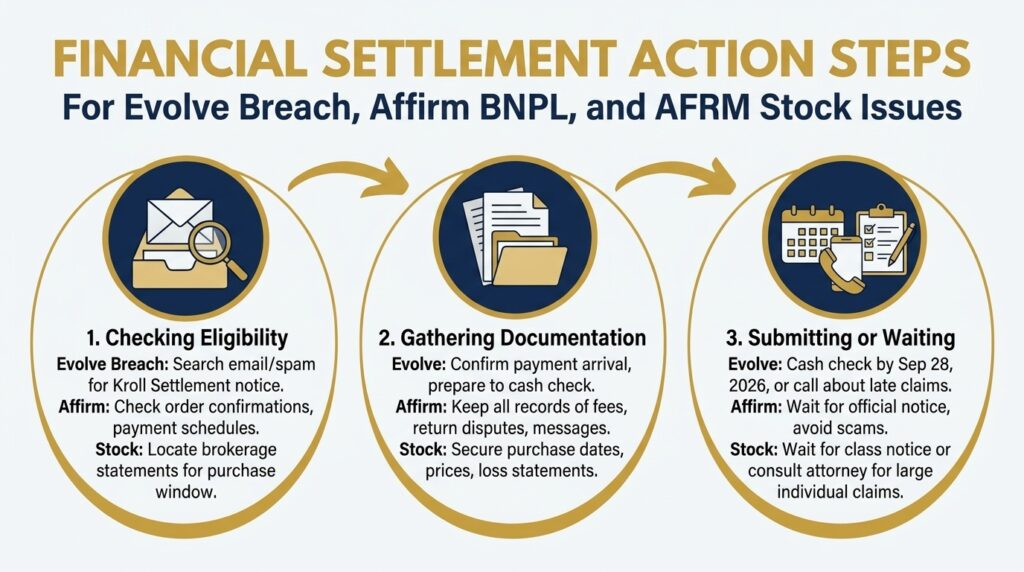
- If you were affected by the Evolve Bank breach: Search your email, including spam, for a notice from Kroll Settlement Administration. If you filed and were approved, confirm your payment arrived and cash any check before September 28, 2026. If you never filed, call the administrator to ask about late claims, though approval is not guaranteed.
- If you are an Affirm BNPL customer with a fee or return dispute: Keep every record you have, including order confirmations, payment schedules, and any messages with Affirm about a dispute. Watch for an official class notice if a settlement is reached later, and do not respond to anyone claiming to represent a settlement that does not exist yet.
- If you own or owned AFRM stock: Hold onto your brokerage statements showing purchase dates and prices from the relevant window. If your losses are unusually large, ask a securities attorney whether pursuing an individual claim makes more sense than waiting on the class case.
Can Affirm’s Arbitration Clause Stop You From Suing?
Most Affirm users agree to an arbitration clause when they sign up, which generally requires disputes to go through a private arbitrator instead of a public courtroom. This is one of the more overlooked details in Affirm’s terms, and it matters more than people realize.
What Arbitration Means for Everyday Affirm Users
For most individual consumer disputes, this clause can block you from joining a class action and push your complaint into private arbitration instead. It does not erase your right to bring a claim, but it usually changes where and how you can bring it.
Why It Does Not Block the Investor Case
Arbitration clauses in a consumer loan agreement do not reach shareholders who bought stock on the open market. That is why the Kusnier securities case can proceed as a class action while individual consumer disputes over things like billing often cannot.
Myth vs Fact: Common Affirm Lawsuit Misconceptions
Myth 1: There is one single Affirm class action lawsuit that covers every customer and investor.
Fact: There are three separate cases with different plaintiffs, different courts, and different legal theories. Being an Affirm customer does not automatically connect you to the securities case, and owning AFRM stock does not connect you to the consumer fee case.
Myth 2: The data breach settlement was worth $3.78 million.
Fact: The total settlement fund is $11,858,259.98. The $3.78 million figure that circulates online is actually the maximum attorneys’ fee award, roughly one third of the full fund, not the total amount available to claimants.
Myth 3: Affirm’s arbitration clause means no one can ever sue the company in any form.
Fact: Arbitration clauses generally push individual consumer disputes into private arbitration rather than court, but they do not block securities fraud claims from shareholders, and a properly certified class settlement, like the data breach case, can still proceed.
Myth 4: You can still file a claim in the data breach settlement in 2026.
Fact: The claim deadline was October 30, 2025, and it has passed. Payments already went out to approved claimants in March 2026, and unfiled claims are no longer eligible under the normal process.
How to Spot a Fake Affirm Settlement Scam
Whenever a real lawsuit gets attention, scammers try to cash in on the confusion. A few warning signs are worth memorizing.
- Unsolicited texts or emails demanding your Social Security number or full bank login to “process your Affirm settlement”
- Countdown timers pressuring you to act in the next few hours before you can verify anything
- Any request to pay a fee upfront before they will release money you are supposedly owed
- Promises of a payout tied to the Shepard or Kusnier cases, since neither has a settlement fund to pay from yet
If you get a message like this, go directly to a case’s official settlement website instead of clicking a link in a text. For a broader look at how legitimate no-documentation claims actually work, see our guide on class action lawsuits without proof, and for comparison, our coverage of the Cash App spam text settlement shows how a real claim notice is usually worded.
Do You Need a Lawyer for an Affirm Lawsuit?
For the data breach settlement, no. That process was built to run without one, and the amount at stake for most individual claimants is not large enough to justify legal fees.
When a Consultation Is Actually Worth It
If Affirm’s fee practices cost you a small amount here and there, joining a future certified class, if one happens, is the practical path, and you do not need to hire anyone for that. If your losses are genuinely large, either from stock losses or from a billing dispute that cost you real money, a consultation is worth it.
Be selective about who you talk to. Our guide on signs of a bad attorney covers exactly this kind of situation. Someone who guarantees a specific payout before reviewing your case, or pressures you to sign something the same day, is not who you want handling this.
Affirm Lawsuit FAQ
1. Is Affirm being sued right now?
Ans: Yes, Affirm Holdings currently faces two active lawsuits without settlements, the Shepard consumer case and the Kusnier securities case, along with one data breach settlement that already paid claimants.
2. What is the Affirm lawsuit about?
Ans: It covers three separate legal actions: a 2024 data breach at banking partner Evolve Bank & Trust, allegedly deceptive buy now, pay later marketing, and alleged securities fraud toward investors.
3. Who qualifies for the Affirm class action lawsuit?
Ans: It depends on which case. Data breach claimants were Affirm customers whose data was exposed at Evolve Bank. Consumer case eligibility currently centers on New York BNPL users with fee or dispute issues. The securities case covers AFRM stockholders from a specific 2021 window.
4. How much money can I get from the Affirm lawsuit?
Ans: The data breach settlement offered up to $3,000 for documented losses or a flat payment of roughly $20 without documentation. The consumer and securities cases have not settled, so no payout amount exists yet for either one.
5. How do I file a claim in the Affirm class action settlement?
Ans: The data breach claim deadline passed on October 30, 2025. For the two still-active cases, there is no claim form available yet since neither has reached a settlement.
6. Is the Affirm class action lawsuit still active in 2026?
Ans: Two of the three cases are still active in 2026, the Shepard consumer case and the Kusnier securities case. The data breach case is closed and already paid out.
7. What was the Affirm data breach settlement amount?
Ans: Evolve Bank & Trust agreed to pay $11,858,259.98 total, with individual payouts up to $3,000 for documented losses or roughly $20 for undocumented claims, plus a year of credit monitoring.
8. Can Affirm’s arbitration clause stop me from joining a lawsuit?
Ans: For most individual consumer disputes, yes, it generally pushes claims into private arbitration instead of court. It does not affect the investor securities case, since that involves shareholders rather than loan agreement signers.
9. Can I sue Affirm in small claims court?
Ans: It is possible in some situations, but Affirm’s arbitration clause may require you to resolve the dispute privately first, so review your agreement and consider sending a demand letter before filing anything.
10. What is Affirm Holdings being accused of in the securities case?
Ans: Investors allege the company failed to disclose that its buy now, pay later business was fueling excessive consumer debt and facing rising regulatory risk, which allegedly made its public statements misleading.
What You Should Do Next
Affirm’s legal situation in 2026 comes down to three unrelated cases moving at three different speeds. One already paid out and is finished. Two are still active, and neither has produced a settlement yet.
If you were part of the data breach and already filed a claim, make sure your payment arrived and cash it before it becomes void. If you are a BNPL customer with a fee or return dispute, keep your records ready in case the Shepard case eventually settles. If you owned AFRM stock in 2021, hold onto your brokerage statements and watch for updates on the Kusnier case.
None of this requires panic or an immediate call to a lawyer in most cases. It does require paying attention, since official notice is the only reliable way you will find out if you are owed anything.
This article provides general information only and is not legal advice. Laws vary by state and change over time. Do not rely on this content as a substitute for advice from a qualified, licensed attorney in your jurisdiction. For guidance on your specific situation, consult a licensed attorney directly.

Dirk Wasserthal is the Founder and Lead Writer of LegalDiaries.com, an independent legal information platform. He specializes in Mass Torts, Women’s Rights, and emerging legal issues, delivering clear, well-researched, and trustworthy content across Criminal Law, Family Law, Personal Injury, and more. Dirk’s mission is simple — make the law understandable for everyone.