


The Google Android cellular data lawsuit ended in a $135 million settlement that pays eligible users up to $100 each. The case, known as Taylor v. Google LLC, claimed Android phones sent data to Google over cellular networks without permission, even when the phone was sitting idle. The court gave the settlement final approval on August 21, 2026.
- What Is the Google Android Cellular Data Lawsuit About?
- What Does Conversion Mean in This Case?
- Timeline: How the Case Got Here
- Who Is Eligible for the Google Android Settlement?
- How Much Money Can You Get?
- How to Claim Your Payment
- Is the Settlement Legit? How to Avoid Scams
- When Will Payments Go Out?
- Myth vs Fact: Google Android Settlement
- Frequently Asked Questions
- Final Thoughts
If you have owned or used an Android phone since late 2017, this probably affects you. Here is everything you need to know, in plain terms, without the legal noise.
What Is the Google Android Cellular Data Lawsuit About?
The case started back in 2020. A group of Android users sued Google, saying the company programmed Android phones to send information back to Google’s servers using cellular data instead of Wi-Fi.
Here is the part that made people angry. The lawsuit claimed this happened in the background, without any notice. It allegedly kept happening even when the phone’s screen was locked, apps were closed, and location sharing was turned off.
Think of it this way. Imagine you paid your carrier for a limited amount of cellular data each month. Now imagine your phone was quietly using part of that data to send Google information you never agreed to share, even while the phone sat untouched on your nightstand overnight. That is the exact behavior the plaintiffs said was happening.
Google has denied doing anything wrong. A company spokesperson said the case mischaracterized standard industry practices that keep Android safe, according to reporting from Reuters. Still, Google agreed to pay $135 million rather than take the case to trial.
What Does Conversion Mean in This Case?
You will see the word conversion used a lot in coverage of this lawsuit. It sounds technical, but the idea behind it is simple.
Conversion is a legal claim that means one party took something that belonged to someone else and used it for their own benefit, without permission. Usually this term applies to physical property, like a car or a piece of furniture.
The plaintiffs in this case argued that your cellular data counts as your property too. You bought it from your carrier. They said Google took a portion of it for its own purposes, like improving products and running targeted ads, without asking first.
A lawyer for the plaintiffs said this is believed to be the largest settlement ever reached in a conversion case, based on court filings reviewed by CNET. That size and framing is part of why this case drew so much attention.
Timeline: How the Case Got Here
It helps to see the full arc of this case in one place, since news coverage tends to catch it mid-story.
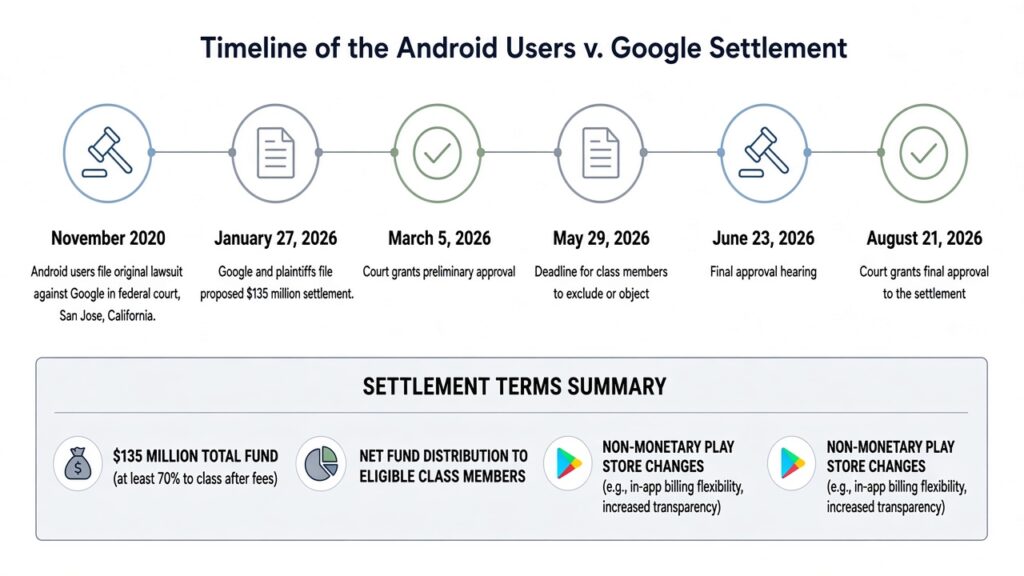
- November 2020: Android users file the original lawsuit against Google in federal court in San Jose, California.
- January 27, 2026: Google and the plaintiffs file a proposed $135 million settlement, avoiding a trial that had been scheduled for August 2026.
- March 5, 2026: The court grants preliminary approval, allowing the settlement process to move forward.
- May 29, 2026: Deadline passes for class members to exclude themselves or object to the settlement.
- June 23, 2026: The court holds a final approval hearing.
- August 21, 2026: The court grants final approval to the settlement.
That last step matters a lot. Several early news articles about this case were written back when the settlement was still just proposed or preliminary. As of August 2026, it is finalized.
Around the same time this settlement was filed, Google also settled a separate class action for $68 million over claims that Google Assistant recorded private conversations to help target ads. Google denied wrongdoing in that case too. It is a different lawsuit from the one covered here, but it shows this was not an isolated legal fight for the company.
See also: If you are curious whether you can join a class action without proof of purchase, our guide on class action lawsuits with no proof breaks down how these no-claim-form settlements typically work.
Who Is Eligible for the Google Android Settlement?
You likely qualify for a payment if all of the following are true. You live in the United States. You used a mobile device running the Android operating system. You accessed the internet through a cellular data network run by a mobile carrier at any point from November 12, 2017 through the date of final approval.
Notice that this is based on usage during that window, not on what phone you own today. Say you had an Android phone from 2018 to 2021, then switched to an iPhone. You would likely still be eligible, because you used cellular data on an Android device during the covered period.
There is one major exception, and it is a common source of confusion.
Why Are California Residents Excluded?
If you live in California, you are not part of this particular settlement. That is because California residents already had their own separate case.
That case, Csupo v. Google LLC, was filed in Santa Clara County Superior Court and made very similar allegations. A California jury actually awarded that group more than $314 million, a larger amount per person than the $135 million federal settlement covers.
Because California residents already had their own resolution, they are carved out of the federal Taylor v. Google settlement to avoid paying the same group twice for the same conduct.
How Much Money Can You Get?
Individual payments are capped at $100 per person. Here is where things get realistic, though. You almost certainly will not get the full $100.
A damages expert working for the plaintiffs estimated that potential damages in this case could have reached as much as $1.05 billion if it had gone to trial. The $135 million settlement is a fraction of that, which is common in class action cases, since a settlement avoids the cost, delay, and uncertainty of a full trial for both sides.
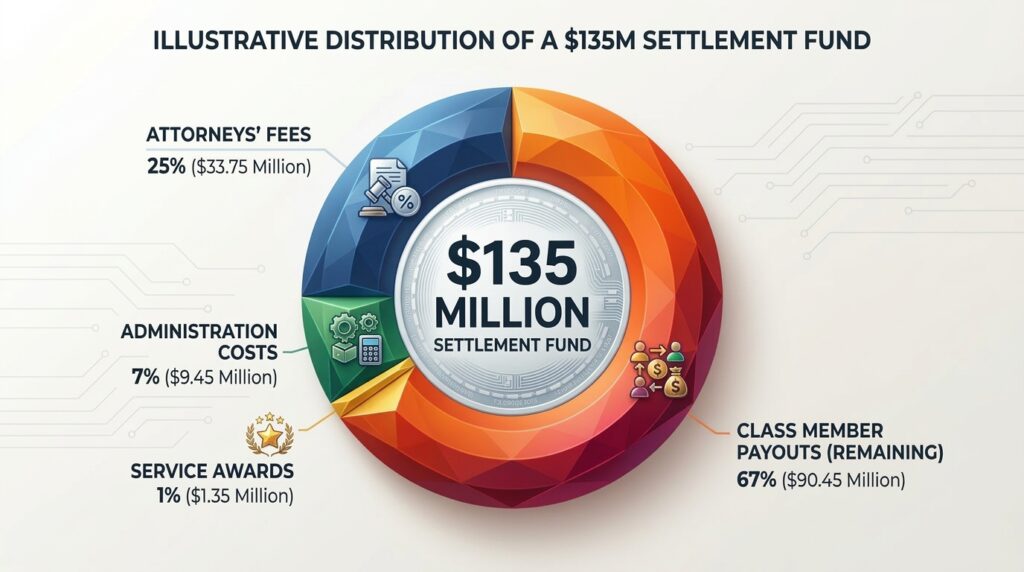
The settlement fund also gets split several ways before any money reaches class members. Attorneys for the plaintiffs may seek up to 29.5 percent of the settlement fund in fees. Based on the settlement terms, the full breakdown looks roughly like this.
| What It Covers | Amount |
|---|---|
| Total settlement fund | $135,000,000 |
| Settlement administration costs | Up to $1,500,000 |
| Attorneys’ fees | Up to $39,825,000 |
| Attorneys’ expenses | Up to $750,000 |
| Service awards to class representatives | Up to $75,000 total |
| Remaining funds for class members | Divided among an estimated 100 million people |
That last row is the key one. With roughly 100 million eligible people sharing what is left after fees, most individual payments will land well below the $100 cap. Payments are distributed pro rata, meaning the more people who file for payment, the smaller each individual check tends to be.
How to Claim Your Payment
Here is the part that surprises people. You do not need to file a traditional claim form for this settlement.
If you are an eligible class member who does not opt out, you are automatically entitled to a payment. That said, taking one extra step gives you a much better chance of actually receiving your money.
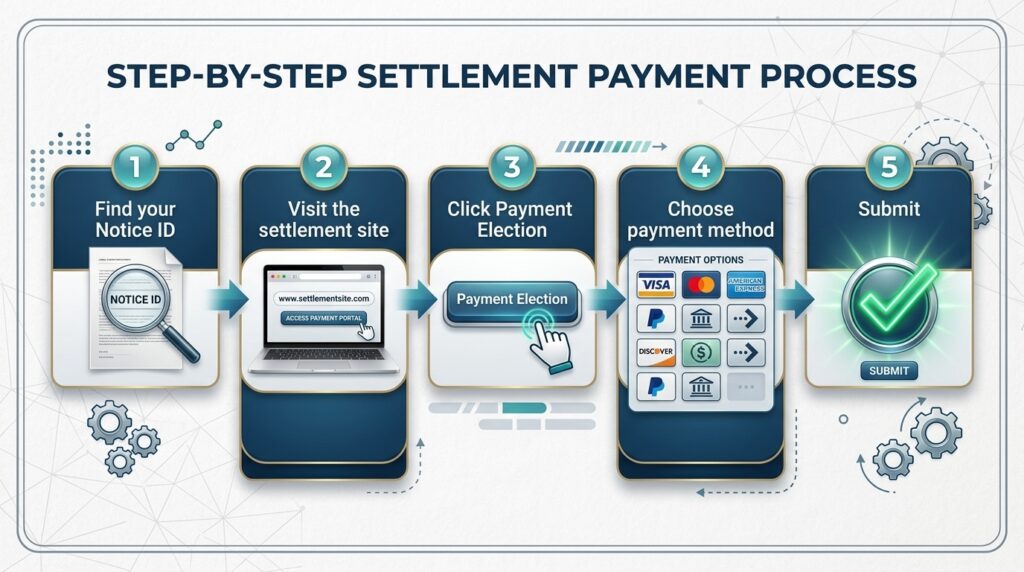
- Find your Notice ID and Confirmation Code. These arrive by email or physical mail from the settlement administrator, a company called Angeion Group.
- Go to the official settlement site, FederalCellularClassAction.com.
- Click Payment Election and log in using your Notice ID and Confirmation Code.
- Choose your payment method. Options typically include PayPal, Venmo, Zelle, ACH bank transfer, or a virtual Mastercard.
- Submit and wait. If you skip this step, the administrator will still try to reach you, but the settlement site itself warns that you run a higher risk of not getting paid if you do not select a method.
If you never received a notice but believe you are eligible, you can call the settlement administrator at 1-844-655-4255 or email Info@FederalCellularClassAction.com to check your status.
See also: If you have gone through a similar settlement claim process before, our breakdown of the Cash App spam text lawsuit settlement walks through another real example of how these payout systems work.
Is the Settlement Legit? How to Avoid Scams
Any time a settlement involves 100 million potential claimants and a website asking for your information, scammers show up. It is smart to be cautious here.
A few things confirm this settlement is real. It comes from an actual federal case, Taylor v. Google LLC, Case No. 5:20-cv-07956-VKD, filed in the US District Court for the Northern District of California. The settlement administrator, Angeion Group, is a well-established firm that handles many large class actions. A lawyer for the plaintiffs has publicly confirmed the official site is legitimate.
Here is a realistic scenario to watch for. Say you get a text message claiming you are owed money from the “Google data lawsuit” and asking you to click a link and enter your bank login. That is very likely a scam. The real settlement process never asks for your bank password, and it only uses the notice ID system tied to the actual court case.
Stick to the official domain, FederalCellularClassAction.com, and never enter sensitive banking credentials outside of a secure payment method selection.
When Will Payments Go Out?
Now that the settlement has final approval as of August 21, 2026, the next step is resolving any appeals. Class action settlements this size can be appealed, and if that happens, the appeal process can stretch on for a year or more.
If no appeals are filed, or once any filed appeals are resolved, the settlement administrator will begin issuing payments. No exact payout date has been announced yet. The settlement website is the most reliable place to check for updates, since payment timing depends entirely on what happens after final approval.
Myth vs Fact: Google Android Settlement
Myth 1: You have to prove you were harmed to get paid.
Fact: No proof of harm or purchase is required. Simply having used an Android device with cellular data during the covered period is enough to qualify.
Myth 2: You must fill out a detailed claim form before a deadline or you lose your payment entirely.
Fact: There is no traditional claim form. Eligible class members are automatically included unless they choose to opt out, though selecting a payment method improves your odds of receiving funds.
Myth 3: Everyone will receive exactly $100.
Fact: $100 is only the maximum possible payment. With an estimated 100 million eligible class members sharing the remaining fund after fees, most people will receive far less.
Myth 4: California residents can also file for this settlement.
Fact: California residents are excluded because they are covered under the separate Csupo v. Google case, which already resulted in a $314 million settlement for that group.
Frequently Asked Questions
1. What is Taylor v. Google LLC?
Ans: It is the federal class action lawsuit, filed in 2020, claiming Google’s Android operating system transferred user data over cellular networks without permission. It settled for $135 million.
2. How much will I get from the Google Android settlement?
Ans: Payments are capped at $100 per person, but the actual amount depends on how many of the roughly 100 million eligible people file for payment. Most people will receive less than the cap.
3. Am I eligible for the Google Android data settlement?
Ans: You likely qualify if you live in the US, used an Android device, and accessed the internet through cellular data at any point from November 12, 2017 through the date of final approval.
4. Is the Google Android cellular data settlement legit?
Ans: Yes. It stems from a real federal court case, and the settlement administrator, Angeion Group, is a recognized firm. Stick to the official site, FederalCellularClassAction.com, to avoid scams.
5. Do I need to file a claim to get paid?
Ans: No traditional claim form is required. You are automatically included as a class member unless you opt out, though choosing a payment method online improves your chances of receiving funds.
6. When will Google settlement payments be sent?
Ans: Payments follow final court approval and the resolution of any appeals. As of this writing, no exact payout date has been announced.
7. Why are California residents excluded from the settlement?
Ans: California residents already resolved similar claims through a separate case, Csupo v. Google LLC, which resulted in a $314 million settlement for that group.
8. What is Csupo v. Google?
Ans: It is a related but separate California state court case that made similar allegations about Android data collection, resulting in a larger settlement specifically for California residents.
9. What does conversion mean in the Google Android lawsuit?
Ans: Conversion is a legal claim meaning one party used another party’s property for their own benefit without permission. Here, the plaintiffs argued that cellular data counts as property.
10. Has the Google Android settlement been finalized?
Ans: Yes. The court granted final approval on August 21, 2026, though payments still depend on any appeals being resolved first.
Final Thoughts
The Google Android cellular data lawsuit shows how much value your phone’s background activity can carry, even when you never see it happening. A $135 million settlement, now finalized, means millions of Android users have a real shot at a payout without filing a single form.
The most useful thing you can do right now is check the official settlement site, confirm your payment method, and be patient while appeals play out. If you are dealing with a more complicated situation, like a dispute over your eligibility or exclusion from the class, it is worth talking to a licensed attorney about your specific circumstances rather than relying only on general settlement guidance.
This article provides general information only and is not legal advice. Laws vary by state and change over time. Do not rely on this content as a substitute for advice from a qualified, licensed attorney in your jurisdiction. For guidance on your specific situation, consult a licensed attorney directly.

Dirk Wasserthal is the Founder and Lead Writer of LegalDiaries.com, an independent legal information platform. He specializes in Mass Torts, Women’s Rights, and emerging legal issues, delivering clear, well-researched, and trustworthy content across Criminal Law, Family Law, Personal Injury, and more. Dirk’s mission is simple — make the law understandable for everyone.