




The Pima County Sheriff lawsuit story is not really one lawsuit. It is at least five of them, all pointing at the same office at the same time. Sheriff Chris Nanos is currently named in claims ranging from a $176 million swatting shooting case to a public records fight with the ACLU, and the pile keeps growing.
- Who Is Chris Nanos, and Why Is He Facing So Many Lawsuits
- The 176 Million Melendez Swatting Shooting Lawsuit
- The Carlos Palazuelos Wrongful Detention Claim
- Heather Lappin’s 2 Million Retaliation Claim
- The ACLU Lawsuit Over ICE and Border Patrol Records
- Jail and Inmate Lawsuits Against the Department
- What Is a Notice of Claim in Arizona
- Can You Sue a Sheriff’s Department? Your Rights, Explained
- Myth vs Fact: Suing a Sheriff’s Department
- Timeline: Every Pima County Sheriff Lawsuit at a Glance
- What Happens Next for Sheriff Nanos and Pima County
- Frequently Asked Questions
- Key Takeaways
If you searched this because you saw a headline about a $176 million claim, you are in the right place. If you searched it because something similar happened to you and you are wondering what your own options are, you are also in the right place. This guide walks through every active claim, explains the Arizona legal process behind them in normal language, and tells you what actually has to happen before any of this turns into a courtroom verdict.
None of what follows is legal advice for your specific situation. It is a clear map of a messy story, written so you do not need a law degree to follow it.
Who Is Chris Nanos, and Why Is He Facing So Many Lawsuits
Chris Nanos is the elected sheriff of Pima County, Arizona, which covers Tucson and the surrounding area. He has held the job for years and won reelection in 2024 by fewer than 500 votes.
Nanos became a national name in 2026 while leading the search for Nancy Guthrie, the 84 year old mother of NBC “Today” co-anchor Savannah Guthrie, who disappeared from her Tucson area home on February 1, 2026. That investigation is still open, and no one has been arrested.
But the lawsuits piling up against Nanos are mostly separate from the Guthrie case itself. Some grew out of how his deputies handled people swept up in that investigation. Others have nothing to do with Guthrie at all. Together they touch nearly every part of the department, from deputies on patrol to corrections officers inside the jail to the sheriff’s own office handling public records requests.
That is unusual. Most sheriffs face the occasional lawsuit. Facing this many, this publicly, at the same time, is what turned a local story into a national one.
The 176 Million Melendez Swatting Shooting Lawsuit
This is the case that put the words “Pima County Sheriff lawsuit” into national headlines, and it starts with a cruel prank.
Swatting is when someone makes a fake emergency call, usually claiming a violent crime is happening at a target’s address, hoping to trick police into a dangerous forced response. It started in online gaming circles and has since been used to harass ordinary people and public figures alike.
On April 10, 2026, someone impersonating 24 year old Axeel Melendez called Tucson’s non emergency line, claiming his father had just shot his sister at their home. According to the notice of claim filed on Melendez’s behalf, he had already warned the sheriff’s department days earlier that online harassers were threatening to swat his house, and deputies told him not to worry.
Deputies came anyway, and the notice of claim says they forced entry through a bedroom window. Believing intruders were breaking in, Melendez grabbed a legally owned firearm and hid. Deputies opened fire, striking him and leaving him with a spinal cord injury. He is now paralyzed.
His attorney, Dev Sethi, filed a notice of claim on July 23, 2026, seeking $176 million total, broken down as $80 million from the county, $80 million from the sheriff’s department, and $16 million for emotional damages to his mother, Carmen Melendez. The filing accuses the department of negligence, excessive force, and what it calls “dangerous incompetence.” As Arizona Public Media reported, Sethi said, “Axeel is a vulnerable young man, his life has been upended.”
Where the case stands now: a notice of claim is not a lawsuit yet. Pima County had 60 days from the July filing to respond or settle. If the county denies the claim or lets the deadline pass without acting, Melendez’s attorneys can then file an actual lawsuit in court.
Here is a real world way to think about it. Imagine you warn your apartment building’s security team that someone is threatening to fake a break in call about your unit. Security promises to flag it, then a week later storms in anyway based on that exact fake call and someone gets hurt. That is roughly the argument Melendez’s claim makes, except the “security team” here is a government agency with sovereign immunity protections that make suing it far more procedural than suing a private company would be.
If you are trying to understand how a case like this typically plays out once it reaches court, our guide on the chances of winning a personal injury lawsuit breaks down the factors that usually decide these outcomes, though claims against government entities carry extra hurdles private injury cases do not.
The Carlos Palazuelos Wrongful Detention Claim
Carlos Palazuelos is a delivery driver from Rio Rico, a small town about 60 miles south of Tucson. He had no connection to the Guthrie case beyond bad timing.
On February 10, 2026, deputies pulled him over during a traffic stop connected to the Guthrie investigation. According to his notice of claim, he was arrested at gunpoint and held for seven to eight hours without being told what was happening, then released without any charges. His home was searched and, he says, left “ransacked.”
What makes this claim sting more, according to the filing, is that Sheriff Nanos posted on social media the same day describing a “subject” detained and “being questioned in connection to the Nancy Guthrie investigation.” Department personnel reportedly also called Palazuelos a “person of interest” to reporters. To the entire country, that made him look like a suspect in a missing person case tied to a national news anchor’s family.
Palazuelos, along with his mother in law Josefina Maddox and Daniel Maddox, filed a notice of claim on July 28, 2026, seeking a combined $3.25 million. Palazuelos is seeking $2.5 million individually for assault, false arrest, negligence, defamation, and false imprisonment. As reported by NBC News, the notice also alleges the warrant naming Palazuelos was obtained using false or baseless evidence.
Sheriff Nanos has said a judge approved probable cause before the detention, and has declined to fully clear Palazuelos’s name, saying no one has been “permanently ruled out.”
This is the kind of case that shows why reputational harm claims exist. If a government agency publicly names you in connection with a high profile crime and it turns out you had nothing to do with it, the damage to your name does not automatically go away just because you were released without charges.
Heather Lappin’s 2 Million Retaliation Claim
Not every claim against Nanos comes from the Guthrie investigation. This one comes from inside his own department.
Heather Lappin is a Corrections Lieutenant at the Pima County Adult Detention Center who ran against Nanos as the Republican challenger in the 2024 sheriff’s race and lost by less than 500 votes. Three weeks before that election, Nanos placed her on paid administrative leave, citing alleged policy violations, including helping a reporter get access to interview inmates.
Lappin’s attorneys filed a notice of claim in early 2025, running over 100 pages, alleging she was subjected to five separate retaliatory investigations after she announced her campaign. The claim seeks $2 million, primarily for First Amendment retaliation, due process violations, and damage to her reputation, according to Arizona Public Media.
First Amendment retaliation means punishing someone for protected speech or political activity, like running for office or criticizing a boss publicly. To win a claim like this, Lappin’s side generally has to show she engaged in protected activity, suffered a real consequence like suspension, and that the timing and evidence point to retaliation rather than a coincidence.
A similar claim came from Sergeant Aaron Cross, president of the Pima County Deputies Organization, who was also suspended after publicly campaigning against Nanos. Cross sued in federal court and lost an early request for a preliminary injunction, but the judge still ordered the department to clarify an ambiguous uniform policy within 24 hours, a small but real win buried inside a loss.
The ACLU Lawsuit Over ICE and Border Patrol Records
This claim is not about a single incident. It is about whether the sheriff’s department has been telling the public the truth about how it works with federal immigration agents.
Sheriff Nanos has repeatedly said his department does not enforce immigration law and does not call Border Patrol during routine stops. In July 2025, the ACLU of Arizona filed a lawsuit in Pima County Superior Court after the department failed to respond to a public records request asking for exactly that: records of deputies contacting Border Patrol or ICE.
Arizona’s Public Records Law generally requires government agencies to hand over most records within a reasonable time when a member of the public asks. The ACLU’s attorney, John Mitchell, put it directly in a statement carried by the ACLU of Arizona: “Our lawsuit is about transparency. Public agency records are public for good reason.”
Records the ACLU eventually obtained through the litigation showed deputies requested Border Patrol assistance at least eight times between January 2022 and June 2023, and turned over at least 16 undocumented migrants during that window, despite the department’s public denials of any immigration enforcement role. One incident report described deputies calling Border Patrol after a security guard reported seeing men who said they were simply looking for work.
The department’s old policy required tracking every call to federal immigration authorities in a monthly report. That tracking policy appears to have quietly stopped, which is part of what the ACLU says it is still trying to get to the bottom of.
Jail and Inmate Lawsuits Against the Department
The Pima County jail has generated its own separate stream of litigation, mostly built around conditions inside the facility rather than incidents out on patrol.
In one case, inmate Steven Kenneth Fox filed a $25 million federal civil rights lawsuit, claiming a jail officer disclosed private information about him to other inmates, leading to assaults, and that he was denied adequate medical care for a spider bite before being held in isolation for days. A federal judge has since dismissed that lawsuit and denied Fox’s attempts to reopen it.
In another, inmate Christopher Michael Marx sued in March 2026, claiming a deputy worked shifts across two housing units, one of which was under COVID-19 quarantine, without properly disinfecting between them. Marx sought $1.35 million, most of which he said he would donate toward housing for people experiencing homelessness, plus a public apology.
These cases usually rest on the Eighth Amendment, the part of the Constitution that bans cruel and unusual punishment, combined with a federal law called 42 U.S.C. Section 1983, which lets people sue government officials for violating their constitutional rights. The legal bar for these claims is called “deliberate indifference,” meaning the jail did not just make a mistake, it knew about a serious risk and ignored it.
Not every jail lawsuit succeeds, as the dismissed Fox case shows. Courts take these claims seriously, but they also require real proof that officials knew about a danger and chose not to act.
What Is a Notice of Claim in Arizona
A notice of claim is a legal notice a person must file within 180 days before suing a government entity or employee in Arizona, under A.R.S. Section 12-821.01. It must state the facts, the legal basis, and a specific dollar settlement amount. The government then has 60 days to respond before a lawsuit can be filed.
Nearly every case above starts with this same document, so it is worth understanding on its own.
Under A.R.S. Section 12-821.01, the official Arizona statute, anyone with a claim against a public entity, public school, or public employee has to file a written notice within 180 days of the incident. Miss that window and the claim is generally barred forever, even though the normal personal injury deadline in Arizona is two years under a different statute.
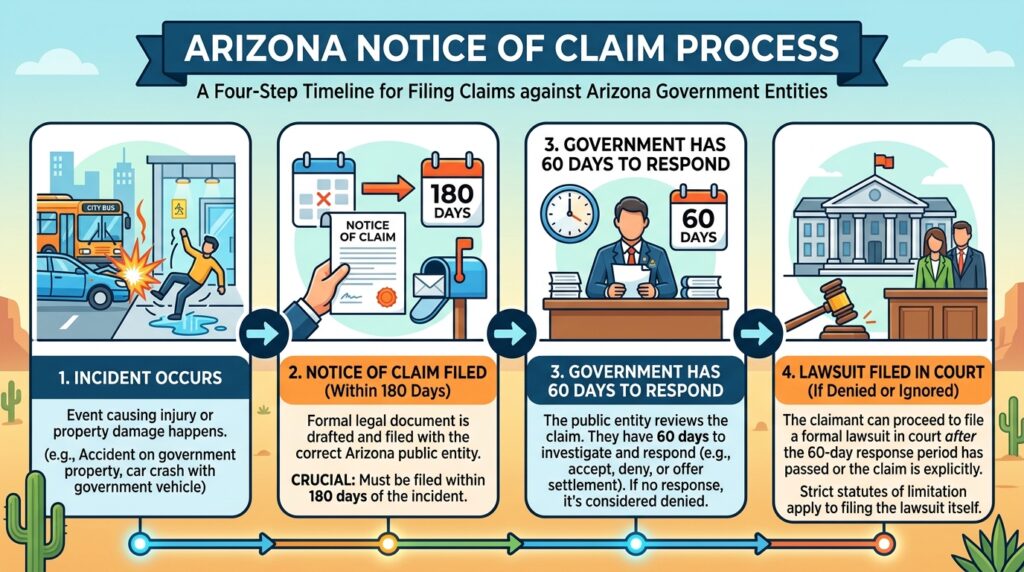
The notice has to include three things:
- Enough facts for the government to understand exactly what happened and why it is responsible.
- The legal basis for the claim, such as negligence or excessive force.
- A specific dollar amount the person is willing to accept to settle.
That last requirement trips people up more than any other. Arizona courts have thrown out notices that were vague about the settlement number, even when everything else was solid. This is exactly why every claim covered here, from Melendez’s $176 million ask to Lappin’s $2 million, spells out an exact figure instead of just saying “a fair amount.”
Once the notice is filed, the government body has 60 days to respond. If it denies the claim, or simply lets the 60 days pass without responding, the claimant is then free to file an actual lawsuit in court.
Here is a simple way to picture the timeline. Say a city garbage truck backs into your parked car on June 1. You would generally have until around late November, 180 days later, to file your notice of claim. If you wait until January thinking you have the standard two year window that applies to a private driver, your claim could be dead before you even get to file it.
This rule is specific to Arizona. If you are reading this from another state, your deadline and process will be different, sometimes shorter, sometimes longer, and you should check your own state’s tort claims act or ask a licensed attorney where you live.
Can You Sue a Sheriff’s Department? Your Rights, Explained
Watching this many claims pile up against one office naturally raises a question: could you actually do this if something similar happened to you?
The short answer is yes, in the right circumstances, but government lawsuits work differently than suing a private person or business. Two legal ideas matter most here.
Sovereign immunity is the general rule that you cannot sue the government without its permission. Arizona, like most states, has agreed to let people sue for things like negligence and civil rights violations, but only if you follow procedures like the notice of claim exactly.
Qualified immunity is a separate, federal doctrine that shields individual government employees, including sheriffs and deputies, from personal liability unless they violated a clearly established constitutional right. It does not block every lawsuit, but it is a real hurdle that private lawsuits do not face, and it is a major reason these cases often take years to resolve.
Common situations that can support a claim against a sheriff’s department include:
- Being shot or physically injured by deputies without legal justification, similar to the Melendez case.
- Being arrested without probable cause, especially if the department makes public statements that damage your reputation, similar to the Palazuelos case.
- Suffering retaliation at work for protected speech, similar to the Lappin and Cross claims.
- Being denied medical care or subjected to dangerous conditions while in custody, similar to the jail cases.
If you think you might have a claim, timing matters more than almost anything else. Talk to an attorney as soon as possible so the 180 day Arizona clock, or your own state’s equivalent, does not run out while you are still deciding what to do. Because these cases involve constitutional law, sovereign immunity, and strict procedural deadlines all at once, the attorney you choose matters. Our guide on signs of a bad attorney is worth a look before you sign with anyone, since a missed deadline in a case like this cannot usually be fixed later.
Myth vs Fact: Suing a Sheriff’s Department
Myth 1: Filing a notice of claim means a lawsuit has already started.
Fact: A notice of claim is a required warning to the government before a lawsuit, not the lawsuit itself. Nothing gets filed in court unless the government denies the claim or ignores it past the 60 day response window.
Myth 2: You cannot sue a sheriff personally, only the department.
Fact: Individual officials, including elected sheriffs and specific deputies, can be named alongside the county and the department, as seen in nearly every claim covered in this article. Qualified immunity can limit personal liability, but it does not eliminate the option to name individuals.
Myth 3: You need airtight video proof before you can even file a claim.
Fact: A notice of claim only requires facts sufficient to explain the basis for liability, not a fully proven case. Evidence gets developed and tested later, during the lawsuit itself, often through depositions and discovery. If you are curious how weak this misconception really is, our piece on filing a class action lawsuit without proof covers a similar misunderstanding people have about how much evidence you need on day one.
Timeline: Every Pima County Sheriff Lawsuit at a Glance
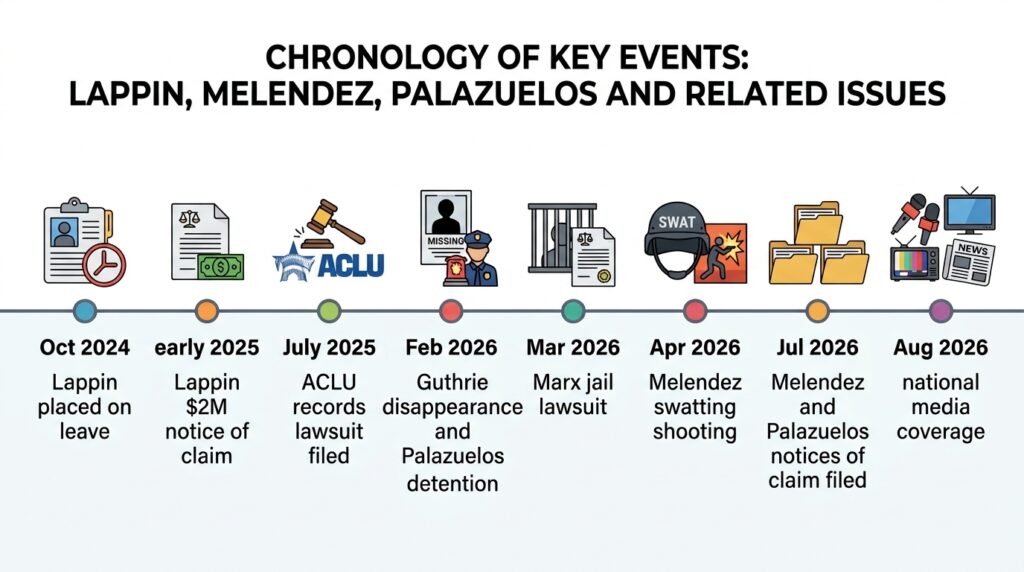
| Date | Case | Amount Sought | Status |
|---|---|---|---|
| Oct 2024 | Lappin placed on administrative leave | N/A | Led to later claim |
| Early 2025 | Heather Lappin retaliation claim | $2 million | Notice of claim filed |
| July 2025 | ACLU public records lawsuit | N/A | Ongoing litigation |
| Feb 2026 | Carlos Palazuelos detained | N/A | Led to later claim |
| Mar 2026 | Christopher Marx jail lawsuit | $1.35 million | Filed in federal court |
| Apr 2026 | Axeel Melendez shot by deputies | N/A | Led to later claim |
| May 2026 | Steven Kenneth Fox jail lawsuit | $25 million | Dismissed by judge |
| Jul 2026 | Axeel Melendez notice of claim | $176 million | 60 day response window |
| Jul 2026 | Carlos Palazuelos notice of claim | $3.25 million | 60 day response window |
What Happens Next for Sheriff Nanos and Pima County
None of these claims are resolved yet, so what happens next depends heavily on Pima County’s response over the coming months.
For Melendez and Palazuelos, the county’s 60 day response windows are the next real deadline to watch. If the county denies either claim, or simply lets the clock run out, both cases move into actual lawsuits filed in court, where the real evidence fight begins.
Politically, Nanos is also facing pressure beyond the courtroom. A Pima County Board of Supervisors member introduced a motion to censure him over alleged election interference tied to the Lappin and Cross suspensions, and there has been public talk of a recall effort. Neither of those is a legal proceeding, but both add pressure that can influence how aggressively the county decides to settle versus fight these claims.
Arizona has seen this pattern before. Pima County paid $3.4 million to settle a lawsuit over the 2011 SWAT raid that killed Marine veteran Jose Guerena, an incident that happened under a previous sheriff, not Nanos. That history shows the county is capable of settling large claims when the facts are damaging enough, though every case still gets evaluated on its own.
If you are following how Arizona government agencies handle lawsuits and public accountability more broadly, our coverage of the Arizona voter data lawsuit dismissal is a useful companion read, since it shows how a different kind of claim against an Arizona government body played out in court.
Frequently Asked Questions
1. What is the $176 million lawsuit against the Pima County Sheriff about?
Ans: It is a notice of claim filed by Axeel Melendez, who was shot and paralyzed after Pima County deputies raided his home during a fake “swatting” call he had already warned them about. He is seeking $176 million for medical costs, lost income, and his mother’s emotional damages.
2. Who is suing Pima County Sheriff Chris Nanos?
Ans: At least five separate parties have active claims against Nanos as of August 2026, including Axeel Melendez, Carlos Palazuelos and his family, Heather Lappin, Sergeant Aaron Cross, and the ACLU of Arizona.
3. What is a notice of claim in Arizona?
Ans: It is a written legal notice required under A.R.S. Section 12-821.01 before suing an Arizona government entity or employee. It must be filed within 180 days of the incident and include a specific settlement amount.
4. How long do you have to file a lawsuit against a public entity in Arizona?
Ans: You have 180 days to file the required notice of claim, which is much shorter than Arizona’s usual two year personal injury deadline. Missing the 180 day window generally bars the claim permanently, even if the two year deadline has not passed.
5. Has Sheriff Chris Nanos been sued before?
Ans: Yes. Beyond the recent claims, his department has faced past employment related claims, including a notice of claim from officers alleging wage law violations, and Pima County settled a major lawsuit over a 2011 SWAT raid under a previous sheriff.
6. What happened to Axeel Melendez?
Ans: Melendez was shot multiple times by Pima County deputies responding to a fake emergency call about his home in April 2026, leaving him paralyzed with a spinal cord injury. He had reported the swatting threat to the department days earlier.
7. Why was Carlos Palazuelos detained?
Ans: Palazuelos was detained during the investigation into Nancy Guthrie’s disappearance after deputies believed he resembled a person of interest, and he was held for several hours before being released without any charges.
8. Is the Pima County Sheriff being investigated by the ACLU?
Ans: The ACLU of Arizona has sued the department, not for an investigation in the criminal sense, but over its refusal to turn over public records about deputies’ contacts with Border Patrol and ICE.
9. Can you sue a sheriff’s department for excessive force?
Ans: Yes, generally through a civil rights claim under 42 U.S.C. Section 1983 or a state law negligence claim, though you must first satisfy your state’s notice of claim requirements if one exists. Most people benefit from hiring a lawyer for this given the strict deadlines and qualified immunity issues involved, and our guide on the difference between an attorney and a lawyer is a good starting point if the terminology itself is confusing you.
Key Takeaways
The Pima County Sheriff lawsuit story is really a cluster of separate cases that happen to share one office and one sheriff. Melendez’s $176 million swatting shooting claim and Palazuelos’s $3.25 million wrongful detention claim are both still in the notice of claim stage, waiting on the county’s response. The Lappin retaliation claim and the ACLU records lawsuit are further along and tell a different story, about how the department treats its own employees and the public’s right to information.
If you take one practical thing from this article, let it be this: in Arizona, the 180 day notice of claim deadline is unforgiving, and it runs far faster than most people expect. Whether you are watching this story out of curiosity or because something similar happened to you, understanding that deadline is the single most useful piece of information here.
This article provides general information only and is not legal advice. Laws vary by state and change over time. Do not rely on this content as a substitute for advice from a qualified, licensed attorney in your jurisdiction. For guidance on your specific situation, consult a licensed attorney directly.

Dirk Wasserthal is the Founder and Lead Writer of LegalDiaries.com, an independent legal information platform. He specializes in Mass Torts, Women’s Rights, and emerging legal issues, delivering clear, well-researched, and trustworthy content across Criminal Law, Family Law, Personal Injury, and more. Dirk’s mission is simple — make the law understandable for everyone.