




A motorcycle accident lawsuit is a civil case you file against the driver, company, or government body whose negligence caused your crash, so you can recover money for your medical bills, lost income, and pain. It matters because insurance companies routinely lowball riders more than car drivers, betting that you don’t know what your claim is really worth.
- Quick Answer: How a Motorcycle Accident Lawsuit Works
- Why Motorcycle Cases Are Different From Car Accident Cases
- Do You Need a Motorcycle Accident Attorney?
- Can I Sue the Driver Personally, or Just Their Insurance Company?
- How to File a Motorcycle Accident Lawsuit: Step by Step
- Step 1: Get Medical Care — Even If You Feel Fine
- Step 2: Document the Scene and Preserve Evidence
- Step 3: Talk to a Lawyer Before You Talk to the Insurer
- Step 4: Investigation and Fault-Finding
- Step 5: The Demand Letter
- Step 6: Negotiation
- Step 7: Filing the Lawsuit
- Step 8: Discovery and Depositions
- Step 9: Mediation
- Step 10: Settlement or Trial
- The Statute of Limitations: The Deadline That Can Kill Your Case
- Who Is at Fault in a Motorcycle Accident?
- Left-Turn Accidents
- Lane-Splitting Accidents
- Hit-and-Run Accidents
- Drunk or Impaired Driver Accidents
- Defective Parts and Product Liability
- Head-On Collisions
- Comparative Negligence: What If You’re Partly at Fault?
- What Compensation Can You Recover?
- Economic Damages
- Non-Economic Damages
- Catastrophic Injuries and Traumatic Brain Injury
- Wrongful Death Claims
- What Is My Motorcycle Accident Case Worth?
- Dealing With Insurance Companies
- When a Claim Gets Denied
- Suing the Insurance Company for Bad Faith
- Uninsured and Underinsured Motorist Claims
- Myth vs. Fact
- Finding a Motorcycle Accident Attorney Near You
- Frequently Asked Questions of Motorcycle Accident Lawsuit
- The Bottom Line
If you’re reading this, you’re probably not here out of curiosity. You’re hurt, the bills are stacking up, and an adjuster is either ignoring your calls or offering you far less than you need. Whatever brought you here, you deserve a straight answer not a wall of legal jargon dressed up as help. That’s what this guide is.
Quick Answer: How a Motorcycle Accident Lawsuit Works
Here’s the short version, before we get into the details.
- You get medical treatment and document everything.
- A lawyer investigates who was at fault and gathers evidence.
- Your attorney sends the at-fault driver’s insurer a demand letter.
- If the insurer won’t offer fair money, your attorney files suit before your state’s deadline runs out.
- Both sides trade evidence in a phase called discovery.
- Most cases settle here, often during mediation, before ever reaching a courtroom.
- If nobody agrees, the case goes to trial and a judge or jury decides.
Most people never see a courtroom. But knowing the full path including the “what if we can’t agree” part helps you negotiate like someone who understands the game, instead of someone hoping to get lucky.
Why Motorcycle Cases Are Different From Car Accident Cases
Here’s something most guides gloss over: insurance companies treat riders differently than car drivers, and not in your favor. There’s a built-in assumption from adjusters, from juries, sometimes even from the officer writing the police report that if you were on a bike, you were probably being reckless. Even when the facts say the opposite.
That bias shows up in two very real ways. First, insurers tend to open with lower settlement offers for riders, betting you already expect to be blamed and will take less rather than fight. Second, the injuries are almost always worse. A car has a steel cage, airbags, and a seatbelt between the driver and the pavement. A motorcycle has none of that. What would total a bumper on a car can put a rider in the ICU.
The numbers back this up. According to the National Highway Traffic Safety Administration, 6,228 motorcyclists were killed in 2024, accounting for 16% of all traffic deaths even though motorcycles make up a tiny fraction of registered vehicles. Per mile traveled, NHTSA’s own data puts the motorcyclist fatality rate at roughly 27 times higher than for someone riding in a car.
A real-world example: picture two nearly identical crashes. A car rear-ends another car at 20 mph both drivers walk away with sore necks. A car rear-ends a motorcycle at the same speed the rider goes over the handlebars and breaks a collarbone and two ribs. Same impact, wildly different outcome. That gap is exactly why insurers and juries need to be shown, not just told, how much worse a “minor” collision really is for a rider.
Do You Need a Motorcycle Accident Attorney?
Nobody legally requires you to hire a lawyer to file a claim. But skipping one is one of the costliest mistakes an injured rider can make. Insurance companies have entire departments built around paying out as little as possible, and they know an unrepresented person usually doesn’t know what their claim is actually worth, what tricks adjusters use, or which deadlines can quietly kill a case.
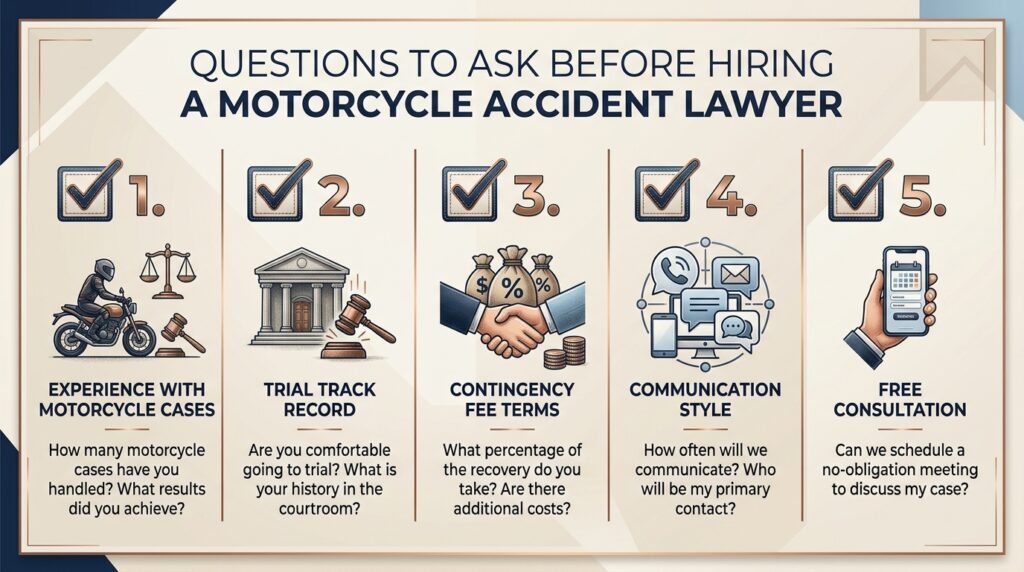
Most motorcycle accident attorneys work on a contingency fee you pay nothing upfront, and the fee comes only out of what they recover for you. No win, no fee. If they don’t get you money, you don’t owe them anything for their time. Most firms also offer a free consultation, so you can find out where you stand before you commit to anything.
A quick check before you sign anything: if a lawyer promises you an exact settlement number on day one, before reviewing your medical records or the crash details, that’s a red flag, not a sign of confidence. Nobody can honestly know your case’s value that fast.
See also: not sure how to spot a firm that’s more interested in volume than your outcome? Our guide on signs of a bad attorney walks through the red flags before you sign a retainer. And if you’re wondering whether you need an “attorney” or a “lawyer” in the U.S.,they’re the same thing.
Can I Sue the Driver Personally, or Just Their Insurance Company?
Yes, you have the legal right to sue the at-fault driver directly. In practice, most claims get resolved through their insurance company instead, since collecting money from an individual person can be much harder than collecting from an insurer that’s contractually required to pay valid claims.
To win a lawsuit against the person who caused your crash, you (or your attorney) have to prove four things. This comes straight from basic negligence law, laid out clearly by Cornell Law School’s Legal Information Institute:
- Duty — the other driver owed you a duty to drive reasonably and safely.
- Breach — they violated that duty, either by doing something careless or failing to do something they should have.
- Causation — that careless act actually caused your crash.
- Damages — you suffered real losses because of it: injuries, medical bills, lost income, pain.
All four have to hold up for a court to find the other driver liable. This is exactly what your attorney is building evidence toward from day one, whether the case ever sees a judge or not.
Here’s when suing the person directly actually comes up: say the at-fault driver has no insurance, or their policy limit is far below what your injuries are worth. If that driver also has significant personal assets, a house, a business, saving a direct lawsuit against them personally, on top of any insurance claim, might be the only way to recover the full value of your case.
How to File a Motorcycle Accident Lawsuit: Step by Step
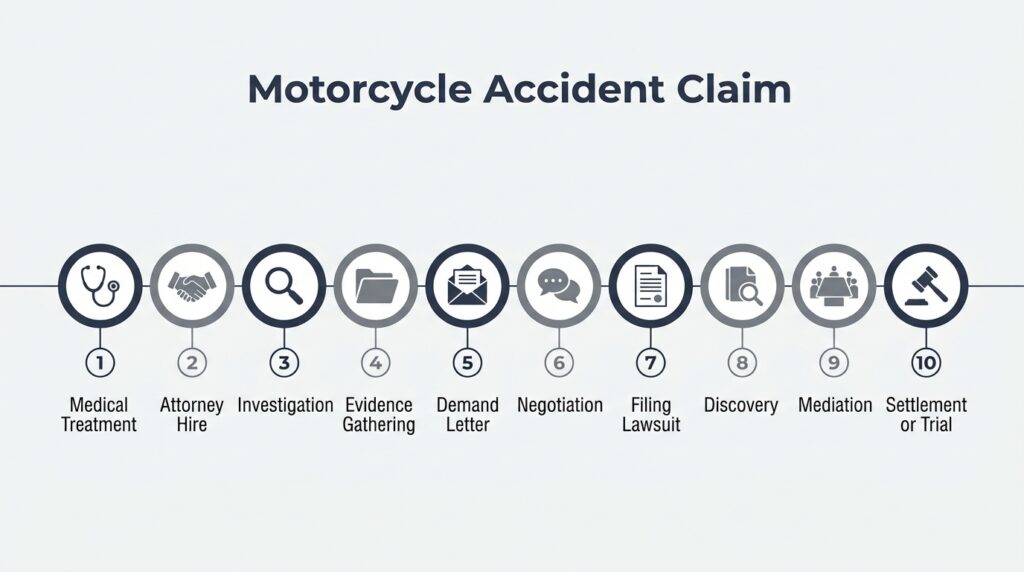
The process isn’t as mysterious as it sounds once you see it laid out. Here’s what actually happens, roughly in order.
Step 1: Get Medical Care — Even If You Feel Fine
Adrenaline hides pain. Plenty of riders walk away from a crash feeling okay, only to discover a concussion or internal bleeding two days later. There’s a legal reason to see a doctor immediately, too: insurers use any gap between the crash and your first visit as “proof” you weren’t really hurt.
Step 2: Document the Scene and Preserve Evidence
If you’re physically able (or someone can do this for you), gather photos of the scene, your bike, your gear, and your injuries. Get witness contact information. Get the police report number. Keep your damaged helmet and jacket, don’t throw them away, they can help prove how hard the impact really was.
Step 3: Talk to a Lawyer Before You Talk to the Insurer
Adjusters are trained to call early, often within days, before you know the full extent of your injuries. Even something as innocent as “I’m fine, just a little sore” can end up in your file as evidence against you later. Let your attorney handle every conversation with the insurance company from here on.
Step 4: Investigation and Fault-Finding
Your attorney pieces together what actually happened the police report, witness statements, traffic camera footage, sometimes an accident reconstruction expert. This step decides almost everything that follows, since your compensation is tied directly to who was at fault and by how much.
Step 5: The Demand Letter
Once your treatment has stabilized, your attorney sends the insurer a demand letter. It lays out the facts, the evidence, your injuries, and a specific dollar figure that reflects what your case is actually worth.
Step 6: Negotiation
The insurer almost always counters with something lower. That’s normal it doesn’t mean your case is weak, it’s just how negotiation works. Most motorcycle accident settlements get worked out entirely at this stage, without a lawsuit ever being filed.
Step 7: Filing the Lawsuit
If the insurer refuses to offer fair money, or denies the claim outright, your attorney files suit in civil court. This formally starts litigation and puts real pressure on the other side, since it opens the door to discovery and, eventually, trial.
Step 8: Discovery and Depositions
Both sides exchange evidence and take depositions sworn, recorded interviews of the people involved. This phase often produces fresh settlement offers once each side sees how strong (or weak) the other’s case really is.
Step 9: Mediation
Even after a lawsuit is filed, negotiations usually keep going. Mediation is a structured, last-ditch effort to settle before trial: a neutral third party meets with both sides (often in separate rooms) and helps them find common ground. The mediator can’t force anyone to agree — they just help both sides see the case clearly.
Step 10: Settlement or Trial
Most cases resolve here, during or shortly after mediation. If a fair deal still isn’t on the table, the case goes to trial, and a judge or jury decides fault and compensation.
A common mistake: accepting a fast, “no lawsuit needed” offer just to be done with it. Once you sign a settlement, that’s it, the case is closed forever, even if your injury turns out to be worse than anyone realized. A rider who settles for $15,000 two weeks after a crash, before knowing whether his wrist injury needs surgery, has no way to go back and ask for more once the real bill for surgery and rehab arrives.
The Statute of Limitations: The Deadline That Can Kill Your Case
This is the single most important legal concept in this whole guide, so we’re not burying it. The statute of limitations is the legal deadline for filing your lawsuit. Miss it, and in almost every case, you permanently lose the right to sue no matter how strong your case is or how badly you were hurt.
As a general rule of thumb (not a sourced legal fact for your specific state more on that in a second), most states give injured riders somewhere in the range of one to a few years from the date of the crash, and wrongful death claims sometimes run on a separate, shorter clock. Claims against a government entity, say, a city responsible for a poorly maintained road often come with a much shorter notice deadline, sometimes just months.
Here’s the honest caveat: statute of limitations rules genuinely vary by state, and general “1 to 3 years” summaries you’ll see across the internet (including this one) are useful as a rough guide, not a substitute for checking your specific state’s rule with a licensed attorney. Don’t build your timeline around a number from a blog post to confirm your exact deadline early.
A real scenario: say you were hurt in a crash and spent the first year focused entirely on recovery and physical therapy, without talking to a lawyer. If your state’s deadline is two years, you’d still have time but just barely, and evidence only gets harder to gather as memories fade and footage gets deleted. Waiting isn’t free, even when you’re technically still inside the deadline.
Who Is at Fault in a Motorcycle Accident?
Fault is rarely as simple as “the other driver ran a red light.” Insurance companies build entire strategies around shifting blame onto the rider, so understanding the common fault scenarios matters.
Left-Turn Accidents
This is one of the most common and dangerous scenarios on the road. A car turning left across an intersection fails to see an oncoming motorcycle, misjudges its speed, or simply doesn’t look and turns directly into the rider’s path. Because the turning driver typically has a legal duty to yield to oncoming traffic, these cases usually favor the rider.
Example: a rider is going straight through a green light at 35 mph. A car waiting to turn left sees a gap and takes it, misjudging how fast the bike is closing. The rider T-bones the car’s passenger door. Even though the rider technically “hit” the car, the turning driver is almost always the at-fault party here, because they failed to yield.
Lane-Splitting Accidents
Lane splitting riding between lanes of stopped or slow traffic is legal in California and treated differently in other states. In California, it’s explicitly allowed under Vehicle Code Section 21658.1, and the California Highway Patrol publishes official safety guidance for it. The CHP’s California Motorcyclist Safety page notes plainly that “lane splitting can be dangerous and extreme caution should be exercised. It should not be performed by inexperienced riders.”
Being legal doesn’t mean a rider is automatically off the hook in a crash; fault still comes down to whether the specific lane-split was done safely and reasonably, and whether the other driver did something like opening a door or changing lanes without checking a blind spot. This is one of the most misunderstood areas of motorcycle law, and it varies significantly by state.
Hit-and-Run Accidents
When the at-fault driver flees the scene, your path to compensation usually shifts toward your own uninsured motorist coverage, alongside efforts sometimes with police help to track down and identify the driver who fled. If they’re eventually identified, a direct claim or lawsuit against them becomes possible too.
Drunk or Impaired Driver Accidents
A crash caused by a drunk or drugged driver often opens the door to punitive damages and extra money a court can award specifically to punish especially reckless behavior, on top of your normal compensation. Courts tend to treat intoxicated driving as a more serious form of negligence than ordinary carelessness.
Defective Parts and Product Liability
If a mechanical failure, faulty brakes, a defective tire, a throttle that stuck open caused or worsened your crash, you may have a product liability claim against the manufacturer. This is a separate legal track from a claim against another driver, and it can run alongside one.
Head-On Collisions
These tend to produce the most severe injuries of any crash type, and fault usually comes down to who crossed the center line or was on the wrong side of the road. Because the forces involved are so extreme, these cases often move quickly toward the “catastrophic injury” category discussed below.
Comparative Negligence: What If You’re Partly at Fault?
Most states use some version of comparative negligence, a rule that lets you recover compensation even if you were partly responsible for the crash your payout just gets reduced by your percentage of fault.
According to Nolo’s legal dictionary, about 18 states follow “pure” comparative negligence, meaning you can recover something even if you were 90% at fault. Roughly 35 states follow “modified” comparative negligence, which cuts off your recovery entirely once your share of fault crosses a threshold usually 50% or 51%.
Example: say a jury finds you 20% at fault for a crash maybe you were going slightly over the limit — and your total damages come to $100,000. In a pure comparative negligence state, you’d recover $80,000. In a modified comparative negligence state with a 51% bar, you’d still recover $80,000, since you’re well under the cutoff. But if a jury found you 55% at fault in that same modified state, you’d recover nothing.
This is exactly why insurers push so hard to pin even a small amount of fault on the rider every percentage point they can shift onto you is money they don’t have to pay.
What Compensation Can You Recover?
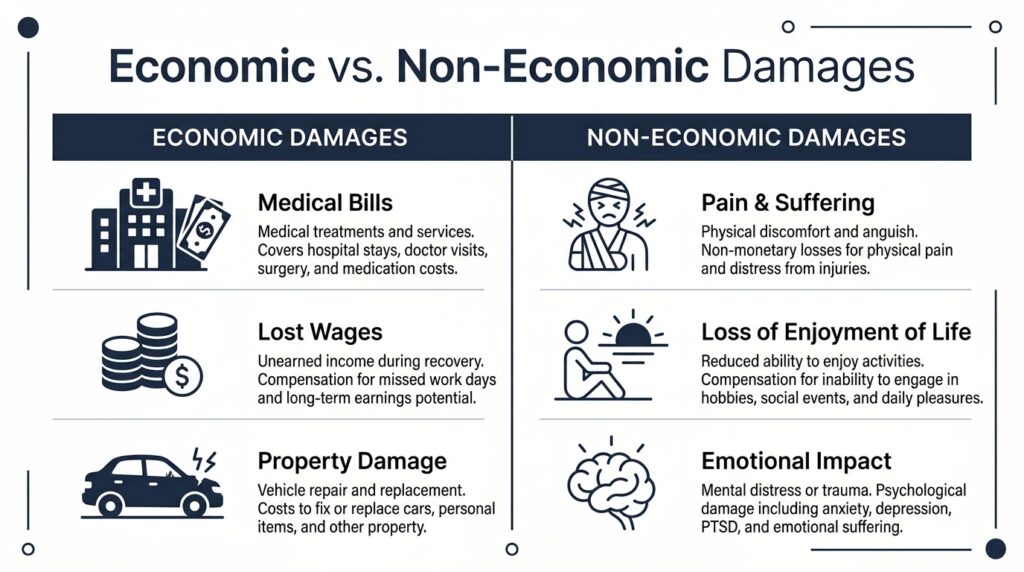
Compensation generally falls into two buckets: money you can add up with receipts, and harder-to-price harm that still counts.
Economic Damages
- Medical bills — emergency care, surgery, hospital stays, physical therapy, and future treatment
- Lost wages — income missed during recovery, plus reduced future earning capacity for long-term injuries
- Property damage to your motorcycle and gear
- Home modifications or long-term care costs, in serious injury cases
Non-Economic Damages
- Pain and suffering — the physical pain and emotional toll of the injury itself
- Loss of enjoyment of life, especially when the injury limits activities you used to love
- Psychological impact, including anxiety, depression, or PTSD following the crash — these are real, compensable harms, not just physical pain
- Loss of companionship, in cases affecting a spouse or family
Catastrophic Injuries and Traumatic Brain Injury
Some crashes cross into a different category entirely: a catastrophic injury, meaning one that permanently changes someone’s life. This includes traumatic brain injuries, spinal cord injuries and paralysis, and amputations. These cases require specialized medical experts to project lifetime care costs, and they’re rarely something to negotiate without an attorney who has handled cases at that scale.
Example: a rider suffers a moderate TBI in a crash. Six months later, symptoms that seemed minor at first trouble concentrating, mood changes, headaches turn out to be permanent. An early settlement based only on the first hospital bill would have massively undervalued what that injury will actually cost over a lifetime.
Wrongful Death Claims
If a rider dies from crash-related injuries, surviving family members, usually a spouse, children, or parents, depending on the state, may be able to file a wrongful death lawsuit. This is separate from a standard injury claim and can include funeral costs, the income the deceased would have provided, and compensation for the family’s loss of companionship.
See also: if you’re helping manage a loved one’s affairs during this kind of loss, our guide on conservatorship vs. power of attorney explains the difference between the two.
What Is My Motorcycle Accident Case Worth?
This is the question everyone wants answered first and honestly, anyone who gives you an exact number before reviewing your medical records isn’t being straight with you. There’s no single “average” that applies to your specific situation. Cases range from a few thousand dollars for minor injuries to seven figures for catastrophic ones, and the details of your case are what actually move that number, not a generic industry average.
What consistently drives the value up or down:
- The severity and permanence of your injuries
- Total medical costs, past and projected future costs
- How much income you’ve lost and will continue to lose
- How clear the liability is a clean-cut case is worth more than a disputed one
- Whether you carry any percentage of fault under your state’s comparative negligence rules
- The at-fault driver’s available insurance coverage
- Your state’s specific damage caps, if any apply
Online settlement calculators can give you a rough ballpark, but treat that exactly like a ballpark, not a prediction. They can’t account for your specific medical evidence, your state’s fault rules, or how strong your liability case actually is.
See also: for a deeper look at what actually shapes outcomes in cases like this, see chances of winning a personal injury lawsuit.
Dealing With Insurance Companies
Your first move after a crash is usually filing a claim with the at-fault driver’s insurer, or your own, depending on your coverage and state. Be careful here: recorded statements, quick low offers, and requests for broad access to your medical records are all common early tactics that can work against you.
When a Claim Gets Denied
Insurers deny claims for all kinds of reasons, some legitimate, many not. A denial isn’t the end of the road. It’s often just the start of an appeal, or the trigger for filing suit.
Suing the Insurance Company for Bad Faith
In some situations, especially unreasonable delays, deceptive tactics, or flatly refusing to pay a valid claim you may have grounds to sue the insurer directly for bad faith, separate from the underlying accident claim itself. This is a distinct legal action against the insurer’s own conduct, not just a claim for your crash injuries.
Uninsured and Underinsured Motorist Claims
If the at-fault driver had no insurance, or fled the scene, your own uninsured/underinsured motorist (UM/UIM) coverage may be your best path to compensation assuming you carry that coverage on your own policy.
A common mistake: riders assume that if the other driver has no insurance, there’s simply no case. In reality, this is exactly the situation UM coverage exists for but only if you have it, and only if you notify your own insurer promptly.
Myth vs. Fact
Myth: If I wasn’t wearing a helmet, I can’t sue.
Fact: In most states, you can still sue. Helmet use might reduce your compensation if your state ties it to your injuries under comparative negligence, but it rarely eliminates your right to recover anything. Helmets clearly save lives; the Governors Highway Safety Association reports that in states without universal helmet laws, 51% of motorcyclists killed in 2023 weren’t wearing one, compared to just 10% in states that require helmets for everyone but not wearing one isn’t a legal bar to filing a claim.
Myth: Lane-splitting automatically makes the rider at fault.
Fact: Where it’s legal, like California, lane-splitting doesn’t automatically shift blame to the rider. Fault still depends on whether it was done safely and what the other driver did.
Myth: I can accept the insurance company’s first offer and ask for more later if things get worse.
Fact: Once you sign a settlement, it’s final. You can’t reopen the case later, even if your injury turns out to be worse than expected.
Myth: If the police report blames me, my case is over.
Fact: A police report is evidence, not the final word. Officers aren’t always right, and your attorney can challenge a report’s conclusions with other evidence.
Finding a Motorcycle Accident Attorney Near You
If you’re searching for a motorcycle accident lawyer near you, look for someone who specifically handles motorcycle cases, not just general car-accident work. Motorcycle cases involve unique bias issues, unique injury patterns, and sometimes unique state laws (like lane-splitting rules) that a generalist may not have deep experience with.
Ask directly: how many motorcycle cases have they handled, how do they typically approach comparative negligence arguments, and have they taken a case like yours to trial when an insurer refused to pay fairly?
Frequently Asked Questions of Motorcycle Accident Lawsuit
1. What is the statute of limitations for a motorcycle accident lawsuit?
It varies by state, generally somewhere in the range of one to a few years from the date of the crash. Confirm your exact deadline with a local attorney don’t rely on a general number.
2. Who is usually at fault in a motorcycle accident?
It depends on the crash, but common causes include drivers turning left across a rider’s path, unsafe lane changes, and following too closely. Fault is determined by evidence, not assumptions about riders.
3. How much does it cost to hire a motorcycle accident lawyer?
Most work on contingency, meaning no upfront cost, and they only get paid a percentage of what they recover for you. Many also offer a free initial consultation.
4. What is the average motorcycle accident settlement amount?
There’s no reliable universal average — cases range from a few thousand dollars to seven figures depending on injury severity, liability clarity, and available insurance coverage.
5. Can I sue someone personally after a motorcycle accident, or just their insurance?
You have the legal right to sue the driver personally. In practice, most claims resolve through their insurance company, since collecting from an individual can be harder than collecting from an insurer.
6. How long does a motorcycle accident lawsuit take?
It depends on the case’s complexity. Straightforward cases can resolve in a few months; cases that go through full litigation and trial can take a year or more.
7. Do most motorcycle accident cases go to trial?
No. Most settle before trial, often during mediation. Trials are typically a last resort when negotiations completely stall.
8. Can I still recover compensation if I was partially at fault?
In many states, yes, under comparative negligence rules though your compensation is reduced by your percentage of fault, and some states cut off recovery entirely past a certain threshold.
9. What if the at-fault driver has no insurance?
Your own uninsured motorist coverage, if you carry it, is usually the path to compensation in this situation.
10. What happens if my motorcycle accident insurance claim is denied?
A denial isn’t final. You can appeal, gather more evidence, or your attorney can move toward filing a lawsuit if the denial wasn’t justified.
The Bottom Line
A motorcycle accident lawsuit exists to make sure someone else’s negligence doesn’t become your permanent financial burden. The process has real deadlines and real complexity, but it follows a predictable path: get treated, document everything, get a lawyer in your corner early, and let the process demand, negotiate, and if needed, litigate run its course.
If you’re dealing with this right now, don’t wait to talk to a licensed attorney in your state. The deadlines are real, and the sooner someone starts building your case, the stronger it tends to be.
This article is for general informational purposes only and does not constitute legal advice. Laws vary by state and change over time. For guidance specific to your situation, consult a licensed attorney in your jurisdiction.

Dirk Wasserthal is the Founder and Lead Writer of LegalDiaries.com, an independent legal information platform. He specializes in Mass Torts, Women’s Rights, and emerging legal issues, delivering clear, well-researched, and trustworthy content across Criminal Law, Family Law, Personal Injury, and more. Dirk’s mission is simple — make the law understandable for everyone.