



Conservatorship vs power of attorney is one of the most life-altering decisions a family can face. When a parent, spouse, or loved one begins to struggle with managing money, health care, or daily life, the legal path you choose determines how much control, privacy, and money you keep. These two tools serve similar end goals making decisions for someone who can’t but they operate in completely different worlds. One is built on trust and planning. The other is driven by court orders and public oversight.
- What Is a Power of Attorney (POA)?
- What Is a Conservatorship?
- Guardianship vs Conservatorship vs Power of Attorney: Clear Definitions
- Conservatorship vs Power of Attorney: Head-to-Head Comparison
- Cost Breakdown: Conservatorship vs Power of Attorney
- State-Specific Guidance: California and Connecticut
- Power of Attorney vs Conservatorship California
- Power of Attorney vs Conservatorship in Connecticut (CT)
- When to Choose a Power of Attorney vs When Conservatorship Is Unavoidable
- How to Set Up a Durable Power of Attorney (Step-by-Step)
- How to Avoid Conservatorship Entirely
- How to Verify a Power of Attorney or Conservatorship (Protect Your Family)
- 2026 Relevance: Trends, Law Updates, and Why This Year Matters
- Common Myths That Put Families at Risk
- Frequently Asked Questions (FAQ)
- Final Thoughts
This guide unpacks conservatorship vs power of attorney from every practical angle. You’ll see not only the definitions and costs but real-world scenarios, step-by-step setup instructions, 2026 legal trends, verification checklists, and the critical differences between power of attorney vs conservatorship, guardianship vs conservatorship vs power of attorney, durable power of attorney vs conservatorship, and state-specific rules like power of attorney vs conservatorship California and in CT. By the end, you’ll know exactly which tool fits your situation and how to protect your family without losing time, money, or dignity.
What Is a Power of Attorney (POA)?
A power of attorney is a legal document in which a competent adult the principal freely chooses another person, the agent (or attorney-in-fact), to act on their behalf. It’s one of the most flexible, affordable, and private planning instruments available. You design it while you are still healthy and clear-minded, and you decide exactly which powers to grant.
The principal keeps total control until (and unless) they become incapacitated. Even then, a well-drafted durable power of attorney continues without interruption. That single feature durability is often what separates a smooth family transition from a painful court battle.
Main Types of Power of Attorney
Understanding the types is essential because the wrong document can leave you unprotected.
- Durable Power of Attorney Remains effective after the principal’s incapacity. This is the gold standard for long-term planning. If you do nothing else, establish a durable POA.
- General Power of Attorney grants broad powers but ends automatically if the principal becomes incapacitated. Rarely used for elder planning.
- Springing Power of Attorney Only “springs” into effect upon a specific event, usually a doctor’s written certification of incapacity. While appealing in theory, it can create delays and disagreements about when the triggering event has occurred.
- Limited (Special) Power of Attorney Restricts the agent to specific tasks, like selling a house or handling a single transaction.
- Financial Power of Attorney Covers money management, bills, investments, real estate, and taxes. You can pair it with a healthcare document.
- Medical / Healthcare Power of Attorney Lets the agent make medical decisions when you can’t. Often combined with a living will or advance healthcare directive.
Key Takeaway: A durable power of attorney is the single most effective document to avoid court-ordered conservatorship later.
What Is a Conservatorship?
A conservatorship (called guardianship in some states for the person) is a court-supervised arrangement. A judge appoints a conservator to manage the affairs of an adult the conservatee who has been legally determined to lack capacity. Unlike a POA, it’s not voluntary. The person in need didn’t choose it. The court imposes it, often after a family member files a petition.
Conservatorships are designed to protect vulnerable adults, but they come with significant trade-offs: high costs, public exposure, loss of autonomy, and ongoing court oversight.
Common Types of Conservatorship
- Conservatorship of the Estate — The conservator handles finances, pays bills, manages assets, and files accountings with the court.
- Conservatorship of the Person — The conservator makes decisions about daily care, living arrangements, medical treatment, and meals.
- Limited Conservatorship — The court gives the conservator only specific, listed powers. Common for adults with developmental disabilities who can still make some decisions independently.
- Temporary Conservatorship — An emergency short-term appointment, often while a full hearing is pending.
Real-World Scenario: Imagine your 78-year-old father has advancing dementia and never signed a POA. He begins giving away money and refuses help. Without a valid POA, you can’t legally step in. Your only option is to petition the probate court for a conservatorship, a process that can take months, cost thousands of dollars, and expose private family struggles in public records.
Guardianship vs Conservatorship vs Power of Attorney: Clear Definitions
Terminology confusion causes families to make costly mistakes. In many states, “guardianship” refers to personal and medical decisions, while “conservatorship” covers finances. In others, the terms overlap or are used interchangeably for adults. To simplify:
- Power of Attorney: A private, voluntary document created by a capable adult before a crisis.
- Conservatorship: A court proceeding after incapacity, covering finances, personal care, or both.
- Guardianship: Often refers to minor children or, in some states, personal care of an adult. When comparing adult care, focus on conservatorship vs POA.
Comparison Table: POA, Conservatorship, and Guardianship
| Aspect | Power of Attorney | Conservatorship | Guardianship (Adult) |
| Initiated By | Principal (voluntary) | Court after petition by interested person | Court petition |
| Timing | Before incapacity | After incapacity | Often after incapacity |
| Court Involvement | None (or minimal) | High, ongoing supervision | High, ongoing supervision |
| Cost | $200–$800 typically | $3,000–$15,000+ initial, plus annual fees | Similar to conservatorship |
| Privacy | Private document | Public court records | Public court records |
| Revocation | By principal any time while competent | Only by court order | Only by court order |
| Agent/Conservator Choice | Principal picks | Court decides, may consider family wishes | Court decides |

Conservatorship vs Power of Attorney: Head-to-Head Comparison
When you compare conservatorship vs power of attorney directly, five core differences emerge. These shape everything from family harmony to your bank account.
1. Voluntary vs. Involuntary
A POA is an act of trust. You choose who will speak for you. A conservatorship is an act of last resort when someone else asks a judge to grant authority over you. Voluntary planning preserves dignity; involuntary proceedings often fracture families.
2. Timing and Prevention
POAs are proactive. You sign them when life is normal. Conservatorships are reactive; they begin only after capacity is lost. A durable power of attorney vs conservatorship comparison almost always favors the POA because it prevents the crisis.
3. Cost and Complexity
Creating a POA can cost a few hundred dollars. Setting up and maintaining a conservatorship can drain $10,000 to $20,000 in the first year alone, especially if family members contest it. The financial savings of a POA are staggering.
4. Privacy
A POA stays in a drawer or with an attorney. Conservatorship filings, including medical reports and financial inventories, become part of the public record. Anyone can access them.
5. Oversight and Control
POA oversight relies on the agent’s integrity and, if needed, on family vigilance. Conservatorships have built-in judicial oversight: regular accountings, court reviews, and sometimes court-appointed attorneys. That protection comes at the price of the conservatee’s independence.
Key Takeaway: A well-drafted durable POA keeps decisions in the hands of people you love, not a courtroom.
Cost Breakdown: Conservatorship vs Power of Attorney
Money is often the decisive factor. Families are shocked by the true price of a conservatorship.
Power of Attorney Costs (2026 Estimates)
- Attorney-drafted financial and healthcare POA package: $300–$800 for an individual, $500–$1,200 for a couple.
- Online legal services with attorney review: $150–$400.
- No ongoing fees. You pay once and update occasionally.
Conservatorship Costs (2026 Estimates)
- Attorney fees for petition and hearing: $3,000–$7,000 (uncontested). Contested cases can exceed $15,000–$30,000 quickly.
- Court filing fees: $200–$500, depending on the state.
- Court-appointed attorney for the proposed conservatee: often $500–$1,500.
- Annual accounting fees: $1,000–$3,000 for professional fiduciary or CPA preparation.
- Conservator compensation (if a professional): often $50–$150 per hour, or a percentage of assets.
- Surety bond premiums: a few hundred dollars annually, required for estate conservators.
Over five years, a conservatorship can easily consume $30,000 to $60,000 or more. That’s money that could have stayed in the family.
Pros and Cons at a Glance
Power of Attorney Advantages
- Low cost and fast to create
- Private no court filings
- Flexible you set the limits
- Respects your autonomy
- Avoids court entirely when durable
Power of Attorney Disadvantages
- Relies on agent honesty choose someone you trust completely
- Can be difficult for third parties to accept if it seems stale
- Needs updating after major life changes
Conservatorship Advantages
- Strong court oversight deters abuse
- Can protect someone who resists help
- Provides clear legal authority to third parties
Conservatorship Disadvantages
- Expensive and time-consuming
- Public loss of privacy
- Strips away personal rights
- Ongoing court involvement
- Can breed family conflict
State-Specific Guidance: California and Connecticut
Laws vary. Understanding your state’s specifics can be the difference between a smooth process and a legal nightmare.
Power of Attorney vs Conservatorship California
California law demands the least restrictive alternative be tried first. Before a judge grants a conservatorship, you’ll need to prove a POA or other informal help isn’t enough. The state’s limited conservatorship is a humane option for adults with developmental disabilities, preserving their rights where possible. For forms, investigator guides, and step-by-step walkthroughs, visit the California Courts Self-Help on Conservatorships.
California’s POA rules are strict: you need a notary or two witnesses. A durable POA here is your best shield against the state’s lengthy probate conservatorship pipeline.
Power of Attorney vs Conservatorship in Connecticut (CT)
Connecticut probate courts handle both person and estate conservatorships. Interestingly, CT permits voluntary conservatorships; a person who understands the proceeding can request one without an incapacity finding. But most cases are contested. The Connecticut Probate Court conservatorship overview outlines medical evidence rules, the role of the court-appointed attorney, and reporting duties.
CT’s statutory short-form POA is widely accepted, making proactive planning here especially smooth. In Connecticut, a durable POA is your single best defense against probate court.
When to Choose a Power of Attorney vs When Conservatorship Is Unavoidable
Use a durable power of attorney when:
- You or your loved one still has the mental clarity to understand what you’re signing.
- You want to choose your decision-maker and keep control over the scope.
- Privacy and cost matter to you.
- You’re planning ahead and value simplicity.
Conservatorship may be the only path when:
- Capacity is already lost, and no valid POA exists.
- The vulnerable person refuses to need help and poses a danger to themselves.
- An existing POA is being abused and must be overridden by court order.
- A third party, like a bank or care facility, refuses to honor a POA and only a court order will suffice.
Important: A court-appointed conservator can sometimes override an existing POA if the judge finds it’s in the conservatee’s best interest. So even with a POA, family monitoring is critical.
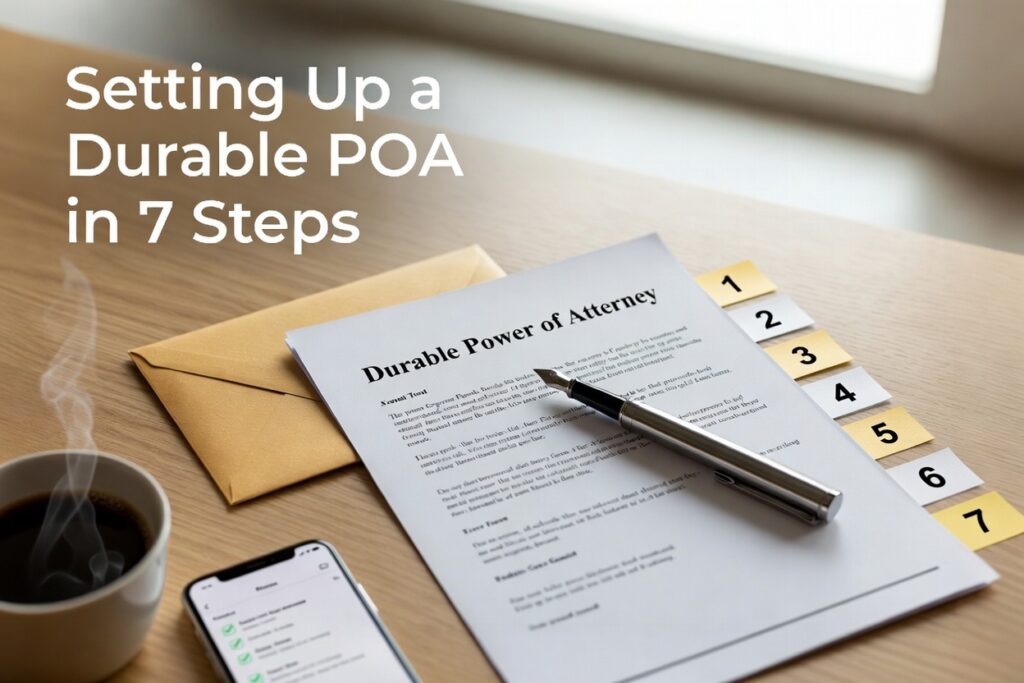
How to Set Up a Durable Power of Attorney (Step-by-Step)
Following these steps in 2026 ensures your POA will be honored when it matters most.
Step 1: Decide what you need. Do you want one document for finances and another for healthcare? A durable financial POA with an advanced healthcare directive is the standard comprehensive package.
Step 2: Choose your agent wisely. This person will have enormous power. Pick someone who is trustworthy, organized, and geographically close. Always name at least one successor agent in case the first choice cannot serve.
Step 3: Work with a qualified legal professional. Estate planning isn’t a DIY area. A small mistake can invalidate the document. If you’re unsure about legal titles, take a moment to understand the difference between an attorney and a lawyer.
Step 4: Draft the document with specific powers. A good POA covers digital assets, access to online accounts, and the authority to deal with retirement plans. Vague language invites rejection by financial institutions.
Step 5: Sign with proper formalities. Most states require notarization. Some also require witnesses. Follow your state’s exact statute. A POA that isn’t properly acknowledged is worthless in a crisis.
Step 6: Distribute copies. Give the original to your agent. Provide copies to your successor agent, your primary care physician, your financial advisor, and your attorney. Don’t hide it in a safe deposit box that no one can access without a court order.
Step 7: Review and update every 3–5 years. Life changes, marriages, divorces, deaths, and relocations can make an old POA legally stale. Many banks reject POAs that are more than five years old. Keep it fresh.
For expert background, the National Institute on Aging provides an excellent overview of powers of attorney and other legal and financial planning tools. Use it to educate family members.
How to Avoid Conservatorship Entirely
The best strategy starts today, not when a doctor says “incapacity.”
1. Execute a comprehensive durable power of attorney for finances and healthcare before any signs of decline.
2. Consider a revocable living trust. A trust can manage assets without court involvement, working alongside a POA to cover all bases.
3. Register digital estate plans. In 2026, access to cryptocurrency, social media, and online banking is a major headache without explicit legal authority. Include digital asset clauses.
4. Use supported decision-making agreements. Some states recognize formal agreements where a person keeps full legal capacity but designates helpers to explain choices. It’s an even lighter touch than POA.
5. Have honest family conversations early. Many conservatorships happen not because of bad intent but because families waited too long to talk.
6. Keep your POA current. A fresh, recently signed, properly witnessed POA is far more likely to be accepted by banks and hospitals without pushback.
How to Verify a Power of Attorney or Conservatorship (Protect Your Family)
Elder financial abuse is on the rise, and some POAs are fraudulently created. Others are outdated. Here’s how to verify legitimacy.
Verifying a Power of Attorney
- Check the execution date. If it’s more than 5–7 years old, a financial institution may reject it. Ask for a newer one or an attorney’s opinion letter.
- Confirm notarization and witness compliance with state law.
- Contact the principal’s attorney directly (if listed) to confirm the POA wasn’t revoked.
- Look for springing POA conditions. Has the triggering event actually occurred? Demand the required physician’s certificate.
- Watch for red flags: sudden POA changes, new “best friends” getting authority, or signatures that don’t match.
Verifying a Conservatorship
- Search the probate court’s online docket. Most counties allow you to look up case numbers and see current orders.
- Ask to see the Letters of Conservatorship, the official court document that proves the conservator’s authority. No letters, no power.
- Check for bond filings in estate conservatorships. A bond protects the conservatee from theft.
- Review court accountings. Conservators must file periodic reports. You can often request them.
- Report suspected abuse to the court and Adult Protective Services immediately.
2026 Relevance: Trends, Law Updates, and Why This Year Matters
The legal landscape continues to shift, making 2026 a pivotal year for estate planning.
Uniform Power of Attorney Act adoption. More states are updating their POA statutes to accept out-of-state documents and clarify agent duties, reducing rejection rates by third parties.
Remote online notarization is permanent in many states, allowing POAs to be executed without leaving home a critical access issue for disabled or rural individuals.
Rising elder financial exploitation cases are pushing courts to scrutinize POAs more closely and demand stricter accounting from conservators.
Digital asset management laws have matured. If your POA doesn’t explicitly mention digital accounts, your agent may be locked out of everything from email to cryptocurrency.
Intersection with family law changes. Just as families needed to understand updated child support laws in 2025, staying current on estate planning shifts is equally vital for protecting every generation.
Planning now with durable powers of attorney and a clear understanding of the conservatorship safety net puts you ahead of 90% of families who will face these issues unprepared.
Common Myths That Put Families at Risk
Myth 1: “I’m too young for a power of attorney.”
Reality: A sudden accident, stroke, or illness can happen at any age. Every adult over 18 needs a POA.
Myth 2: “A power of attorney gives away all my rights.”
Reality: You retain full control until you are incapacitated. Even then, a durable POA lets you structure the powers granted.
Myth 3: “My family can just step in if something happens.”
Reality: Without a POA or conservatorship, no one has legal authority to pay your bills or speak with doctors. Families often face frozen accounts and medical gridlock.
Myth 4: “A conservatorship is only for the very old.”
Reality: Young adults with severe mental illness, traumatic brain injury, or developmental disabilities often become conservatees.
Myth 5: “Once I have a POA, I can forget about it.”
Reality: POAs must be updated. Laws change, banks become pickier, and agents may die or become unsuitable.
Myth 6: “Conservatorships are always abusive and should be avoided at all costs.”
Reality: While high-profile cases highlight abuse, many conservatorships are lifesaving for individuals who have no plan and no one to help. They are a necessary legal backstop.
Frequently Asked Questions (FAQ)
What is the main difference between conservatorship and power of attorney?
A power of attorney is voluntary and private, created before incapacity. A conservatorship is court-ordered after incapacity, with ongoing supervision.
2. Can a durable power of attorney prevent conservatorship?
Yes, in most cases. A comprehensive durable POA for finances and healthcare eliminates the need for a court to intervene.
3. How much does a conservatorship cost vs a power of attorney?
A POA typically costs $200–$800 one-time. A conservatorship can run $3,000–$15,000+ initially, plus thousands annually in court, accounting, and legal fees.
4. Is guardianship the same as conservatorship?
Not exactly. Guardianship often covers personal care decisions, while conservatorship often refers to finances. Terminology varies by state.
5. What is a durable power of attorney vs general power of attorney?
A durable POA stays effective after incapacity. A general POA automatically ends when the principal becomes incapacitated. Always choose durable for long-term planning.
6. Can a conservator override a power of attorney?
Yes. A court-appointed conservator can revoke or override an existing POA if the judge finds it’s in the conservatee’s best interest.
7. Can you have both a power of attorney and a conservatorship?
Sometimes. If a POA doesn’t cover all needs or an agent is mismanaging affairs, a court may establish a conservatorship for limited purposes while leaving the POA partially intact.
8. How long does a conservatorship last?
It lasts until the conservatee regains capacity and the court terminates it, or until the conservatee’s death. It often continues for years.
9. What happens if there is no POA and no conservatorship?
No one has legal authority. Bills go unpaid, healthcare decisions stall, and assets can be lost. The family must seek a court-ordered conservatorship, often in a crisis.
10. How do you revoke a power of attorney?
As long as you are competent, you can revoke it by signing a written revocation, notifying your agent and any institutions, and destroying the old document. Incapacity changes the equation.
11. What is a springing power of attorney?
It only becomes effective upon a specific event, like a doctor’s certification of incapacity. While appealing, it can cause delays and disputes.
12. Does a power of attorney need to be notarized?
In most states, yes. Some require witnesses as well. Always follow state law to avoid rejection.
13. Can a power of attorney be used after death?
No. A POA automatically terminates at the principal’s death. After death, the executor or trustee takes over.
14. What is a limited conservatorship?
A court restricts the conservator’s powers to only those areas where the individual truly needs help, preserving as much independence as possible.
15. What are alternatives to conservatorship?
Durable POA, revocable living trust, supported decision-making agreements, representative payee arrangements, and advance healthcare directives.
16. How do you choose an agent for a power of attorney?
Pick someone you trust completely, often a spouse, adult child, or close friend who is financially responsible, organized, and willing to serve. Name a successor.
17. What is supported decision-making?
A legal arrangement where a person retains full capacity but uses trusted advisors to help understand and communicate decisions. It’s gaining recognition as a less restrictive alternative.
18. What are the signs that a conservatorship may be needed?
Unpaid bills despite sufficient funds, repeated falling for scams, inability to manage medications, self-neglect, and refusal to accept help despite clear incapacity.
19. How often must a conservator report to the court?
Typically annually for estate accounting, and sometimes more frequently for personal status reports. Missing filings can lead to removal.
20. Can a conservatorship be challenged?
Yes. Interested persons can petition the court to terminate or modify it, request a new conservator, or object to accountings. Legal assistance is strongly advised.
Final Thoughts
Conservatorship vs power of attorney ultimately comes down to timing, trust, and preparation. A durable power of attorney signed when you’re healthy, kept current, and built with professional guidance is one of the most powerful gifts you can give your family. It spares them from courtrooms, public records, and tens of thousands of dollars in unnecessary costs.
If you wait until a crisis hits, the choice disappears. Don’t let that happen. Start the conversation, meet with an estate planning attorney, and lock in your wishes now. In 2026, there are more tools than ever to keep control in your hands. Use them.
This article is for general informational purposes only and does not constitute legal advice. Laws vary by state and change frequently. Always consult a licensed attorney in your jurisdiction for advice tailored to your specific situation.

Dirk Wasserthal is the Founder and Lead Writer of LegalDiaries.com, an independent legal information platform. He specializes in Mass Torts, Women’s Rights, and emerging legal issues, delivering clear, well-researched, and trustworthy content across Criminal Law, Family Law, Personal Injury, and more. Dirk’s mission is simple — make the law understandable for everyone.