




New child support laws 2025 raised income caps, rewrote parenting-time credit rules, and updated guideline schedules in several states, with Texas, Colorado, Massachusetts, and California making the biggest moves. None of it rewrites your order for you. You still have to act. That matters because a lot of parents assume the update happens on its own, and it doesn’t.
- What’s Changing in Child Support Law in 2025
- Why So Many States Are Updating Guidelines at Once
- Texas: The New $11,700 Net Resources Cap
- Colorado: Goodbye to the 93-Overnight Rule
- Massachusetts: New Guidelines Starting December 1, 2025
- California: The SB 343 Formula Overhaul
- Other States Making Changes
- What the Federal Government Actually Did in 2025
- Does This Change Your Existing Order Automatically
- Myth vs Fact: Child Support Law Changes
- What to Do Right Now
- Frequently Asked Questions
- Conclusion
Here’s why this year stands out. Several large states hit their scheduled guideline review at the same time, and years of inflation had piled up without the formulas catching up. So instead of one change trickling out, a cluster of them landed together. If your order is more than a couple years old, it’s worth five minutes to check whether any of this touches you.
What’s Changing in Child Support Law in 2025
The short version: income caps went up, parenting-time credit got more precise, and low-income protections expanded, but none of it applies to your case until you or your co-parent files for a modification.
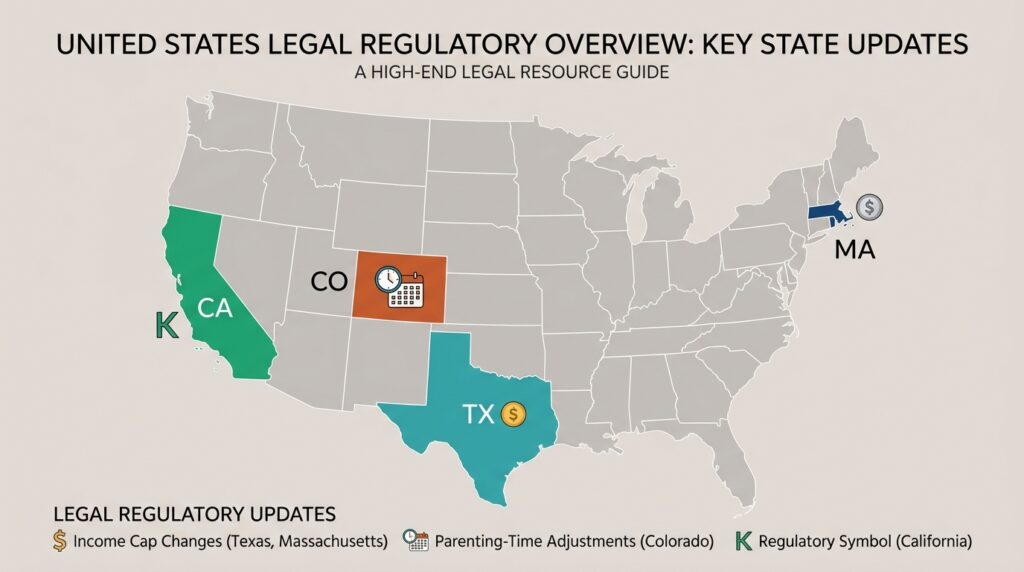
Here’s a quick side-by-side look at the states covered in this guide.
| State | What Changed | Effective Date | Applies Automatically? |
|---|---|---|---|
| Texas | Net resources cap rose from $9,200 to $11,700 a month | September 1, 2025 | No, new cases and modifications only |
| Colorado | Removed the 93-overnight rule, raised income ceiling to $40,000 combined monthly | May 31, 2025 (parenting-time formula starts March 1, 2026) | No, new cases and modifications only |
| Massachusetts | New guidelines, income cap raised to $450,000 a year | December 1, 2025 | No, new cases and modifications only |
| California | SB 343 replaced the old formula with a new “K factor” calculation | Phased in since September 2024 | No, new cases and modifications only |
Why So Many States Are Updating Guidelines at Once
Under federal law, every state has to review its child support guidelines at least once every four years. That review checks whether the numbers still match what it actually costs to raise a kid.
Most years, that review produces small tweaks. This year, several big states happened to land on their review cycle around the same time, and a few years of inflation had built up without the tables catching up. That’s why you’re seeing headlines from Texas, Colorado, Massachusetts, and California all in the same stretch of months.
It’s not one federal law rewriting child support everywhere. It’s a handful of separate state reviews landing close together, plus one federal bill about enforcement funding that we’ll get to later. Child support amounts are still set state by state. There’s no single national formula.
Texas: The New $11,700 Net Resources Cap
Texas raised the income cap used to calculate guideline child support from $9,200 to $11,700 a month in net resources, effective September 1, 2025. It’s the largest single increase to the cap since it was created.
Texas courts use a formula built around net resources, which just means income after certain taxes and deductions come out. Under Texas Family Code section 154.125, the guideline percentages only apply up to a cap. Above that cap, a judge can order more, but it’s not automatic.
That cap sat at $9,200 since 2019. As of September 1, 2025, it’s $11,700, a jump of about 27 percent, and the biggest adjustment the cap has seen in the six-year review cycle the statute requires. The percentages themselves didn’t change. Here’s what that looks like in dollars.
| Children | Guideline Percent | Max Support at Old Cap | Max Support at New Cap |
|---|---|---|---|
| 1 | 20% | $1,840/month | $2,340/month |
| 2 | 25% | $2,300/month | $2,925/month |
| 3 | 30% | $2,760/month | $3,510/month |
| 4 | 35% | $3,220/month | $4,095/month |
| 5 or more | 40% | $3,680/month | $4,680/month |
This only matters if your net monthly income is above $9,200. If you earn less than that, the cap change doesn’t touch your number at all. It also does not mean support is capped at $11,700 outright. Guideline percentages apply up to that figure, and a court can still order additional support above it if the child’s proven needs justify it.
A quick example. Say Marcus pays child support for one child in Houston. His net monthly income is $12,000. Before September 2025, the guideline calculation stopped at $9,200, capping his support at $1,840 a month. Under the new cap, the calculation runs up to $11,700, so his guideline support rises to $2,340 a month, an increase of $500. But that increase doesn’t happen by itself. Marcus’s co-parent would need to file a modification for the court to apply it.
See also: If you’re heading into a modification and want to know what a competent attorney should be telling you upfront, this guide on warning signs of a bad attorney is worth a read before you hire anyone.
Colorado: Goodbye to the 93-Overnight Rule
Colorado’s House Bill 25-1159, signed May 31, 2025, removes the old rule that required a parent to hit 93 overnights a year before getting any credit toward reduced child support. The calculation changes take effect March 1, 2026.
Under the old system, a parent with 92 overnights got zero credit. One with 93 overnights got a real reduction. That single-night difference sent a lot of parents into expensive custody fights just to cross the line on paper.
The new law replaces that cliff with a sliding scale. A parent with zero overnights gets no credit. A parent with all 365 gets full credit. Everyone in between gets something proportional, though not a straight one-to-one match. A parent with 25 percent of the overnights, for example, receives roughly a 13 percent credit rather than a full 25 percent, reflecting the fact that the majority-time parent still carries higher fixed costs like housing. The official bill text from the Colorado General Assembly lays out the full formula if you want to see it directly.
A few other pieces of the same law:
- The combined income ceiling for the standard guideline tables rose from $30,000 to $40,000 a month.
- Extraordinary medical expenses are now shared starting from the first dollar. The old rule required $250 per child per year in expenses before sharing kicked in.
- Courts have more flexibility in deciding which parent claims a child as a tax dependent, instead of a strict income-based formula.
- A new self-support reserve, tied to roughly 29 hours a week at the state minimum wage, protects the lowest-income parents from support orders that would leave them below subsistence income.
- Judges must now enter a support order in cases involving children, where the old law only said they could, closing a gap that occasionally left children without any order at all.
A quick example. Picture Sarah and David in Denver, sharing a child. David has 60 overnights a year, well under the old 93-night threshold. Under the old rule, he got zero credit toward his support obligation despite covering food, clothes, and housing during that time. Under the new formula, those 60 overnights now count toward a real, if partial, credit. That’s a meaningful shift for parents who never got close to the old cutoff.
If you’re mid-dispute over overnights right now, this is worth raising with your attorney immediately, since the March 2026 effective date is close enough to affect ongoing negotiations.
Massachusetts: New Guidelines Starting December 1, 2025
Massachusetts issued new child support guidelines effective December 1, 2025, the biggest update since 2021, raising the income cap used for base support from $400,000 to $450,000 a year.
Every four years, a Massachusetts Trial Court task force reviews the guidelines with help from outside economists. This round raised the income ceiling, adjusted the percentages applied at different income levels, and gave judges more say over extras like private school or summer camp.
A few other changes worth knowing about. The benchmark the guidelines use for reasonable child care costs rose from $355 to $430 a week per child, reflecting current infant care prices in the state. The old rule requiring a support recipient to cover the first $250 of uninsured medical expenses before costs were shared has also changed. Courts may now divide those expenses in proportion to each parent’s share of combined income instead. And for the first time, the guidelines address families where a child has more than two legal parents, following a related update to the state’s parentage law.
One notable shift on discretionary extras: courts must now weigh whether a parent can actually afford to contribute to costs like camp or private school, not just whether it serves the child’s interests. The official Massachusetts guidelines page spells out exactly when a modification can happen, including any material and substantial change in circumstances.
A quick example. Consider Priya, a Boston parent whose child support order was set under the 2023 guidelines. Her ex-spouse’s income has grown since then, but nothing dramatic happened, no job loss, no big raise. Under the new 2025 guidelines, the fact that her existing order no longer matches what the current formula would produce can, by itself, count as grounds for modification. She’d still need to file for it. It won’t switch over on its own.
California: The SB 343 Formula Overhaul
California’s SB 343 replaced the state’s child support formula, unchanged since 1992, with an updated calculation sometimes called the “K factor,” adjusting how income bands are set and giving low-income parents a meaningfully larger reduction than before.
This is the longest rollout on this list. The core formula became operative in September 2024, and courts spent 2025 transitioning their calculation software and working through implementation details. One practical wrinkle worth knowing: the widely used DissoMaster calculation tool stopped receiving updates around the same time, so older versions of that software, or any calculator that has not been updated for the new law, will not produce an accurate number for cases filed on or after September 1, 2024. You’ll see conflicting dates across different sources for exactly when each piece kicked in, so if your case touches this law, confirm the current status with your attorney or the court directly rather than relying on any single date you read online.
The official SB 343 bill text from the California Legislature shows the underlying changes: updated income bands for the K-factor table, income-proportional sharing of add-on costs like childcare, and a meaningfully higher low-income threshold, now set near full-time minimum wage, so more low-earning parents qualify for a reduced support percentage.
A quick example. Take Alicia, a parent in Sacramento earning close to minimum wage. Under the old formula, her share of childcare costs might have been split evenly with her ex regardless of the income gap between them, and the low-income adjustment cut off at a very low earnings threshold. Under SB 343, add-on costs like childcare and uninsured medical bills are now shared in proportion to each parent’s income, and the low-income threshold has moved up substantially, so her share shrinks relative to a higher-earning co-parent.
See also: Child support rarely gets decided in isolation. If you’re working through a broader separation, this overview of how divorce proceedings typically unfold covers how support, custody, and property often get negotiated together.
Other States Making Changes
Texas, Colorado, Massachusetts, and California got the most attention, but they weren’t alone. Reporting suggests Virginia expanded its guideline schedule and New Jersey revised its support tables in 2025, with more states, including New York, Pennsylvania, Washington, and Georgia, expected to update guidelines in 2026.
Treat those last two states as a general trend rather than confirmed detail. Guideline rules vary by state and change often, so if you live somewhere other than the four states covered above, check directly with your state’s child support agency or a local family law attorney for the current numbers.
What the Federal Government Actually Did in 2025
No, there’s no new federal formula for calculating child support. Congress passed the Supporting America’s Children and Families Act, signed into law January 4, 2025, but it deals with enforcement funding and data access, not how any state calculates a support amount.
You may have seen headlines mentioning a “new federal child support law.” Here’s the distinction that matters. This law, formally Public Law 118-258, reauthorizes federal child welfare funding and gives state and tribal child support enforcement programs, along with their contractors, expanded access to federal tax information for locating parents and collecting owed support. Most of its provisions took effect October 1, 2025, the start of the federal fiscal year. A Congressional Research Service summary lays out exactly what the law does and doesn’t cover.
It does not create a national calculation formula. It does not override any state’s guidelines. If a source claims otherwise, treat that claim with skepticism. Support amounts remain entirely a matter of state law, now and going forward.
Does This Change Your Existing Order Automatically
No. In every state covered here, a new guideline applies to new cases and to anyone who files for a modification. Courts don’t go back and rewrite existing orders on their own.
This is the single biggest misunderstanding parents run into. To actually benefit from, or be affected by, one of these updates, you’ll generally need to do a few things.
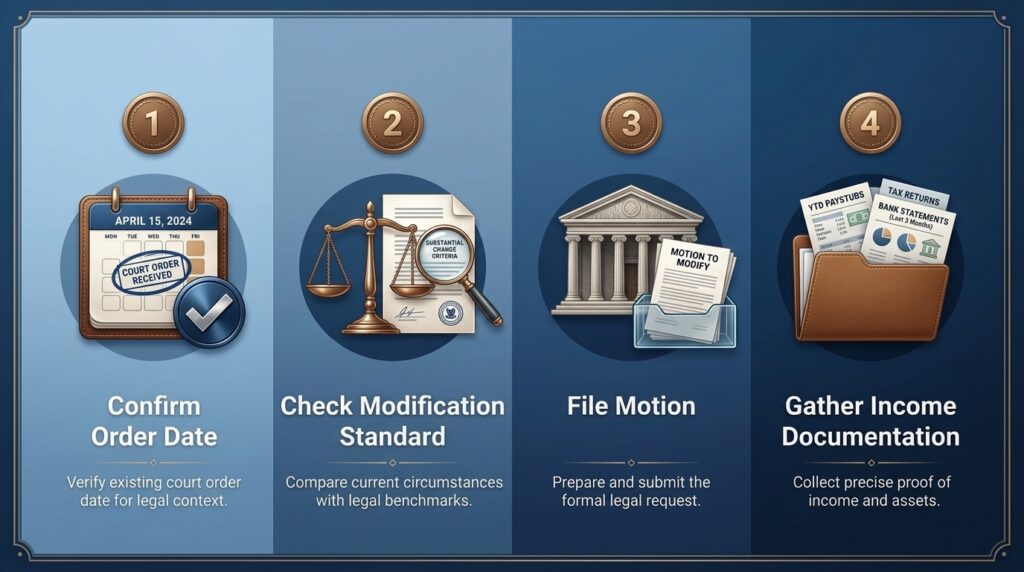
- Confirm your order predates the new guideline’s effective date.
- Check your state’s modification standard. Most states need either a substantial change in circumstances or a set waiting period since your last order, often two to three years, sometimes combined with a minimum percentage difference between the old and new calculated amounts.
- File a motion to modify with the court that issued your original order.
- Gather current income documentation for both parents.
A quick example. Say James has a Texas order from 2022 based on the old $9,200 cap. His income has since grown to $13,000 a month net. Nothing changes for him unless he, or his co-parent, files a modification request citing the new $11,700 cap and the resulting difference in the guideline calculation.
See also: Not sure whether you need a full attorney or just someone to review paperwork? This breakdown of attorney versus lawyer terminology clears up some of the confusion before you start calling firms.
Myth vs Fact: Child Support Law Changes
1. The new guidelines automatically update every existing child support order.
Fact: Nothing changes on its own. A parent has to file for a modification before a court applies a new guideline to an existing case.
2. A higher income cap or guideline change in one state means the same thing everywhere in the country.
Fact: Child support is calculated at the state level. A change in Texas has no effect on a case in Ohio or Florida.
3. If your income hasn’t changed, you can’t ask for a modification just because the guidelines did.
Fact: Several states, including Texas and Massachusetts, allow a modification request based on the guideline change itself, sometimes combined with a minimum time period since the last order.
4. The federal government now sets one national child support formula.
Fact: The 2025 federal law deals with enforcement funding and tax information access. It does not touch how any state calculates a support amount.
What to Do Right Now
If you have an active or recent child support case, here’s a short checklist worth working through.
- Pull your current order and check the date against your state’s guideline change.
- Ask a family law attorney whether the new numbers would actually help or hurt your specific situation before filing anything.
- Gather updated pay stubs, tax returns, and expense records, since the newer formulas tend to want more detail than older ones did.
- If your case involves a child with a disability or long-term care needs, understand how a support order interacts with any conservatorship or guardianship arrangement already in place.
- Don’t assume a change automatically helps you. Depending on which side of the calculation you’re on, a higher income cap could raise or lower what you pay or receive.
Frequently Asked Questions
1. What states are changing child support laws in 2025?
Ans: Texas, Colorado, Massachusetts, and California made the most significant updates in 2025, with Virginia and New Jersey also reported to have made changes. More states have updates scheduled for 2026.
2. Does new child support law apply to existing orders?
Ans: No. Every state covered here applies new guidelines to new cases and to modification requests, not automatically to orders already in place.
3. How much is the new Texas child support cap?
Ans: Texas raised its net resources cap from $9,200 to $11,700 a month, effective September 1, 2025, under Texas Family Code section 154.125.
4. What is the maximum child support in Texas in 2025?
Ans: For one child, guideline support tops out at $2,340 a month under the new $11,700 cap, up from $1,840 under the old cap. The amount rises with more children.
5. How do I modify child support in 2025?
Ans: You generally need to show a substantial change in circumstances, or meet your state’s waiting period since the last order, then file a motion to modify with the court that issued the original order.
6. Is there a new federal child support law in 2025?
Ans: Congress passed the Supporting America’s Children and Families Act in January 2025, but it addresses enforcement funding and tax information access, not calculation formulas.
7. What is the Colorado child support overnight rule change?
Ans: House Bill 25-1159 removed the old 93-overnight threshold and replaced it with a sliding scale, so any amount of parenting time can now count toward a credit, once the calculation changes take effect March 1, 2026.
8. How is child support calculated in California in 2025?
Ans: California’s SB 343 updated the state’s K-factor formula for the first time since 1992, expanding the low-income adjustment and requiring add-on costs like childcare to be shared in proportion to each parent’s income.
9. When do the new Massachusetts child support guidelines take effect?
Ans: The 2025 Massachusetts guidelines took effect December 1, 2025, raising the income cap for base support from $400,000 to $450,000 a year.
10. Can child support be increased without going to court?
Ans: Generally, no. Most states require a court order or a formal modification process, even when both parents agree to a change.
Conclusion
Child support guidelines moved a lot in 2025, but the through-line is simple. Income caps went up, parenting-time credit got more precise, and low-income protections expanded, state by state, not all at once nationwide. None of it changes your order until someone files.
If you think one of these updates might affect what you pay or receive, the smartest next step is a conversation with a licensed family law attorney in your state. They can run your actual numbers against the current guideline and tell you honestly whether filing makes sense.
This article provides general information only and is not legal advice. Laws vary by state and change over time. Do not rely on this content as a substitute for advice from a qualified, licensed attorney in your jurisdiction. For guidance on your specific situation, consult a licensed attorney directly.

Dirk Wasserthal is the Founder and Lead Writer of LegalDiaries.com, an independent legal information platform. He specializes in Mass Torts, Women’s Rights, and emerging legal issues, delivering clear, well-researched, and trustworthy content across Criminal Law, Family Law, Personal Injury, and more. Dirk’s mission is simple — make the law understandable for everyone.