



The Trump White House ballroom lawsuit reached its biggest turning point yet on August 21, 2026, when the Supreme Court let construction keep going while the case heads toward a final decision. This fight pits presidential authority over the White House against a federal law that says Congress must approve major changes to the building. Here is what happened, why it matters, and what could happen next.
- What Is the Trump White House Ballroom Lawsuit About
- Full Timeline of the Trump White House Ballroom Lawsuit
- Who Is Suing and Why
- What the Trump Administration Says
- The Supreme Court Stay, Explained
- The Standing Fight Nobody Saw Coming
- Money, Funding, and Who Really Pays
- History of the East Wing
- The WHCA Shooting and Its Legal Ripple Effect
- Myth vs Fact
- What Happens Next
- Frequently Asked Questions
- Key Takeaways
What Is the Trump White House Ballroom Lawsuit About
The Trump White House ballroom lawsuit is a court fight over whether President Trump can build a massive new ballroom on the site of the demolished East Wing without asking Congress first.
The National Trust for Historic Preservation sued the National Park Service and Trump administration officials in December 2025. The Trust says the administration broke federal law by tearing down the East Wing and starting construction on a 90,000 square foot ballroom before getting required approvals. The administration says the President has the authority to modernize the White House and that modern security threats make the ballroom necessary.
Three courts have now looked at this case. Two of them, a federal district judge and a federal appeals court, ruled that the project needs congressional approval. The Supreme Court has not yet ruled on the merits. It only agreed, for now, to let construction keep moving while it decides what to do.
The project itself has grown since it was first announced. What started as a roughly 200 million dollar plan is now a 90,000 square foot White House ballroom with an estimated price tag of 400 million dollars, built to hold between 999 and 1,350 guests for state dinners and official events. The administration has increasingly described it as a Military and Ballroom Complex, pointing to underground bunkers, bomb shelters, and reinforced structures built alongside the event space.
Full Timeline of the Trump White House Ballroom Lawsuit
Here is the sequence of events, updated through August 2026.
July 2025. The White House first announces plans for East Wing modernization.
October 2025. Demolition crews begin tearing down the East Wing, a structure that dates back to 1902. Historians and preservation groups immediately call for a pause.
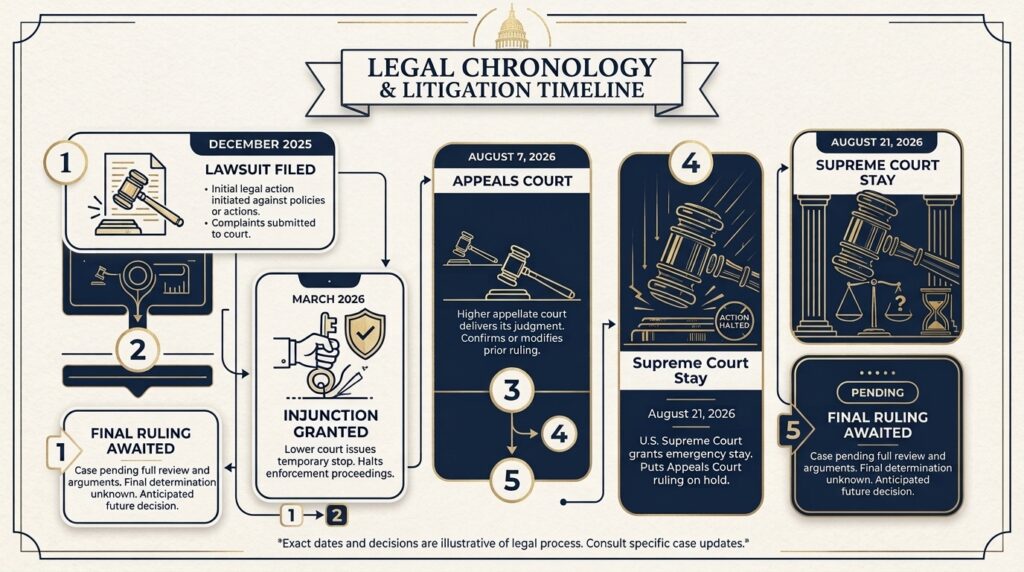
December 12, 2025. The National Trust for Historic Preservation sues the National Park Service and administration officials in federal court in Washington, D.C. The lawsuit claims violations of the National Historic Preservation Act, the National Environmental Policy Act, and a failure to get congressional authorization.
December 16, 2025. Judge Richard Leon declines to issue an immediate order stopping the project, saying the Trust had not yet shown irreparable harm. He sets a hearing for early 2026.
March 31, 2026. Judge Leon grants a preliminary injunction. He rules that no law gives the President the authority he claims to have over this project.
April 26, 2026. Judge Leon clarifies his order. Below ground construction, including bunkers and security infrastructure, can continue. Above ground ballroom construction cannot, unless Congress authorizes it.
April 25 to 26, 2026. A shooting incident occurs at the White House Correspondents Dinner at the Washington Hilton. No principals are hurt, but the event becomes a talking point in the case.
April 27 to 28, 2026. Justice Department officials pressure the National Trust to drop the lawsuit, pointing to the shooting as proof of the need for a secure, on site venue. The Trust refuses.
June 5, 2026. The U.S. Court of Appeals for the D.C. Circuit hears oral arguments.
August 7, 2026. In a divided 2 to 1 ruling spanning 136 pages, the D.C. Circuit panel upholds Judge Leon’s injunction. The majority writes that deciding whether a massive ballroom gets built is a job for Congress, not something the executive branch can decide for itself. Judge Neomi Rao dissents, arguing the National Trust never had legal standing to sue in the first place. The panel puts its own order on hold for 14 days so the government can ask the Supreme Court to step in.
August 14, 2026. The Trump administration files an emergency request with the Supreme Court, telling the justices the ballroom is 65 percent complete, being built by a 250 person crew working 20 hour days, seven days a week, and could be substantially finished by November 2026.
August 21, 2026. Chief Justice John Roberts issues a temporary administrative stay, allowing above ground construction to continue while the full Supreme Court weighs the government’s request. This is not a final ruling on whether the ballroom is legal.
Current status, August 2026. Construction is ongoing. The Supreme Court has not scheduled oral argument. A final decision could come through further orders on the emergency docket, or after full briefing and argument later this year.
Who Is Suing and Why
The plaintiff is the National Trust for Historic Preservation, a nonprofit group chartered by Congress. The Trust argues the administration skipped several legally required steps before demolishing the East Wing and starting construction, including:
- Section 106 review under the National Historic Preservation Act, a process that requires federal agencies to consider how a project affects historic buildings before moving forward.
- Environmental review under the National Environmental Policy Act, often called NEPA, a law that requires federal agencies to study a project’s environmental impact first.
- Review by the National Capital Planning Commission and the Commission of Fine Arts, two bodies that normally weigh in on major changes to federal buildings in Washington, D.C.
- Authorization from Congress for major alterations to President’s Park, the federal land that includes the White House grounds.
National Trust President and CEO Brent Leggs praised the D.C. Circuit’s August ruling, calling it a win for the public’s right to weigh in on historic places that belong to the country, including the White House.
What the Trump Administration Says
The administration’s core argument is that the President has broad authority over how the White House operates and looks, and that this authority covers security related construction. Officials point to the following:
- The President has historically had discretion to renovate and modernize the White House, citing statutes that give the executive branch authority over federal executive residences.
- Modern threats such as drones, vehicle attacks, and active shooters make an on site, secure event space necessary rather than optional.
- The 400 million dollar ballroom itself is funded through private donations, not taxpayer money, though the administration has not published a full donor list.
- Because construction is now more than halfway complete, stopping or reversing the project would be wasteful and could itself pose new safety risks.
After the April 2026 shooting at the Correspondents Dinner, administration officials leaned harder into the security argument, framing the lawsuit as something that puts lives at risk by delaying a safer venue.
The Supreme Court Stay, Explained
On August 21, 2026, Chief Justice John Roberts issued what is called an administrative stay. In plain words, this is a short term pause button. It temporarily blocks the lower court’s order so construction can continue while the full Supreme Court decides whether to grant a longer stay or take up the case entirely.
This is an important distinction many headlines glossed over. The stay does not say the ballroom is legal. It does not resolve whether Congress needed to approve the project. It simply keeps the status quo, meaning ongoing construction, in place a little longer.
A National Trust spokesperson made this point directly, stating that the order was not a final decision on the merits of the government’s request and that the group awaits further action from the Court.
The government’s filing to the justices leaned heavily on the practical reality of the construction timeline, telling the Court the project was 65 percent complete and that a 250 person crew was working around the clock. The Trust countered that the administration deliberately raced to finish construction specifically to make the legal fight moot, calling it an attempt to outrun judicial review.
The Standing Fight Nobody Saw Coming
A surprising twist emerged in the D.C. Circuit’s ruling: a fight over legal standing, meaning whether the National Trust even has the right to bring this lawsuit at all.
The Trust’s case rests almost entirely on one member, retired preservation historian Alison Hoagland, who says she regularly walks near the White House and would suffer what courts call aesthetic injury from seeing the finished ballroom. Judge Rao’s dissent argued this is not enough. She wrote that the lower court had stretched Hoagland’s actual statements further than what Hoagland herself claimed, and that a passerby’s discomfort at a building’s appearance is not the kind of concrete, particularized harm the law usually requires before a court can step in.
This matters because if the Supreme Court agrees with Rao, it could throw out the entire case on a technicality without ever deciding whether Congress needed to approve the ballroom in the first place. Legal analysts have noted this is a real risk for the Trust, since the Supreme Court’s conservative majority has generally applied strict standing rules in past cases.
Money, Funding, and Who Really Pays
The administration has repeatedly said the ballroom itself is funded by private donors, not taxpayers. That claim is only part of the picture.
Independent reporting places the project’s total cost at roughly 400 million dollars, up from an original estimate closer to 200 million dollars when it was first announced. Separately, reporting indicates taxpayers are expected to cover at least 300 million dollars in related security infrastructure and Secret Service costs tied to the broader complex, even if the ballroom’s visible construction is privately funded.
Donor transparency remains an open question. The administration has not released a complete list of contributors, and ethics watchdogs have raised concerns about potential conflicts of interest when private money funds changes to public, federally owned property.
History of the East Wing
Understanding why this fight cuts so deep requires a little history.
The East Wing was built in 1902 under President Theodore Roosevelt as a formal entrance and reception area. President Franklin Roosevelt expanded it in 1942, adding a second story that concealed the Presidential Emergency Operations Center, a bunker still used for security purposes today. Over the following decades, the East Wing housed First Lady offices, a small theater, and visitor services.
Past presidents made changes to the White House too, but usually with far more consultation. The Truman administration’s 1948 to 1952 reconstruction involved significant congressional oversight due to structural failures in the building. The rapid 2025 demolition skipped several of the traditional review steps that accompanied those earlier projects, which is exactly what fuels the current lawsuit.
The WHCA Shooting and Its Legal Ripple Effect
On April 25, 2026, a shooting occurred at the White House Correspondents Dinner at the Washington Hilton. A suspect attempted to breach security before an exchange of gunfire. President Trump and other officials were evacuated safely, and there were no fatalities among the event’s principals.
The administration used the incident to argue that off site venues carry real, demonstrated risks, strengthening the case for an on site secure ballroom. The National Trust responded that legitimate security concerns do not excuse skipping legally required reviews, and that proper planning could have addressed security needs without bypassing the law.
Days later, Justice Department officials pressed the Trust to drop its lawsuit, citing the shooting directly. The Trust refused, calling the pressure inappropriate given that a court case was actively pending.
Myth vs Fact
Myth 1: Taxpayers are not paying anything for the White House ballroom.
(Fact:) The ballroom’s visible construction is described as privately funded, but independent reporting indicates taxpayers are expected to cover at least 300 million dollars in related security and infrastructure costs tied to the broader complex.
Myth 2: The Supreme Court already ruled that the ballroom is legal.
(Fact:) The Court issued a temporary administrative stay on August 21, 2026, allowing construction to continue while it decides next steps. It has not ruled on whether the project violates federal law, and the National Trust has said it expects further proceedings.
What Happens Next
A few realistic paths remain open in the Trump White House ballroom lawsuit:
- The Supreme Court could grant a longer stay while it takes up the underlying legal questions, letting construction continue for months.
- The Court could rule on standing first, potentially ending the case without ever deciding whether Congress needed to approve the project.
- The Court could deny the stay, forcing construction to pause while the appeal proceeds.
- Congress could pass authorizing legislation, which would resolve the core legal dispute regardless of what the courts decide.
- The project could reach substantial completion, around November 2026 according to the administration’s own filings, which could make parts of the legal fight moot in practice even if not in law.
Frequently Asked Questions
1. What is the Trump White House ballroom lawsuit about?
(Ans:) It is a legal fight over whether President Trump needed congressional approval before demolishing the East Wing and building a 90,000 square foot ballroom at the White House.
2. Who filed the lawsuit?
(Ans:) The National Trust for Historic Preservation, a nonprofit group chartered by Congress, filed the lawsuit in December 2025.
3. Has construction been stopped?
(Ans:) No. As of August 21, 2026, the Supreme Court issued a temporary stay allowing construction to continue while the case proceeds.
4. How much does the ballroom cost?
(Ans:) The project is now estimated at 400 million dollars, with taxpayers expected to cover at least 300 million dollars in related security costs even though the ballroom’s construction is described as privately funded.
5. Why did the D.C. Circuit rule against the administration?
(Ans:) The appeals court ruled on August 7, 2026, that deciding whether to build a massive ballroom on federal property is a decision for Congress, not something the executive branch can approve on its own.
6. What is the standing issue in this case?
(Ans:) Standing refers to whether the National Trust has the legal right to sue at all. The case rests on one member’s claim of aesthetic harm from seeing the finished ballroom, an argument one appellate judge said falls short of the concrete injury courts usually require.
7. Could this case go back to a lower court?
(Ans:) Yes. If the Supreme Court rules on standing without addressing the underlying legal questions, the case could be sent back for further proceedings, or dismissed entirely.
8. Is the ballroom close to finished?
(Ans:) According to the administration’s own August 2026 filing to the Supreme Court, construction was 65 percent complete, with a goal of substantial completion by November 2026.
9. Could Congress still weigh in?
(Ans:) Yes. Lawmakers could pass legislation authorizing the project, which would resolve the core dispute regardless of how the courts rule.
Key Takeaways
- The Trump White House ballroom lawsuit now centers on two separate questions: whether the project violates federal preservation and planning law, and whether the National Trust even has legal standing to sue.
- The Supreme Court’s August 21, 2026 stay is temporary. It lets construction continue but does not decide the underlying legal fight.
- Construction was reported as 65 percent complete in August 2026, with a target of substantial completion by November 2026.
- Taxpayers are expected to cover a significant share of related security costs, even though the ballroom’s visible construction is described as privately funded.
- A final resolution could come from the Supreme Court, from Congress, or simply from the project reaching completion before the legal questions are fully resolved.
For related coverage of legal challenges to executive branch actions, see this breakdown of the Costco Trump Tariffs Lawsuit. For a look at how procedural compliance shapes major legal disputes, see the Ford F-150 Oil Consumption Lawsuit and the GM CP4 Pump Class Action Lawsuit. Readers curious about donor transparency and oversight questions in government adjacent funding disputes may also want to read the Edward Jones Kingsview Advisors Lawsuit. If you are new to how legal terms like standing and injunction actually work, our guide on the difference between an attorney and a lawyer is a good plain language starting point, and if you are considering a legal career shaped by cases like this one, see How to Start a Law Firm.
Disclaimer: This article is for general informational purposes only and does not constitute legal advice. Laws and court rulings referenced here can change, and the status of ongoing litigation may shift after publication. Readers should consult a licensed attorney for guidance specific to their situation.

Dirk Wasserthal is the Founder and Lead Writer of LegalDiaries.com, an independent legal information platform. He specializes in Mass Torts, Women’s Rights, and emerging legal issues, delivering clear, well-researched, and trustworthy content across Criminal Law, Family Law, Personal Injury, and more. Dirk’s mission is simple — make the law understandable for everyone.