



The Costco Trump tariffs lawsuit is actually two different fights wearing one name. Costco sued the federal government to get its own tariff money back, and won. Now Costco’s own customers are suing Costco, arguing they deserve a cut of that same money. If you shop at Costco and you’re trying to figure out what any of this means for your wallet, you’re in the right place.
- The Short Version
- What Is the IEEPA
- Why Costco Sued the Trump Administration
- The Supreme Court Steps In: Learning Resources v. Trump
- Where Does Costco’s Own Refund Stand Right Now?
- The Customers Fight Back: Two Class Actions Against Costco
- Stockov v. Costco Wholesale (Illinois)
- Briggs et al. v. Costco (Washington State)
- Who’s Eligible? The Class Period and State Rules
- Costco Isn’t the Only One
- Costco’s Own Lawsuit vs. the Customer Lawsuits: Don’t Mix Them Up
- Is There a Costco Class Action I Can Join Right Now?
- Myth vs. Fact
- What Should You Do If You Shopped at Costco During the Tariff Period?
- Frequently Asked Questions
- The Bottom Line
This case moves fast, and it’s easy to mix up who is suing whom. So let’s slow down and walk through it step by step, the way we’d explain it to a friend at dinner.
The Short Version
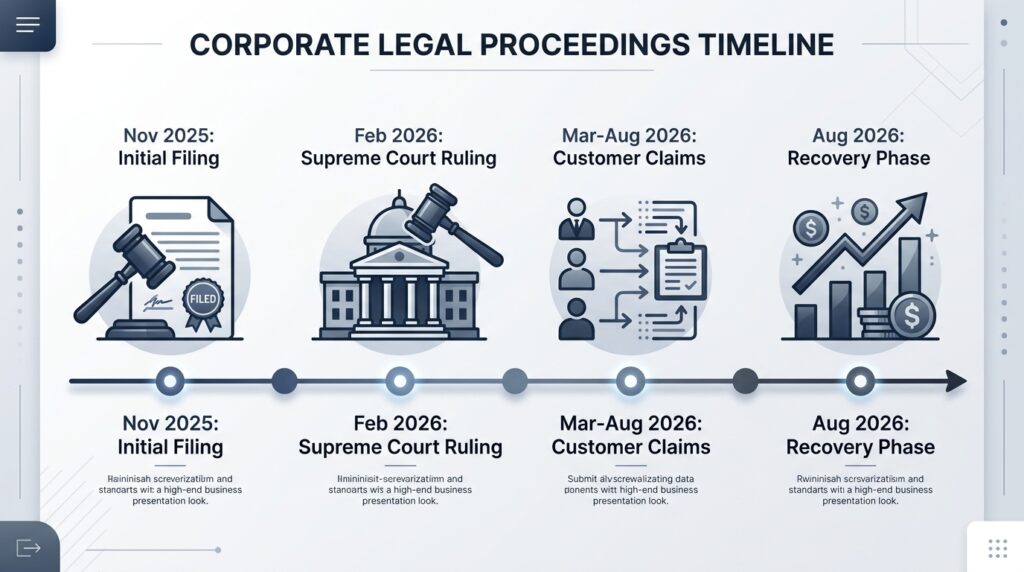
Costco filed its own lawsuit against the Trump administration in November 2025, asking for a refund of tariffs it had paid on imported goods. The company argued those tariffs were never legal in the first place.
In February 2026, the Supreme Court agreed. It ruled that the law behind the tariffs, the International Emergency Economic Powers Act, never gave the president the power to impose them.
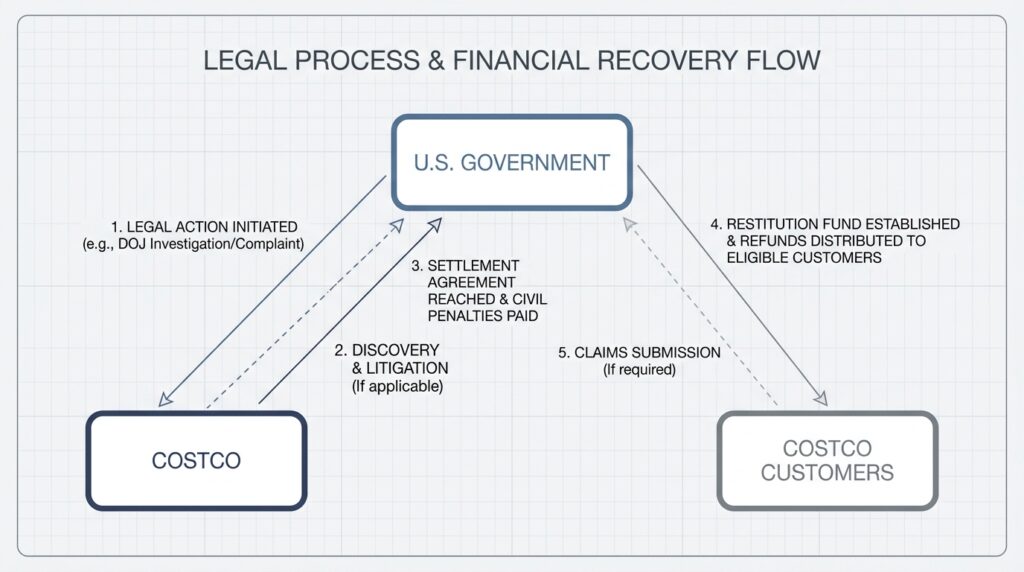
Costco has since started getting some of that money back from the government. But the company won’t send any of it directly to the customers who paid the higher, tariff-inflated prices at the register. That refusal is why Costco is now the one being sued, in two separate customer lawsuits, over what those customers call double recovery.
No class has been certified in either customer case as of this writing. If you shopped at Costco during the tariff period, there’s nothing to sign up for yet.
What Is the IEEPA
The International Emergency Economic Powers Act, or IEEPA, is a law from 1977. It lets the president take economic action, like freezing assets or blocking certain transactions, when there’s a real emergency coming from outside the United States.
Nowhere in that law does it mention tariffs. Every other time a president has imposed tariffs, Congress passed a separate law spelling that out. Starting in 2025, the Trump administration used IEEPA anyway. It argued that trade deficits and drug trafficking counted as the kind of emergency the law was written for.
A congressional research report on the case explains the core legal problem plainly. IEEPA authorizes the president to “regulate” or “prohibit” imports, but it does not specifically authorize tariffs, according to the Congressional Research Service’s legal analysis of the Supreme Court’s ruling. That gap between “regulate imports” and “tax imports” is the entire legal fight in one sentence.
Here’s a quick way to picture it. Imagine your landlord’s lease lets them “manage the building.” Most people would agree that covers fixing a broken elevator. It probably doesn’t cover charging you a brand new monthly fee they invented on the spot. Courts eventually decided the tariffs were more like that invented fee than a normal use of “managing” the building.
Why Costco Sued the Trump Administration
Costco filed its case, known as Costco Wholesale Corp. v. United States, on November 28, 2025, in the U.S. Court of International Trade. That’s a specialized federal court that only hears trade and customs disputes, so it was the right place to bring this claim.
A few things pushed Costco to act when it did. Roughly a third of everything Costco sells in the United States is imported, so the tariffs were a real, ongoing cost. Other big companies, including Revlon, EssilorLuxottica (the parent company of Ray-Ban), Kawasaki, and Bumble Bee, had already filed similar suits. Dozens more followed. Trade law observers took note of Costco’s size. A Georgetown University trade law professor described it as one of the first times a company that large had stepped into the fight publicly, since smaller businesses had mostly been carrying it alone until then.
There was also a deadline problem. U.S. Customs and Border Protection was set to liquidate, or permanently finalize, Costco’s import entries on December 15, 2025. Once an entry gets liquidated, it becomes much harder to get a refund later, even if a court later rules the tariff was illegal. Importers generally get a limited window to challenge those entries, commonly reported as around 180 days, so timing really mattered here.
Say you’re a small importer, not Costco. You paid $40,000 in IEEPA tariffs over the year. If your entries get liquidated before any court rules on the tariffs, you could lose your shot at getting that $40,000 back, even after a win at the Supreme Court. That’s exactly the trap Costco’s lawyers were trying to avoid.
Costco’s lawsuit didn’t specify an exact dollar figure it wanted refunded. But it wasn’t a long shot. Lower courts, including the Court of International Trade and a federal appeals court, had already ruled against the administration’s use of IEEPA earlier in 2025. The White House pushed back within days of Costco’s filing, with a spokesperson defending the tariffs as sound policy and voicing confidence the Supreme Court would ultimately side with the administration. Costco was essentially betting the other way, and filing early enough to make sure it could actually collect if it won.
The Supreme Court Steps In: Learning Resources v. Trump
While Costco’s case sat in the trade court, the bigger legal question was already in front of the Supreme Court in a separate case, Learning Resources, Inc. v. Trump, consolidated with Trump v. V.O.S. Selections, Inc. The Court heard arguments on November 5, 2025.
On February 20, 2026, the Supreme Court issued its ruling. In a 6 to 3 decision written by Chief Justice John Roberts, the Court held that IEEPA does not authorize the president to impose tariffs, full stop. You can read the official opinion directly from the Supreme Court if you want to see the reasoning in the justices’ own words.
The ruling covered both the broad reciprocal tariffs applied to most countries and the separate tariffs tied to Canada, Mexico, and China. It applied retroactively, meaning every IEEPA tariff was treated as invalid from the moment it was first imposed, not just from the date of the ruling.
What the Court did not do is spell out exactly how refunds should work. It sent that question back down to the lower courts, which is a big part of why this story is still unfolding well into 2026 instead of wrapping up neatly in February.
Common mistake to avoid: Don’t assume the Supreme Court striking down the tariffs automatically means checks are in the mail. A ruling on legality and a functioning refund process are two very different things, and the gap between them is exactly where all these lawsuits live.
Where Does Costco’s Own Refund Stand Right Now?
As of Costco’s most recent court filings in August 2026, the company said it had recovered roughly one third of the refund it believes it’s owed. It has started using some of that recovered money to lower prices on certain products going forward.
That’s not the same as sending money back to the people who actually paid the higher prices in 2025 and early 2026. Costco’s plan, so far, is future lower prices for future shoppers, not repayment for past purchases.
If you want to see how the government side of the refund process actually works, U.S. Customs and Border Protection runs an official IEEPA Duty Refunds page that explains the process for importers like Costco. It’s worth a look if you’re curious how the mechanics behind the scenes actually function, and it even includes a warning about scammers impersonating CBP to steal information from importers during the refund process.
The Customers Fight Back: Two Class Actions Against Costco
Once it became clear Costco might actually get real money back, Costco’s own shoppers started asking a simple question. What about us?
Stockov v. Costco Wholesale (Illinois)
Matthew Stockov, an Illinois Costco member, filed the first suit (Case No. 1:26-cv-02734) in March 2026 in the U.S. District Court for the Northern District of Illinois. Reuters covered the filing in detail, reporting that the lawsuit seeks a court declaration forcing Costco to return any tariff refunds it receives to the customers who paid inflated prices.
Stockov says he bought imported electronics, food, household goods, and small appliances at prices that were higher because Costco passed its tariff costs on to shoppers. According to the lawsuit, the tariffs affecting the products at issue ranged from about 10 percent up to as high as 145 percent, depending on the product and its country of origin. Stockov’s argument comes down to this: Costco is on track to get paid twice for the same tariff burden, once by customers through higher prices, and once by the government through a refund. His complaint calls this double recovery.
That same Reuters report quoted Costco CEO Ron Vachris, who told analysts around the same time that it was still unclear whether or when Costco would actually receive its refund. Vachris said that if the money does come through, Costco plans to use it for lower prices and better value for members, not direct payouts to past shoppers.
Costco fired back in May 2026 with a motion to dismiss. Its main argument was that the case was too early, since Costco hadn’t received any refund money yet. By August 2026, that argument looked weaker, since Costco had just admitted in its own filing that it had already recovered about a third of its expected refund. As of this writing, the motion to dismiss is still pending, and no class has been certified.
A quick hypothetical to make this concrete. Imagine you bought a $600 imported patio set at Costco in mid-2025, and $80 of that price reflected the tariff Costco was paying. If Costco eventually gets that $80 back from the government but only uses it to shave a few dollars off future patio sets, you personally never see your $80 again. That’s the injury Stockov’s lawsuit is built around.
Briggs et al. v. Costco (Washington State)
A second, similar case (Case No. 2:26-cv-01064) landed in the U.S. District Court for the Western District of Washington. The named plaintiffs, David Briggs, Marcus Carreon, Erin Charlton, Emily Maldonado, Kelsey Morse, Ashley Parker, and Karyn Wygle, live across Washington, Ohio, California, and Pennsylvania. Spreading plaintiffs across states is a common way attorneys try to represent a genuinely nationwide group rather than just one state’s shoppers.
The allegations closely mirror the Stockov case. Costco raised prices because of the tariffs, later became eligible for a government refund of those same tariffs, and hasn’t promised to pass that refund back to the shoppers who actually paid the markup. The complaint itself estimates Costco could be entitled to hundreds of millions of dollars in tariff refunds, and possibly more than a billion. That figure comes from the plaintiffs’ own filing, not from Costco or the government, so treat it as an estimate rather than a confirmed number.
Who’s Eligible? The Class Period and State Rules
This part genuinely varies depending on where you live, so don’t treat it as one size fits all. The Stockov case, according to reporting from the Chicago Sun-Times, proposes to cover Costco customers who bought a product subject to IEEPA tariffs between February 1, 2025, and February 24, 2026, and who live in one of ten states: Illinois, California, Florida, Michigan, Missouri, New Jersey, New York, Ohio, Washington, and Wisconsin.
That state list connects to specific state consumer protection laws, such as the Illinois Consumer Fraud and Deceptive Business Practices Act and similar statutes in the other named states. If you live outside those ten states, that particular case’s claims may not apply to you the same way, though the broader legal questions could still matter if a court reaches a favorable ruling that other courts later follow. A local attorney can tell you exactly how your state’s consumer protection law would treat a similar claim.
Costco Isn’t the Only One
If this all sounds familiar, it’s because the same double recovery theory has shown up in lawsuits against other big companies too, including FedEx, UPS, Lululemon, Nintendo, and EssilorLuxottica. There’s a real difference in how these companies have responded, though. FedEx has publicly committed to refunding customers and shippers if it gets its own tariff refund. Costco, by contrast, has only promised general future value through lower prices. That gap between a firm promise and a vague one has become a central argument in the lawsuits against Costco specifically.
Costco’s Own Lawsuit vs. the Customer Lawsuits: Don’t Mix Them Up
This is where a lot of readers get tangled, so here’s the cleanest way to keep it straight.
| Who Sues Whom | What They Want | Where It’s Filed | |
|---|---|---|---|
| Costco Wholesale Corp. v. United States | Costco vs. the federal government | A full refund of tariffs Costco itself paid | U.S. Court of International Trade |
| Stockov v. Costco | A Costco customer vs. Costco | A share of the refund, or repayment of price markups | N.D. Illinois |
| Briggs et al. v. Costco | Seven Costco customers vs. Costco | Same theory as Stockov, broader plaintiff pool | W.D. Washington |
Costco is the plaintiff in the first case and the defendant in the other two. It’s suing the government for the exact category of money its own customers are now suing Costco for.
Is There a Costco Class Action I Can Join Right Now?
Not yet, and it’s worth being cautious if you see anyone online claiming otherwise. As of this writing, no class has been certified in either the Stockov or Briggs case. There’s no settlement, no claim form, and no deadline to file anything.
If either case eventually gets certified or reaches a settlement, the process usually looks similar across most consumer class actions: a notice period, an official claims administrator, and a real filing deadline. None of that exists here today. If you’ve never followed a class action before, our guide on class action lawsuits without proof of purchase walks through how these claim processes typically work once a case actually reaches that stage.
It also helps to see what a finished process looks like. Our coverage of the Cash App spam text lawsuit settlement shows the kind of formal notice and claims window that eventually opens up in cases like this, once they clear the early hurdles Costco’s cases are still stuck on.
Myth vs. Fact
Myth 1: Once Costco gets its tariff refund, I’ll automatically get a check in the mail.
Fact: No class has been certified, and Costco has said it plans to use recovered money for future lower prices, not direct payments. There’s no automatic refund process for past purchases right now.
Myth 2: The Supreme Court ruling means the lawsuits are basically over.
Fact: The ruling only settled whether the tariffs were legal. It didn’t decide how refunds get paid out, which is exactly what the current lawsuits are fighting over.
Myth 3: If I don’t live in one of the ten states named in the Stockov case, I have no options at all.
Fact: You may not be covered by that specific case, but the underlying legal questions could still affect you if courts elsewhere reach similar rulings, or if a future nationwide settlement gets structured differently. A licensed attorney in your state can walk you through your specific options.
What Should You Do If You Shopped at Costco During the Tariff Period?
Start by keeping your receipts and your Costco.com order history for anything imported you bought roughly between early 2025 and February 2026. Electronics, food, small appliances, and household goods are the categories named specifically in the current complaints, so those purchases matter most.
Don’t pay anyone to register you for either lawsuit right now. At this stage, there’s genuinely nothing to sign up for, and anyone asking for money to add your name to a list should raise a red flag.
Keep an eye out for a class certification decision or a settlement announcement, since that’s the point when an actual claims process, if one ever opens, would begin.
If you’re weighing whether to talk to a lawyer about a related issue, it helps to understand the terminology first. Our post on the difference between an attorney and a lawyer is a quick, useful primer for anyone new to this. And if you do end up hiring someone, our rundown of signs of a bad attorney is worth a read before you sign anything.
Frequently Asked Questions
1. Did the Supreme Court actually rule Trump’s tariffs illegal?
Ans: Yes. On February 20, 2026, the Supreme Court ruled 6 to 3 in Learning Resources, Inc. v. Trump that IEEPA does not give the president authority to impose tariffs, and the tariffs were treated as invalid from the day they started.
2. Is Costco suing Trump, or is Trump suing Costco?
Ans: Neither, technically. Costco sued the federal government, naming agencies like U.S. Customs and Border Protection as defendants, seeking a refund of tariffs it paid. That’s separate from the two lawsuits customers have filed against Costco.
3. Why are Costco customers suing Costco instead of the government?
Ans: Individual shoppers can’t file a claim directly with U.S. Customs and Border Protection for a tariff refund, because only the importer of record, which is Costco in this case, is eligible to do that. Customers argue that since they actually paid the higher prices, they deserve a share of whatever Costco gets back.
4. Has Costco received any tariff refund money yet?
Ans: Yes. According to Costco’s own August 2026 court filing, the company had recovered roughly a third of the refund it expects, and had begun using part of that money to lower prices on certain products going forward.
5. Will Costco send refund checks to customers who paid higher prices?
Ans: Not based on anything Costco has said publicly. The company’s stated plan is to pass value back through future lower prices, not direct reimbursement to past purchasers, which is the exact issue both customer lawsuits are challenging.
6. What is IEEPA?
Ans: IEEPA is a 1977 law that lets the president respond to genuine foreign national security or economic emergencies, but courts have ruled it doesn’t give the president the power to impose tariffs, which the Constitution assigns to Congress.
7. Can I join the Costco tariff refund lawsuit right now?
Ans: No. As of this writing, no class has been certified in either customer case against Costco, so there’s no claim form, settlement, or deadline to worry about yet.
8. Is this the same as other tariff refund lawsuits in the news?
Ans: It’s part of the same wave. After the Supreme Court struck down the tariffs, similar customer lawsuits followed against other major companies, including FedEx, UPS, Lululemon, Nintendo, and EssilorLuxottica.
9. Who is eligible to be part of the Costco customer class action?
Ans: The Stockov case proposes covering shoppers who bought IEEPA-tariffed goods from Costco between February 1, 2025, and February 24, 2026, and who live in one of ten specific states, though no class has actually been certified yet.
The Bottom Line
Costco made a smart, defensive move by suing the government early, before the Supreme Court ruled, and that bet paid off. But the same lawsuit that protected Costco’s own refund is now the evidence its customers are using to argue they deserve a piece of it too.
Both customer cases are still in early stages, with a motion to dismiss pending in Illinois and a newer case moving forward in Washington. Nothing is certified, nothing has settled, and nothing requires action from you right now. If you shopped at Costco during the tariff period and want to understand your specific options, especially if you live outside the ten states named in the current filings, talk to a licensed attorney in your state rather than relying on general articles like this one.
This article provides general information only and is not legal advice. Laws vary by state and change over time. Do not rely on this content as a substitute for advice from a qualified, licensed attorney in your jurisdiction. For guidance on your specific situation, consult a licensed attorney directly.

Dirk Wasserthal is the Founder and Lead Writer of LegalDiaries.com, an independent legal information platform. He specializes in Mass Torts, Women’s Rights, and emerging legal issues, delivering clear, well-researched, and trustworthy content across Criminal Law, Family Law, Personal Injury, and more. Dirk’s mission is simple — make the law understandable for everyone.