




Edward Jones Kingsview Advisors lawsuit is the name people use for a group of legal fights between Edward Jones and financial advisors who left the firm to join Kingsview Wealth Management. The short answer is that this is not about clients losing money. It is a dispute over contracts, client contact rules, and who owns the relationship once an advisor walks out the door.
- What Is the Edward Jones Kingsview Advisors Lawsuit
- Timeline of the Edward Jones Kingsview Advisors Lawsuit
- The Keith Demetriades Case
- Who Is Keith Demetriades
- What Edward Jones Accused Him Of
- The FINRA Arbitration Process, Explained Simply
- What Is a Stipulated Award
- Did Demetriades Fight Back
- The Farmer Family Case in Arkansas
- Who Are Andrew and Zachary Farmer
- What Is Pre Solicitation, and Why It Matters
- What Is Happening in the Case Right Now
- Why Edward Jones Keeps Winning These Fights
- The Legal Terms in This Case, Explained Simply
- Myth Versus Fact
- Is Kingsview’s Recruiting Push Worth the Risk
- What This Means If You Are an Edward Jones Client
- Do Not Confuse This With Other Edward Jones Lawsuits
- Frequently Asked Questions
- Conclusion
That distinction matters. If you searched this term because you saw a headline mentioning millions of dollars, it is easy to assume something went wrong with your account. It did not. What went wrong, according to Edward Jones, is that some departing advisors broke the rules they agreed to when they were hired.
This guide walks through both known cases in plain language, explains the legal terms without the jargon, and tells you exactly what to do if your own advisor is one of the people who made the jump.
What Is the Edward Jones Kingsview Advisors Lawsuit
The Edward Jones Kingsview Advisors lawsuit is not one case. It is a series of legal disputes between Edward Jones and former financial advisors who left the firm for Kingsview Wealth Management. Edward Jones accuses these advisors of breaking non solicitation and confidentiality agreements. The most resolved matter ended with a $1.5 million settlement in June 2025.
Two cases make up almost everything reported so far. The first involves an advisor named George Keith Demetriades, who settled through arbitration in June 2025. The second involves a father and son team, Andrew Farmer and Zachary Farmer, who are still fighting an active lawsuit in Arkansas as of this writing.
Kingsview itself is rarely named as a defendant. The lawsuits target the individual advisors, not the company that hired them. That is worth remembering, because a lot of headlines make it sound like Edward Jones is suing Kingsview directly, when the legal target is almost always the person who left.
Here is a simple way to picture it. Imagine you work at a bakery for ten years and you sign an agreement promising not to take the customer list when you leave to open your own shop down the street. If you print that list and start calling customers before your last day, your old employer has a real complaint against you, not against the new bakery that hired you.
Timeline of the Edward Jones Kingsview Advisors Lawsuit
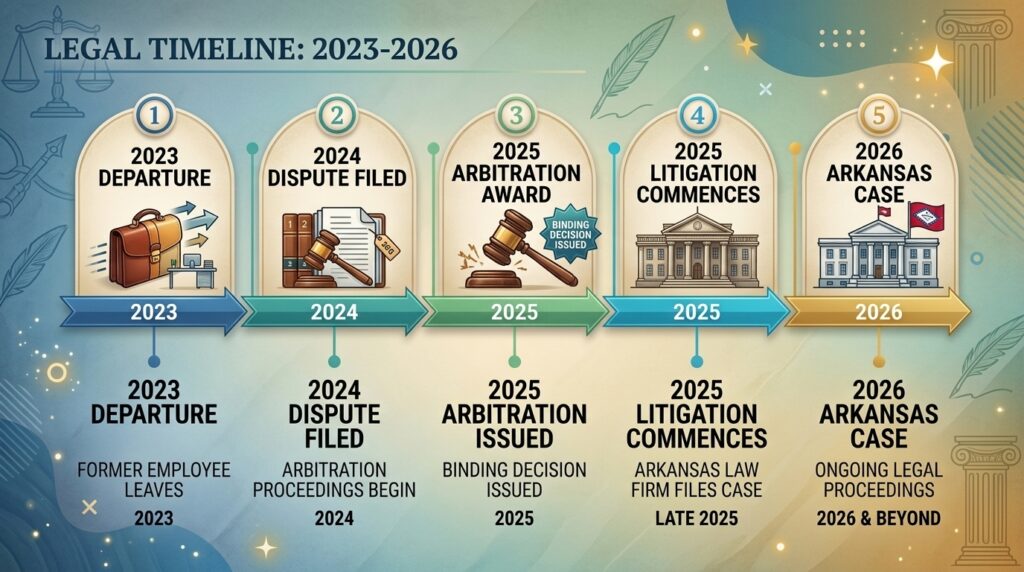
Following the order of events makes the whole story much easier to follow.
- June 2023: Keith Demetriades leaves Edward Jones and opens a Kingsview office in Pampa, Texas.
- August 2023: Edward Jones files a FINRA arbitration claim against Demetriades alleging broken agreements.
- June 2025: A FINRA panel issues a stipulated award requiring Demetriades to pay Edward Jones $1.5 million.
- July 2025: Andrew Farmer and his son Zachary leave Edward Jones for a Kingsview office in Mountain Home, Arkansas.
- August 2025: Edward Jones sues the Farmers in Baxter County Circuit Court, and the case remains active into 2026.
Two years separate the start of the first case and the filing of the second. That gap tells you something important. This is not a one time event. It is a pattern that keeps repeating as more advisors consider the same move.
The Keith Demetriades Case
Who Is Keith Demetriades
George Keith Demetriades is a former Edward Jones financial advisor who worked at the firm’s branch in Pampa, Texas, from 2012 to June 2023. He managed roughly $230 million in client assets before leaving to open a Kingsview Wealth Management office. He was later ordered to pay Edward Jones $1.5 million.
Demetriades spent more than a decade building his book of business at one branch. That kind of tenure usually means deep, personal relationships with clients, some of whom likely trusted him with money for their entire retirement. When he left in June 2023, he did not just quit a job. He walked away with knowledge of hundreds of client relationships that Edward Jones considers company property.
What Edward Jones Accused Him Of
Two months after Demetriades left, Edward Jones filed a FINRA arbitration claim. The firm made three separate accusations.
The first was breach of his non solicitation agreement, meaning he allegedly contacted former clients when his contract said he could not. The second was breach of confidentiality, meaning he allegedly used private client information he was not supposed to keep. The third was trade secret misappropriation, a legal term for taking protected business information, in this case client lists and account details, and using it somewhere else.
Think of trade secret misappropriation like taking your old company’s recipe book with you to a new kitchen. The recipe itself might feel like it belongs to you because you helped write it, but if your employment contract says the recipe stays with the company, taking a copy can create real legal exposure.
The FINRA Arbitration Process, Explained Simply
Most disputes between financial firms and their advisors do not go to a regular courtroom. They go through FINRA, the Financial Industry Regulatory Authority, which runs the largest dispute resolution system for the securities industry in the United States. According to FINRA’s own description of the process, arbitration works similarly to court but is faster, cheaper, and less complicated.
Here is roughly how it unfolds.
- The firm or advisor files a claim explaining the dispute and what they want.
- Both sides pick arbitrators from a list, and a panel is formed.
- Each side presents evidence, similar to a trial but with fewer formal rules.
- The panel issues a binding decision called an award.
Cases that settle before a full hearing typically wrap up in about a year, while cases that go all the way to a hearing often take around sixteen months.
What Is a Stipulated Award
A stipulated award is a FINRA arbitration outcome that both sides agree to before a full hearing takes place. In the Demetriades case, the panel approved a $1.5 million payment to Edward Jones and dismissed his counterclaims, without publishing detailed reasoning, which is standard practice in FINRA proceedings.
According to reporting from AdvisorHub, the panel did not explain the reasoning behind the amount, since FINRA panels rarely publish detailed explanations for their awards. What the public record does show is the size of the number, and industry observers have called it roughly equal to a full year of revenue for a high performing advisor.
Did Demetriades Fight Back
Demetriades did not simply accept the claims against him. He filed counterclaims against Edward Jones and two of its employees, alleging unfair treatment and violations of industry standards for commercial honor. Those counterclaims were dismissed by the panel.
His attorney, James Heavey, said publicly that Demetriades was “thrilled to be done with the Edward Jones distraction” and continues serving his clients at Kingsview. That comment gives some insight into how the advisor viewed the two year fight, even after paying a significant sum.
See also: If you are weighing whether to hire counsel for a dispute like this, our guide on signs of a bad attorney can help you evaluate who you are trusting with your case.
The Farmer Family Case in Arkansas
Who Are Andrew and Zachary Farmer
Andrew Farmer spent his entire career, more than two decades, at Edward Jones before leaving in July 2025. His son Zachary had joined the firm as an associate advisor in 2024. Together they managed close to $160 million in client assets and generated roughly $1.1 million in annual revenue.
A father and son leaving together adds an emotional layer that the Demetriades case did not have. Picture a family business where the parent spent a lifetime building trust in a small town, then the child joins to eventually take it over, only for both of them to walk out the same week to start fresh somewhere else. That kind of exit is bound to raise questions from clients left behind.
What Is Pre Solicitation, and Why It Matters
According to AdvisorHub’s coverage of the filing, Edward Jones filed its complaint in Baxter County Circuit Court on August 8, 2025, alleging the Farmers began contacting clients about six weeks before their official departure. The complaint claims they printed client lists, shared personal cell phone numbers, and told customers about the move ahead of time.
Pre solicitation simply means reaching out to clients before you have actually left the company, while you are technically still bound by your old employment agreement. It is treated as more serious than solicitation after departure, because it suggests planning and preparation rather than a spontaneous choice made after the fact.
A useful comparison. Imagine an employee who tells a handful of favorite customers about a future job change while still clocked in and being paid by the old employer. Even without taking a single document, that early conversation alone can count as solicitation if the contract bars it.
What Is Happening in the Case Right Now
As of this writing, the Arkansas case remains active with no reported hearing date. Edward Jones has asked the court for a temporary restraining order, sometimes called a TRO, to stop the Farmers from contacting former clients and to force the return of any client information they still hold.
An Edward Jones spokesperson stated that the firm’s “top priority will always be serving our clients,” reflecting the company’s public position that this dispute is about protecting the people it serves, not punishing former employees for leaving.
Why Edward Jones Keeps Winning These Fights
What Is the Broker Protocol
The Broker Protocol is a 2004 industry agreement that lets advisors take basic client contact information when moving between member firms. According to the official protocol administrator, J.S. Held, Edward Jones has never signed it, which means departing advisors face far stricter limits than advisors at most other large firms.
The Broker Protocol started in 2004 as a kind of cease fire between three big wirehouses that were constantly suing each other over departing brokers. Firms that sign it agree to let advisors take a short, specific list of information, usually client names, addresses, phone numbers, and email addresses, when they move to another signatory firm without facing a lawsuit over it.
Why This One Decision Explains Everything
Edward Jones made a deliberate choice to stay outside that agreement. Because of that, the firm treats even a client’s phone number as confidential company property. An advisor leaving a Broker Protocol firm for another Protocol firm could call clients on day one with almost no legal risk. An advisor leaving Edward Jones cannot do the same thing without inviting a lawsuit.
That single fact, being outside the Protocol, is the common thread running through both the Demetriades case and the Farmer case. It also explains why Edward Jones responds so aggressively and so quickly whenever an advisor leaves for a firm like Kingsview.
The Legal Terms in This Case, Explained Simply
Three legal terms show up again and again in these disputes, and understanding them makes the rest of the story click into place.
A non solicitation agreement is a promise, usually signed at hiring, not to actively pursue a former employer’s clients for a set period after leaving, often one to two years. It does not stop a client from choosing to follow their advisor. It stops the advisor from being the one who reaches out first.
A confidentiality agreement is a promise to keep certain business information private, both during and after employment. In the financial advisory world, that typically includes client account details, contact information, and internal notes about a client’s goals or finances.
Trade secret misappropriation is a legal claim that someone took protected business information, like a curated client list built over years, and used it somewhere it does not belong. Courts and arbitrators generally treat this as more serious than a simple contract breach, because it involves something the company argues gives it a real competitive advantage.
See also: For a broader sense of how legal terminology works and who actually handles these disputes, see our explainer on the difference between attorney and lawyer.
Myth Versus Fact
Myth 1: This lawsuit means Edward Jones clients lost money because of bad investment advice.
(Fact:) Nothing in either case involves claims of investment losses or bad advice. Both disputes are about contract terms and client contact rules, not financial harm to any customer.
Myth 2: Edward Jones is suing Kingsview Wealth Management as a company.
(Fact:) The lawsuits name individual advisors, not Kingsview itself. Kingsview has not been named as a defendant in either the Demetriades arbitration or the Farmer lawsuit.
Myth 3: Advisors who leave Edward Jones can never contact old clients again.
(Fact:) Non solicitation restrictions are temporary, typically lasting one to two years. Once that period ends, most agreements no longer restrict the advisor from reaching out.
See also: If the word lawsuit made you think of a class action, our guide on class action lawsuits with no proof explains how that type of case actually differs from a dispute like this one.
Is Kingsview’s Recruiting Push Worth the Risk
Despite two very public legal fights, Kingsview has not slowed its recruiting. Between 2023 and 2025, the firm reportedly brought on more than 15 advisors from Edward Jones, including Terry Hoppmann, who managed $368 million in assets, and Colton Lowry, who managed close to $400 million.
That pattern tells its own story. If the legal risk truly outweighed the financial upside, a growing firm like Kingsview would likely slow down its recruiting rather than keep adding advisors who bring significant books of business with them.
One number worth flagging carefully. Some reporting has cited an Edward Jones advisor attrition rate rising to around 6.4 percent in 2025, attributed to a company spokesperson. This figure comes from secondary reporting rather than a source we could verify directly, so treat it as reported rather than independently confirmed.
What This Means If You Are an Edward Jones Client
Is My Money or Account Safe
Yes. Nothing in either public case suggests any client lost money, had an account mishandled, or received bad investment advice. These disputes are entirely about what an advisor can and cannot do after resigning.
What to Do If Your Advisor Left for Kingsview
If your advisor recently left Edward Jones, you have full control over what happens next. Consider these steps before making a decision.
- Ask Edward Jones for written confirmation of your account status and any new advisor assigned to you.
- Review any paperwork sent by your former advisor’s new firm before signing anything.
- Confirm your former advisor’s current registration using FINRA BrokerCheck, a free public tool that shows employment history and any disclosures.
- Decide based on your own comfort level, not pressure from either side, whether to stay with Edward Jones or follow your advisor to the new firm.
Imagine your advisor of eight years calls to say she has moved to an independent firm and would love to keep working with you. You are allowed to say yes. The legal fight is about how she can contact you, not about whether you are permitted to follow her.
Do Not Confuse This With Other Edward Jones Lawsuits
Edward Jones is a large company with a long regulatory history, and search results can easily blend unrelated cases together. A 2004 California lawsuit accused the firm of failing to disclose mutual fund payments to investors. Separate reporting has also referenced a nationwide settlement tied to mutual fund commission practices, unrelated to advisor departures.
None of that history has anything to do with Kingsview, Demetriades, or the Farmer family. If you are researching this specific keyword, the story you want is the advisor transition dispute covered above, not the older securities cases that occasionally show up in the same search results.
Frequently Asked Questions
1. Is the Edward Jones Kingsview lawsuit about clients losing money?
(Ans:) No. Both known cases involve contract disputes between Edward Jones and departing advisors, not claims of client financial harm or investment losses.
2. Who is Keith Demetriades?
(Ans:) Keith Demetriades is a former Edward Jones advisor who managed roughly $230 million in assets before leaving for Kingsview in 2023 and later paying Edward Jones $1.5 million through arbitration.
3. Did Edward Jones win the lawsuit against Kingsview?
(Ans:) Edward Jones did not sue Kingsview directly. In the Demetriades matter, the firm secured a $1.5 million award against the advisor personally, and his counterclaims were dismissed.
4. What is a non solicitation agreement for financial advisors?
(Ans:) It is a signed promise not to actively contact former clients for a set period, often one to two years, after leaving a firm.
5. Is Edward Jones part of the Broker Protocol?
(Ans:) No. Edward Jones has never signed the Broker Protocol, which means departing advisors face stricter limits on client contact than advisors at many other large firms.
6. What happened to Andrew and Zachary Farmer?
(Ans:) Edward Jones sued the father and son team in Arkansas in August 2025, alleging they contacted clients before officially leaving. The case remains active.
7. How much did Keith Demetriades have to pay Edward Jones?
(Ans:) Demetriades agreed to a stipulated FINRA arbitration award of $1.5 million, approved in June 2025.
8. Are my Edward Jones accounts affected if my advisor moved to Kingsview?
(Ans:) Your account and its holdings are not affected. You retain full control over whether to stay with Edward Jones or transfer to your former advisor’s new firm.
9. What is Kingsview Wealth Management?
(Ans:) Kingsview Wealth Management, also known as Kingsview Partners, is a registered investment advisory firm that has actively recruited experienced advisors away from traditional brokerages like Edward Jones.
10. What is a stipulated award in FINRA arbitration?
(Ans:) It is a settlement outcome that both parties agree to before a full arbitration hearing, which the panel then formally approves as binding.
Conclusion
The Edward Jones Kingsview Advisors lawsuit is really two separate stories connected by the same root cause. One advisor already settled for $1.5 million. A father and son team are still fighting in Arkansas. Both cases trace back to Edward Jones staying outside the Broker Protocol and treating client information as protected company property.
If you are a client, your money is not at risk because of this dispute. If you are an advisor considering a similar move, these cases are a clear signal to review your contract and speak with an attorney before contacting a single client. Either way, understanding the difference between a client harm case and an employment contract fight is the most useful thing you can take from this story.
If your situation involves reviewing your own advisor agreement or responding to a claim, consider speaking with a licensed attorney in your state before taking any action.
This article is for general informational purposes only and is not legal, financial, or investment advice. Details are based on public reporting as of the last updated date above and may not reflect the current status of any ongoing case. Consult a licensed attorney or financial advisor for guidance on your specific situation.

Dirk Wasserthal is the Founder and Lead Writer of LegalDiaries.com, an independent legal information platform. He specializes in Mass Torts, Women’s Rights, and emerging legal issues, delivering clear, well-researched, and trustworthy content across Criminal Law, Family Law, Personal Injury, and more. Dirk’s mission is simple — make the law understandable for everyone.