




The Kim Muratori Mercedes-Benz lawsuit is the story of a Florida woman who bought what she thought was a fully inspected used luxury car, then spent more than three years proving it wasn’t. She won her case in arbitration and was awarded over $66,000. But even a clear win came with a steep, unrecoverable price tag. Here’s what actually happened, in the order it happened, and what it means if you’re shopping for a used car right now.
- Quick Answer
- Who Is Kim Muratori
- The Purchase and the First Red Flag
- The Odometer Problem
- Arbitration: What It Is and Why This Case Went There
- Inside the Arbitrator’s Ruling
- The Dollar Amounts, Explained
- Why Winning Still Cost Her Money
- The Fight to Collect
- Myth vs. Fact
- What This Means If You’re Buying a Used or CPO Car
- Frequently Asked Questions
- Conclusion
Quick Answer
Kim Muratori sued Mercedes-Benz of Fort Lauderdale after her certified pre-owned 2018 Mercedes E-400 turned out to have a zip-tied bumper, a rolled-back odometer, and damaged suspension. An arbitrator ruled the dealership violated Florida’s Deceptive and Unfair Trade Practices Act and awarded her more than $66,000. The dealership fought the ruling for nearly a year before a court upheld it in 2026.
Who Is Kim Muratori
Kim Muratori is a private consumer from the Fort Lauderdale area in South Florida. She isn’t a celebrity or a public figure. She became known publicly only because CBS News Miami covered her fight with a local dealership, and other outlets picked up the story after that.
By her own account, she’s an experienced used-car buyer. She told the arbitrator her last car lasted her 180,000 miles, and she likes buying cars that still have plenty of life left in them. That habit is exactly why the mileage on this Mercedes mattered so much to her.
Think about it this way. If a listing says “low mileage, single owner,” and it turns out to have neither, you didn’t just get a slightly worse car. You got a different car than the one you agreed to buy. That distinction is what her entire case rested on.
The Purchase and the First Red Flag
In November 2022, Muratori bought a 2018 Mercedes-Benz E-400 from Mercedes-Benz of Fort Lauderdale, a dealership operating under Star Motors LLC and owned by AutoNation. She paid close to $55,000, put $15,000 down, and financed the rest at about $901.54 a month for five years.
The contract listed the mileage at 27,546 miles. It also stated the car was certified pre-owned, meaning Mercedes-Benz’s own program requires the dealer to run the car through a detailed inspection checklist before selling it that way. Muratori paid extra for that promise. She bought an extended CPO warranty and several protection packages on top of the purchase price.
Everything seemed fine until August 2023. She came back to her parked car at a shopping center and noticed the front bumper had come loose. A closer look showed the bumper skin was held on with a zip tie, not the clips or brackets Mercedes-Benz uses at the factory. The dealership fixed it for free. At that point, most buyers would have moved on. She almost did too.
The Odometer Problem
Three months later, in November 2023, the car started running rough. Muratori called her service advisor at the dealership. He never called her back.
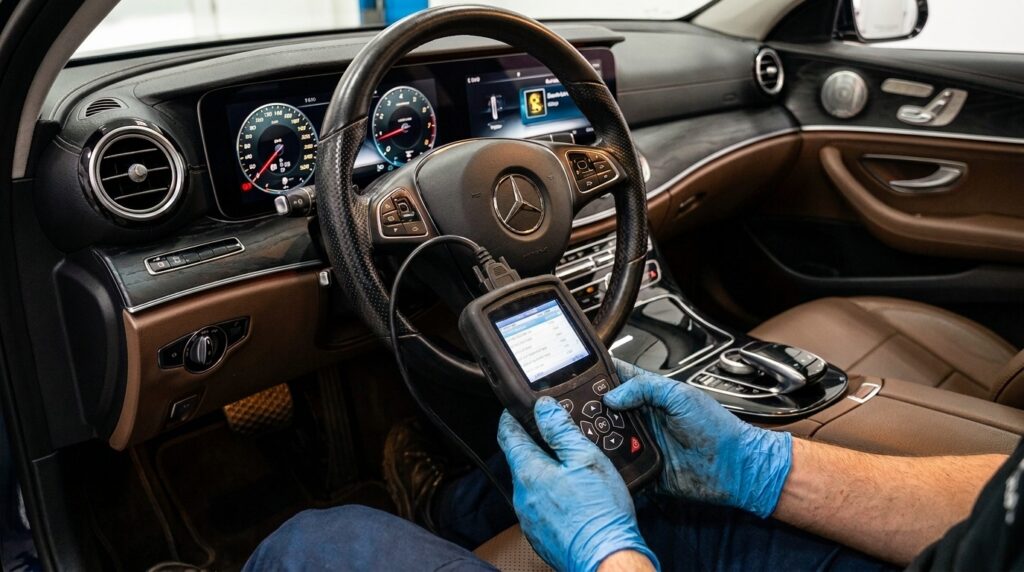
That’s when she stopped trusting the dealership and took the car to Chrome Rose Automotive, an independent shop she had used for years. The technician there, Joseph Angouand, hooked the car up to a diagnostic scanner called an Autel. It reads the mileage stored in a car’s internal computers, not just the number on the dashboard.
The dashboard showed about 39,000 miles. The internal computer showed roughly 114,688 kilometers, which works out to about 71,000 miles. That’s a gap of more than 30,000 miles between what the car claimed and what its own electronics remembered.
This is where odometer fraud law comes in. Rolling back or misrepresenting a car’s mileage violates the federal Odometer Act, and Florida treats altering a vehicle’s odometer as a deceptive trade practice as well. It’s a similar pattern to hidden defects seen in cases like the Ford F-150 oil consumption lawsuit, where owners only learned about a known problem after their purchase was already final.
A second independent mechanic, at a different shop, found something worse a few months later. The right front suspension was worn out badly enough that the car wasn’t safe to drive. Muratori had to sign a release just so the shop would hand the car back to her. From then on, she parked it and bought a second car, a Mini, for about $12,000, just to get around.
Arbitration: What It Is and Why This Case Went There
Muratori’s purchase contract had an arbitration clause in it. Most dealership sales contracts do. That clause meant any dispute had to go in front of a private arbitrator instead of a judge and jury in open court.
Arbitration works a bit like a private trial. Both sides present evidence and testimony to a neutral arbitrator, who then issues a binding decision. It’s often faster than a courtroom lawsuit, and that speed is usually the reason dealerships include the clause in the first place.
In December 2023, Muratori’s first attorney sent formal demand letters to the dealership, including one required under Florida’s consumer protection law. The dealership never responded to any of them. She filed for arbitration herself in February 2024, then hired attorney Eduardo Ayala, who represented her through the rest of the case.
Inside the Arbitrator’s Ruling
The hearing took place over two days, April 24 and 25, 2025, in front of arbitrator Marc S. Dobin through the American Arbitration Association. Both sides had lawyers and called witnesses. You can actually read the arbitrator’s full written decision, since Ayala’s law firm posted the interim award online.
The dealership could not produce the completed CPO inspection checklist for Muratori’s car. Its own former general manager testified that printing and keeping that document was standard practice. Nobody could explain why it no longer existed, in paper or digital form.
The dealership also never used its own Xentry diagnostic tool, the one built specifically to verify a Mercedes-Benz’s true internal mileage, at any point before or after the sale. A witness for the dealership admitted the check would have taken about fifteen minutes and cost nothing but labor.
Based on that record, the arbitrator found the dealership violated three separate parts of Florida’s Deceptive and Unfair Trade Practices Act, Fla. Stat. 501.976, the state law that spells out what a dealer isn’t allowed to misrepresent about a used car. The ruling found the dealer misrepresented the car’s prior use and status, misrepresented its condition, and misrepresented that it had no meaningful body damage. The arbitrator also found the dealership breached its express warranty and committed fraud in the inducement over the CPO claim specifically, though not over the odometer issue alone, since there wasn’t enough evidence the dealership actually knew about that discrepancy at the time of sale.
The Dollar Amounts, Explained
Muratori’s award actually breaks into two separate pieces, something most coverage of this case skips over.
The arbitrator awarded her $14,254.62 in FDUTPA damages. That figure covers the extra products she bought because she believed the car was properly certified: the extended warranty, prepaid maintenance, and protection packages. None of that money would have been spent if the CPO claim had been accurate.
On top of that, the arbitrator ordered $51,971.82 in what’s called rescission damages, essentially unwinding the purchase and returning most of what she had paid, minus a deduction for the time she had already used the car. Add those two figures together and you get a little more than $66,000, which is where the number reported in the news comes from.
The award also included something easy to miss. It grew by $901.54, her monthly loan payment, for every month that passed after April 25, 2025 until the dealership actually took the car back. In other words, the longer the dealership dragged its feet, the more it owed her.
Why Winning Still Cost Her Money
Here’s the part that turns this from a news story into a genuine lesson. Muratori estimated she spent around $17,000 in attorney’s fees that she can never get back, on top of the cost of the second car she had to buy.
Her attorney, Eduardo Ayala, put it plainly to CBS News Miami: “Even if you have resources, the way arbitration law is, the way contract law is in Florida. If you have a small case, you pretty much have no case.” That’s not a complaint about her result specifically. It’s a comment on how the math works for anyone with a claim that isn’t large enough to make a legal fight clearly worth it.
The same math shows up outside car disputes too. Anyone weighing whether to pursue a claim, whether it’s a defective product or a personal injury case, runs into the same basic question. Does the potential recovery justify what it will cost, in time and money, to get there? Muratori had the resources to see her case through. As she told CBS News Miami herself, “Other people may not have that luxury.”
The Fight to Collect
Winning the arbitration in May 2025 turned out to be only half the battle. The dealership refused to comply and appealed to the American Arbitration Association, which denied the appeal outright.
Still unpaid, Muratori had to go to court just to enforce a ruling she had already won. The dealership argued the arbitrator had been biased against it. A judge reviewed the record, found no evidence to support that claim, and upheld the original award exactly as written.
Even after the court ruling, getting the dealership to actually act took more pressure and more time. It wasn’t until April 2026, roughly three and a half years after her original purchase, that a tow truck finally came to take the Mercedes away. It had not moved in 25 months. Muratori filmed the moment herself. AutoNation later told CBS News Miami only that it had “fulfilled our obligations following the court’s decision,” without explaining the delay. Mercedes-Benz USA, the manufacturer, declined to comment on the case at all, since it wasn’t the seller and doesn’t run individual dealership inspections.
Myth vs. Fact
Myth 1: A certified pre-owned label always means the car passed a real inspection.
Fact: A CPO label only means what the manufacturer’s paperwork says it means, and that paperwork has to actually exist and be signed. Muratori’s case shows a dealership can advertise a car as certified without being able to prove the inspection ever happened.
Myth 2: If you win in arbitration, you get paid right away.
Fact: An arbitration award is a legal ruling, not an automatic payment. If the losing side refuses to comply, the winning side may still have to go to court just to enforce it, exactly as Muratori did.
What This Means If You’re Buying a Used or CPO Car
Say you’re standing on a dealership lot right now, looking at a certified pre-owned car with a great price and a clean-looking Carfax. What should you actually do differently because of this case?
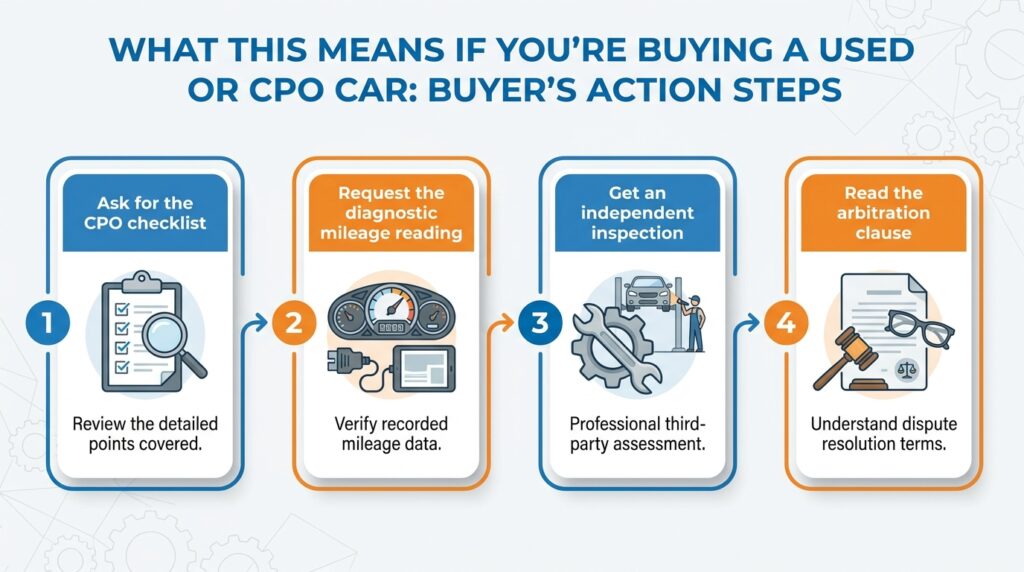
Ask to see the completed CPO inspection checklist before you sign anything, not after. If the dealer can’t produce it on the spot, that’s the exact gap that sank Mercedes-Benz of Fort Lauderdale’s defense.
Request the manufacturer’s own diagnostic mileage reading, not just the number on the dashboard. Most franchise dealerships have the tool to pull this in minutes, and a reputable dealer won’t hesitate to do it.
Get an independent inspection from a mechanic who has no relationship with the seller, before you buy and again if anything ever feels off afterward. Muratori’s most serious findings only came to light because she went outside the dealership both times.
Read the arbitration clause in your purchase contract before you sign it. Knowing upfront that a dispute would go to a private arbitrator, not a courtroom, changes what your options look like if something goes wrong later.
Pull a vehicle history report before you sign, and treat it as a starting point rather than the final word. A clean report didn’t catch the odometer mismatch in this case, since that discrepancy only showed up once someone connected a scanner directly to the car’s own computer.
If you ever suspect a car’s mileage has been altered, you can report it to Florida’s Department of Highway Safety and Motor Vehicles, the Florida Attorney General’s Office, or the FTC, which also enforces the federal rule requiring dealers to post a Buyers Guide on every used car they sell.
If you’re worried about picking the wrong lawyer for a dispute like this, it helps to know the signs of a bad attorney before you sign a retainer, not after months have already gone by.
Frequently Asked Questions
1. Who is Kim Muratori?
Ans: Kim Muratori is a Florida consumer who bought a certified pre-owned 2018 Mercedes-Benz E-400 from Mercedes-Benz of Fort Lauderdale, then discovered a zip-tied bumper and a mismatched odometer reading after the sale.
2. How much did Kim Muratori win in her Mercedes-Benz lawsuit?
Ans: An arbitrator awarded her a combined total of more than $66,000, made up of $14,254.62 in FDUTPA damages and $51,971.82 in rescission damages for unwinding the purchase.
3. What is FDUTPA?
Ans: FDUTPA is the Florida Deceptive and Unfair Trade Practices Act, the state law that bans dealers from misrepresenting a used car’s history, condition, or prior damage.
4. Did Mercedes-Benz USA get sued in this case?
Ans: No. The case was against the independently operated dealership, Mercedes-Benz of Fort Lauderdale, not the manufacturer, and Mercedes-Benz USA declined to comment when asked about it.
5. Why did it take so long for Kim Muratori to get paid?
Ans: Winning the arbitration in 2025 was only the first step. The dealership appealed and then challenged the award in court, and it took a judge’s ruling before the dealership finally complied in 2026.
6. What is a certified pre-owned inspection checklist?
Ans: It’s the signed document a manufacturer requires dealers to complete and keep on file, proving a used car passed every required item on the certification program’s inspection list.
7. Is odometer rollback illegal in Florida?
Ans: Yes. Altering a vehicle’s odometer violates both the federal Odometer Act and Florida’s deceptive trade practices law for vehicle dealers.
8. Does Florida’s lemon law cover used cars like this one?
Ans: Generally no. Florida’s lemon law mainly covers new vehicles with defects found within 24 months of the first owner taking delivery, so a used car this old typically falls outside it.
9. What happens if a car dealership refuses to pay an arbitration award?
Ans: The winning party can ask a court to confirm and enforce the award, which is what Muratori had to do after the dealership refused to comply on its own.
10. Is arbitration better than suing in court?
Ans: It depends on the case. Arbitration is often faster and more private, but enforcing an award you’ve already won can still require going to court, as this case shows.
Conclusion
Muratori did nearly everything right. She kept records, got independent opinions, hired a lawyer, and won her case on the merits. It still took more than three years and left her thousands of dollars poorer.
That’s the real lesson here. Winning a consumer case and getting made whole are two different things, and the gap between them is wide enough that plenty of people give up before they ever get a ruling. If you’re dealing with a car, or any purchase, that doesn’t match what you were promised, don’t wait as long as this dealership hoped Muratori would.
Not sure whether you need an attorney or a lawyer for a dispute like this? The terms often get used interchangeably, but knowing the difference between an attorney and a lawyer can help you ask the right questions before you hire anyone. Whoever you choose, talk to someone licensed in your state early, while your options are still wide open.
This article provides general information only and is not legal advice. Laws vary by state and change over time. Do not rely on this content as a substitute for advice from a qualified, licensed attorney in your jurisdiction. For guidance on your specific situation, consult a licensed attorney directly.

Dirk Wasserthal is the Founder and Lead Writer of LegalDiaries.com, an independent legal information platform. He specializes in Mass Torts, Women’s Rights, and emerging legal issues, delivering clear, well-researched, and trustworthy content across Criminal Law, Family Law, Personal Injury, and more. Dirk’s mission is simple — make the law understandable for everyone.