


The Rhode Island voter data lawsuit ended in April 2026, when a federal judge threw out the Department of Justice’s demand for the state’s private voter file. Rhode Island never had to hand over the sensitive data the DOJ was asking for. This case matters because it touches on how much personal information the federal government can demand from a state, and what protections exist for your voter registration details.
- What Is the Rhode Island Voter Data Lawsuit?
- A Quick Timeline: How We Got Here
- Who’s Involved in United States v. Amore
- Why Did the DOJ Want Rhode Island’s Voter Data?
- What the National Voter Registration Act Actually Requires
- What the Help America Vote Act Actually Requires
- The Civil Rights Act of 1960 Angle
- What “Unredacted Voter File” Actually Means
- Why the Judge Dismissed the Case
- Rhode Island Isn’t Alone: The National Pattern
- What This Means If You’re a Registered Voter in Rhode Island
- Can the DOJ Appeal or Try Again?
- Myth vs Fact: Rhode Island Voter Data Lawsuit
- Frequently Asked Questions
- Conclusion
If you are a registered voter in Rhode Island, or you just want to understand what this fight was really about, here is the full story from start to finish.
What Is the Rhode Island Voter Data Lawsuit?
The Department of Justice sued Rhode Island in December 2025, demanding the state’s complete, unredacted voter file, including driver’s license numbers and partial Social Security numbers. In April 2026, U.S. District Judge Mary McElroy dismissed the case, ruling that the DOJ had no legal right to that data and calling the request a “fishing expedition.” Rhode Island’s voter information stayed protected.
That is the short version. Now let’s slow down and walk through it step by step.
A Quick Timeline: How We Got Here
Court cases can feel like a tangle of dates and filings. Here is the story laid out simply, so you can see how one letter turned into a full federal lawsuit.
- September 2025: The DOJ sent Rhode Island Secretary of State Gregg Amore a letter asking for the state’s entire voter registration file, unredacted. Amore offered the public version of the list but declined to hand over private fields like Social Security numbers.
- December 2, 2025: The DOJ filed suit against Rhode Island in federal court. The same week, it sued several other states, including Vermont, Maryland, and Washington, over the same kind of request.
- January 6, 2026: The court allowed several groups, including the ACLU and Common Cause, to formally join the case to help defend Rhode Island’s position.
- March 26, 2026: The court held a hearing where a DOJ attorney explained the government’s reasoning for wanting the data.
- April 17, 2026: Judge McElroy dismissed the lawsuit in a 14-page decision. Rhode Island’s private voter data stayed exactly where it was.
Think of it like a landlord asking a tenant for a copy of their driver’s license just to confirm they still live in the building, then instead demanding their bank statements, medical records, and old tax returns too. The request went far beyond what was actually needed.
Who’s Involved in United States v. Amore
The lawsuit’s official name is United States v. Amore, filed in the U.S. District Court for the District of Rhode Island. You can view the full case docket, 1:25-cv-00639, on CourtListener if you want to read the filings yourself. Knowing who the players are helps the rest of the story make sense.
The Justice Department’s Side
The DOJ argued it needed Rhode Island’s full voter file to check whether the state was properly maintaining accurate voter rolls. Eric Neff, the acting chief of the DOJ’s Voting Section, represented the government’s position at the March hearing.
Rhode Island’s Side
Secretary of State Gregg Amore, a Democrat, was the named defendant, since his office runs the state’s voter rolls. Rhode Island Attorney General Peter Neronha defended Amore in court and did not hold back afterward, saying the DOJ had been “compromised” by political pressure and had stopped acting independently.
The Judge
Judge Mary S. McElroy decided the case. She was appointed to the bench by President Trump during his first term. That detail matters here, because it undercuts any argument that the ruling was simply partisan.
Who Else Joined the Case
The court let several outside groups formally join Rhode Island’s defense, including the ACLU, the ACLU of Rhode Island, Common Cause, three individual Rhode Island voters, SEIU District 1199NE, and the Rhode Island Alliance for Retired Americans. Common Cause’s Rhode Island director, John Marion, called the outcome “a massive victory for voter privacy.”
Why Did the DOJ Want Rhode Island’s Voter Data?
The DOJ leaned on three different federal laws to justify its request. None of them are as complicated as they sound.
What the National Voter Registration Act Actually Requires
The National Voter Registration Act (NVRA) of 1993 is often called the “motor voter” law, because it lets people register to vote when they get a driver’s license. It also requires states to keep their voter rolls reasonably accurate, for example by removing voters who have died or moved away. You can read the official DOJ summary of the NVRA for the full legal text.
What the Help America Vote Act Actually Requires
The Help America Vote Act (HAVA), passed in 2002, set minimum standards for how states run elections and maintain voter registration systems. The DOJ pointed to this law too, arguing it needed the data to check compliance. The DOJ’s own HAVA page explains what the law actually covers.
The Civil Rights Act of 1960 Angle
The DOJ’s main legal hook was actually a provision of the Civil Rights Act of 1960, a law originally written to help the federal government detect racial discrimination in voting. The judge noted that while the law is not limited only to discrimination cases, the DOJ still had to give a real, factual reason for demanding the records. It never did.
The DOJ’s push actually traces back further than the September 2025 letter. In March 2025, the Trump administration issued an executive order focused on election integrity, and the DOJ’s voter data requests to Rhode Island and dozens of other states grew out of that broader directive.
A common mistake people make here is assuming “voter list maintenance” means the same thing as “investigating voter fraud.” It doesn’t. List maintenance is routine administrative housekeeping, like removing a voter who passed away. Nothing in this case involved a fraud finding.
What “Unredacted Voter File” Actually Means
This phrase gets thrown around a lot, so let’s break it down. Rhode Island already publishes a public voter list that candidates, campaigns, and researchers can request. That version leaves out sensitive personal fields.
The DOJ wanted the unredacted version instead, meaning the full file with nothing blacked out. Specifically, that included:
- Full names and dates of birth
- Home addresses
- Driver’s license numbers
- The last four digits of Social Security numbers
That last item is the one that raised the most alarm. Partial Social Security numbers, combined with a name and birthdate, are exactly the kind of information identity thieves look for. Whether a voter file counts as public or private, and which fields get redacted, varies state to state, so always check your own state’s specific rules if this comes up outside Rhode Island.
Why the Judge Dismissed the Case
Judge McElroy’s ruling came down to one core problem: the DOJ never explained why it actually needed all that private data.
What “Fishing Expedition” Actually Means
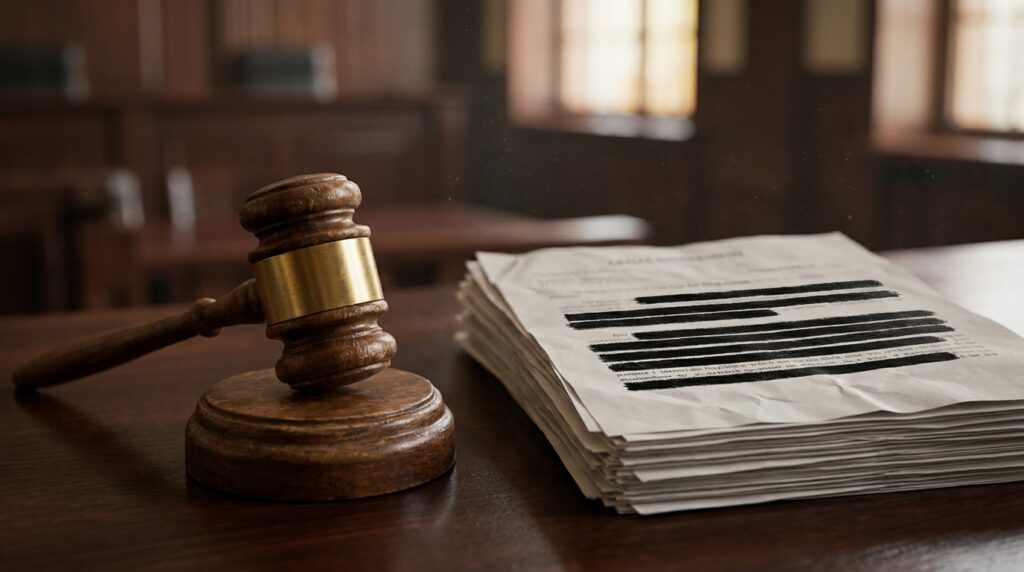
You’ve probably heard the phrase “fishing expedition” before. In legal terms, it means asking a court to let you go digging through someone’s private records without first showing a real, specific reason to believe you’ll find something relevant. It’s the difference between a detective following an actual lead and a detective rummaging through every drawer in your house just in case something interesting turns up.
That’s essentially what Judge McElroy found here. She wrote that federal law does not let the DOJ “conduct the kind of fishing expedition it seeks here,” and she pointed out that the DOJ never offered evidence that Rhode Island was doing anything wrong. This lines up with how other courts have treated cases built on weak or missing factual grounds, which our breakdown of what happens in a class action lawsuit with no proof explains in more detail.
What Rhode Island Already Does to Keep Voter Rolls Accurate
Part of the ruling leaned on the fact that Rhode Island already has its own system for this. Under Rhode Island law, voter records update automatically whenever someone changes their address with the DMV. Local election boards also mail confirmation forms to voters and remove anyone whose mail comes back undeliverable, and the state runs annual verification mailings to catch outdated registrations. In short, Rhode Island was already doing the work the DOJ claimed it needed to check on.
Rhode Island Isn’t Alone: The National Pattern
Rhode Island was just one front in a much bigger fight. The DOJ sent similar requests to nearly every state and eventually sued about 30 states, plus Washington, D.C., after they refused to hand over unredacted voter data.
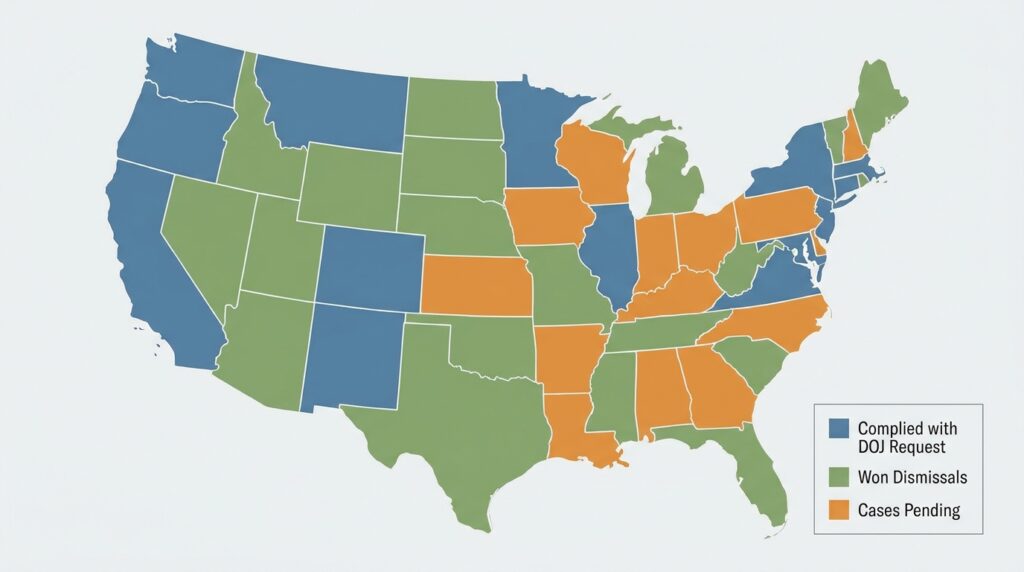
Some states did comply. According to voter data tracking by the Brennan Center for Justice, a number of states, including Texas, Ohio, Indiana, and Tennessee, provided or promised to provide their detailed voter files. Other states fought back in court and won, including California, Oregon, Michigan, and Massachusetts, whose case was dismissed just a week before Rhode Island’s, on April 10, 2026. A Georgia case was dismissed on a technicality over which court it was filed in, and the DOJ simply refiled it elsewhere.
Rhode Island’s win was the DOJ’s fifth court loss in this campaign, and it affected the state’s roughly 750,000 registered voters, all of whom kept their sensitive registration details out of federal hands.
Rhode Island’s case is part of a broader wave of DOJ efforts to compel disclosure of sensitive records from institutions, a pattern also seen in the Homeland Security student visa lawsuit, and it fits a larger thread of Trump administration litigation covered in our piece on the White House ballroom lawsuit. If you want to see how nearly the same legal fight played out somewhere else, our coverage of the Arizona voter data lawsuit dismissal walks through a very similar outcome in a different state.
What This Means If You’re a Registered Voter in Rhode Island
Here’s the part most news coverage skips. If you’re registered to vote in Rhode Island, this ruling is good news for you directly.
Your driver’s license number and partial Social Security number were never turned over to the federal government through this case. The public voter list, the one that just shows your name, address, and voting history, was always available to campaigns and researchers. That part didn’t change.
Say you’re a Rhode Island voter who got a suspicious call or email claiming to be about “voter data verification” after seeing this story in the news. That’s worth treating with caution. This lawsuit never resulted in any new outreach program to individual voters, so anyone contacting you claiming otherwise should be treated as a possible scam.
If you’re still concerned about your registration information, you can always confirm what’s on file by contacting your local board of canvassers or the Rhode Island Secretary of State’s office directly.
Can the DOJ Appeal or Try Again?
Yes, the DOJ generally has the right to appeal a dismissal like this one to the First Circuit Court of Appeals. As of this writing, similar DOJ losses in other states have led to appeals in some circuits, and the legal fight over these voter data demands is still active nationally even though Rhode Island’s individual case is closed.
That said, an appeal doesn’t undo the dismissal right away. Rhode Island’s voter data protections stay in place unless and until a higher court rules otherwise, which has not happened in this case.
Myth vs Fact: Rhode Island Voter Data Lawsuit
Myth 1: Rhode Island refused to cooperate with the DOJ at all.
Fact: Rhode Island offered the DOJ its publicly available voter list from the very beginning. The state only refused to hand over private fields like Social Security numbers and driver’s license numbers.
Myth 2: This ruling proves there was voter fraud in Rhode Island.
Fact: The case never involved any fraud finding. The judge dismissed it because the DOJ failed to show any factual basis for its request, not because fraud was uncovered or ruled out.
Myth 3: My personal voter data is now sitting in a federal database.
Fact: Because the lawsuit was dismissed, Rhode Island’s unredacted voter file was never handed over. Your sensitive information, like your driver’s license number or Social Security digits, was not transferred to the DOJ through this case.
Myth 4: Rhode Island is the only state this happened to.
Fact: The DOJ sent similar demands to nearly every state and sued roughly 30 states plus Washington, D.C. Rhode Island’s outcome mirrors dismissals in California, Massachusetts, Michigan, and Oregon.
Frequently Asked Questions
1. What is the Rhode Island voter data lawsuit about?
Ans: The DOJ sued Rhode Island demanding its complete, unredacted voter file. A federal judge dismissed the case in April 2026, ruling the DOJ had no legal basis for the request.
2. Did Rhode Island win the voter data lawsuit against the DOJ?
Ans: Yes. Judge Mary McElroy dismissed the DOJ’s lawsuit and denied its request to force Secretary of State Gregg Amore to hand over the data.
3. Why did the DOJ want Rhode Island’s voter data?
Ans: The DOJ claimed it needed the data to check Rhode Island’s compliance with federal voter list maintenance laws, but never provided evidence that the state was out of compliance.
4. What is a fishing expedition in a lawsuit?
Ans: It’s a request to dig through private records without a specific, factual reason to believe relevant information will be found there. Judge McElroy used this exact phrase to describe the DOJ’s request.
5. What is the National Voter Registration Act (NVRA)?
Ans: It’s a 1993 federal law, often called the “motor voter” law, that lets people register to vote through DMV visits and requires states to keep voter rolls reasonably accurate.
6. What is the Help America Vote Act (HAVA)?
Ans: HAVA is a 2002 federal law that set minimum standards for how states administer elections and maintain voter registration systems.
7. Which states gave the DOJ their voter data?
Ans: Several states provided or promised their detailed voter files, including Texas, Ohio, Indiana, Tennessee, and a handful of others, according to Brennan Center tracking.
8. Is my voter registration information private in Rhode Island?
Ans: Rhode Island keeps sensitive fields like Social Security numbers and driver’s license numbers private, while basic information like your name and voting history appears on the public voter list.
9. Can the DOJ appeal the Rhode Island voter data ruling?
Ans: Yes, the DOJ can appeal to the First Circuit Court of Appeals, though no appeal has changed the outcome of Rhode Island’s case as of this writing.
Conclusion
The Rhode Island voter data lawsuit came down to a simple legal principle: the government can’t demand your private records just because it wants them. It needs an actual reason. The DOJ never gave the court one, and Judge McElroy said so plainly.
For Rhode Island voters, the practical outcome is straightforward. Your sensitive registration data stayed protected, and the state’s existing safeguards were found to already be doing their job. If you have specific concerns about your own voter record or your data privacy rights, it’s worth reaching out to a licensed attorney who can look at your exact situation.
This article provides general information only and is not legal advice. Laws vary by state and change over time. Do not rely on this content as a substitute for advice from a qualified, licensed attorney in your jurisdiction. For guidance on your specific situation, consult a licensed attorney directly.

Dirk Wasserthal is the Founder and Lead Writer of LegalDiaries.com, an independent legal information platform. He specializes in Mass Torts, Women’s Rights, and emerging legal issues, delivering clear, well-researched, and trustworthy content across Criminal Law, Family Law, Personal Injury, and more. Dirk’s mission is simple — make the law understandable for everyone.