




The United Airlines Yihsing Tien lawsuit is the story of a flight attendant who got hurt at work, lost her job, sued, and lost the case, and then got handed a bill for it. Not a bill from a hospital. A bill from the company that beat her in court.
- Who Is Yihsing Tien?
- The 2018 Injury During a Crew Layover
- The Medical Leave Letter and the Date That Did Not Match
- Was Yihsing Tien Fired After Her Injury?
- The Lawsuit: Tien v. United Airlines, Inc.
- Is Yihsing Tien’s Case Still Going On?
- The $22,000 Bill: What Taxation of Costs Actually Means
- The 0.000037 Percent Argument
- How Much Does Yihsing Tien Actually Owe United Airlines Right Now?
- Disability Discrimination vs. Workers’ Compensation: Why This Was Not a Comp Claim
- What This Case Means for Other Employees
- Myth vs. Fact: Do You Owe Money If You Lose a Lawsuit?
- Frequently Asked Questions
- Key Takeaways
Here is the short version. Yihsing Tien sued United Airlines for disability discrimination after the company fired her following a serious injury. She lost. United then asked a federal court to make her personally pay $21,926.34 in legal costs. This matters because it is not a rare event. It is how federal litigation actually works, and it is a risk almost nobody warns you about before you sue a big employer.
If you are dealing with something similar, or you just want to understand what happened to Tien, let us walk through it together.
Who Is Yihsing Tien?
Yihsing Tien also goes by “Angela” Tien in court records. You will see both names if you look up the case yourself.
She joined United Airlines as a flight attendant in 2013. She worked out of Chicago, where United has one of its biggest hubs. For years, she was what her court filings call a high performing crew member, with no disciplinary record and no red flags.
Think about that for a moment. This was not someone who had been struggling on the job. She built almost a decade with the company before anything went wrong.
Then, in 2018, everything changed.
The 2018 Injury During a Crew Layover
On October 30, 2018, Tien was on a work trip. She fell at the hotel where her flight crew was staying overnight, in what airlines call a “crew layover.”
Here is something worth understanding if you are not in the airline industry. A crew layover counts as work time. Flight attendants do not clock out just because they are at a hotel instead of on a plane. The airline picked the hotel, and the stay is part of the job. So when Tien got hurt there, it was not some random personal accident. It happened during her employment.
And the injuries were serious. Her court filings describe damage to both knees, her left elbow, her left shoulder, and her wrist. She needed surgery, and she went on medical leave to recover.
A quick real world comparison: imagine you are a traveling sales representative, and you slip on ice in the parking lot of a hotel your company booked for you on a business trip. You would expect that to be treated as a workplace injury, not something you just have to sort out on your own. That is the same logic that applies to a flight attendant hurt during a layover.

The Medical Leave Letter and the Date That Did Not Match
This is where the case gets complicated, and honestly, where it gets kind of maddening.
In January 2019, Tien says she received a letter from United’s supervisor of in flight services. The letter told her she could stay on approved medical leave through January 25, 2023. She held onto that date, and she planned her recovery around it.
But United’s flight attendant contract, the collective bargaining agreement negotiated by the union, caps medical leave at three years. Three years from her October 2018 injury put the real deadline at January 25, 2022, a full year earlier than what her letter said.
Tien says United never reached out during her leave. No check in. No call to talk about coming back to work. Nothing. The first time she heard from the company again, she says, was a termination letter, right around that January 2022 date.
She appealed internally. Her argument was simple. If she had known the real deadline was 2022, she could have tried to return, or asked for accommodations that would let her come back sooner. United denied the appeal. Its position was that she should have calculated her own three year deadline, regardless of what the letter said.
Picture this scenario: you get a letter from your mortgage company telling you your grace period runs through next March. You plan your finances around that. Then, this coming January, you get foreclosed on, because the actual deadline, buried in your original loan contract, was this January all along, and nobody ever corrected the letter. That is roughly the dynamic Tien says played out here.
Was Yihsing Tien Fired After Her Injury?
Yes. United terminated Tien in January 2022, saying she failed to return from medical leave within the three year limit set by her employment contract. Tien says she believed her deadline was 2023, based on a letter United sent her, and that the airline never corrected the error or reached out before firing her.
That is the center of everything that followed. Was the wrong date an honest paperwork mistake? Or, as Tien argues, was it the excuse United used to get rid of an employee it no longer wanted to deal with?
The Lawsuit: Tien v. United Airlines, Inc.
In 2023, Tien sued United Airlines in the U.S. District Court for the Northern District of California. The case is officially titled Tien aka Angela Tien v. United Airlines, Inc., et al., case number 4:23-cv-02622-JSW. (Note: this case number is the court’s own official citation format and keeps its original hyphens, since altering a docket number would misstate the actual case identifier.) It landed in front of Judge Jeffrey White, with discovery disputes handled by Magistrate Judge Thomas S. Hixson. According to the public case docket, Tien is represented by Shabbar Law, a firm based in Sacramento, while United’s defense is handled by Reed Smith LLP out of San Francisco, the kind of large, experienced firm you would expect a major airline to bring in for a case like this.
Her second amended complaint, filed in October 2023, laid out nine separate causes of action. The core claims were:
- Disability discrimination, meaning that United fired her because of a disability connected to her 2018 injuries.
- Retaliation, meaning that she was punished for taking protected medical leave or raising concerns.
- Wrongful termination, meaning that the firing violated the terms of her employment.
To win a disability discrimination case like this, a plaintiff generally has to clear a specific legal bar. The EEOC’s own guidance on disability discrimination lays out the basic protections. Title I of the Americans with Disabilities Act bars covered employers from discriminating against qualified employees because of a disability, and it separately makes it unlawful to retaliate against someone for asserting those rights. In practice, that means a plaintiff has to show the employer knew about the disability, that reasonable accommodations were realistically considered, and that the timing of the firing lines up with the disability, rather than some unrelated, legitimate business reason.
That is a high bar. And a company the size of United has the legal resources to fight every piece of it, hard.
Worth noting if you are in California: state law adds another layer on top of the federal ADA. California’s own Fair Employment and Housing Act, known as FEHA, offers overlapping, and in some ways broader, protections against disability discrimination at the state level. Tien’s case moved through federal court, but employees in California dealing with a similar situation often have both federal and state avenues to consider.

Is Yihsing Tien’s Case Still Going On?
Mostly, no, but part of it continues. On February 2, 2026, the court dismissed Tien’s discrimination and retaliation claims. She is now appealing that dismissal to the Ninth Circuit. Separately, a fight over legal costs tied to the same case is still being actively litigated as of mid 2026.
Here is the detail almost nobody covering this story mentions clearly. Tien did not lose because her whole case was thrown out as baseless. According to her attorneys’ own filings, five of her original nine causes of action survived United’s motion to dismiss, meaning the court found those claims legally viable enough to move forward to the next stage. She lost later, on the merits, largely because United’s reliance on the collective bargaining agreement’s three year leave cap turned out to be legally decisive in a close, contested record.
That distinction matters. Losing a case is not the same thing as filing a frivolous one. Courts throw out weak claims early, before they even reach discovery. Tien’s claims made it much further than that.
She is now pursuing a separate appeal at the U.S. Court of Appeals for the Ninth Circuit, asking that court to review whether the district court got the underlying dismissal right.
The $22,000 Bill: What Taxation of Costs Actually Means
Once United won at the district court, it did something federal rules specifically allow a winning party to do. It asked the court to make Tien pay back part of what the lawsuit cost the airline to defend. That process has a formal name: taxation of costs.
Here is the plain English version, because almost nobody explains this well. Under 28 U.S.C. § 1920, a judge or clerk of any court of the United States may tax as costs a specific, limited list of expenses, such as court reporter fees, fees for copies and exhibits necessarily obtained for use in the case, and docket fees. It is not the same as attorneys’ hourly billing. It is a narrower category, and a bill of costs has to be filed and reviewed before it becomes part of the judgment.
Most people assume that if you lose a lawsuit against your employer, the worst that happens is you walk away with nothing. That is not always true. If your case does not hold up, the company you sued can, in many cases, come after you for a slice of what the fight cost them.
United’s bill came to $21,926.34, the exact figure behind the rounded “$22,000” headline you have probably seen.
Real world comparison: imagine losing a small claims dispute over a $2,000 security deposit, and then getting billed $400 in court reporter and filing fees on top of it, even though you never paid your landlord’s lawyer directly. Taxation of costs works on the same basic principle, just at federal court scale.
The 0.000037 Percent Argument
Tien’s legal team did not argue that cost awards are illegal. They argued this particular one should be reduced, because of how lopsided the numbers are.
In their objection, her attorneys pointed out that United Airlines reported $59.1 billion in operating revenue in fiscal year 2025. Then they laid out the comparison plainly. The $21,926.34 United wanted represents roughly 0.000037 percent of that revenue, which they described in their own words as the financial equivalent of a rounding error to a corporation of this scale.
By contrast, according to statements in the filings, that same dollar figure was described as more than twice Tien’s total income from all sources over the past year, and paying it would reportedly require liquidating investment holdings she depends on. It is worth flagging clearly that those specific financial details about Tien’s personal situation come from statements in her attorneys’ court filings, and not from independently verified records. Treat them as her legal team’s characterization, not as confirmed fact.
That gap, a rounding error for one side and a real financial hit for the other, is exactly the kind of comparison courts are allowed to weigh when deciding whether to reduce a cost award.
How Much Does Yihsing Tien Actually Owe United Airlines Right Now?
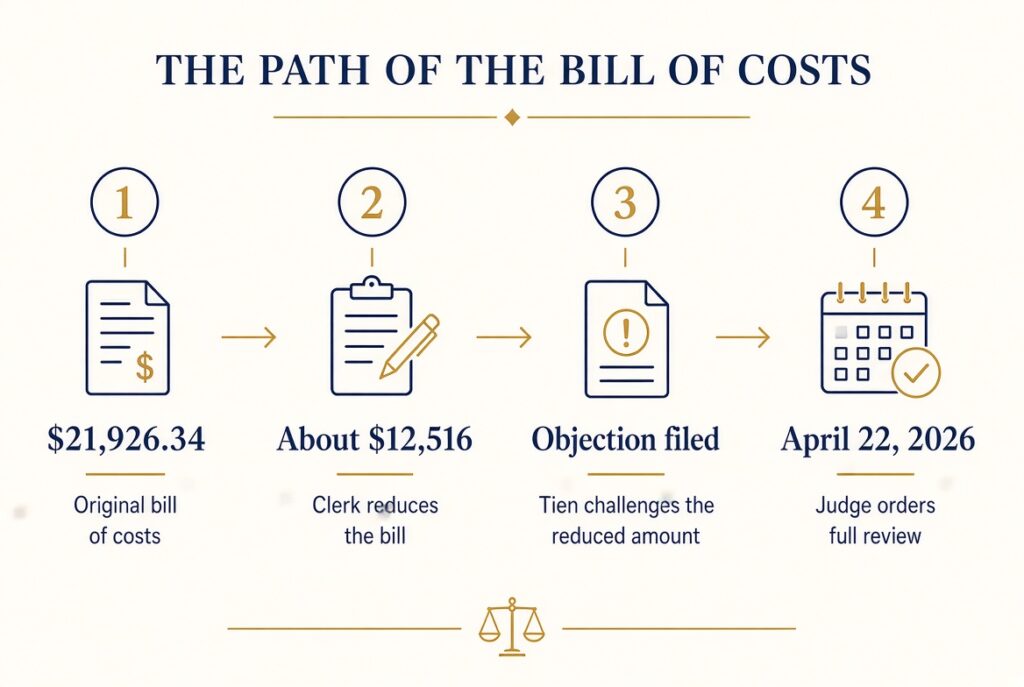
The original request was $21,926.34. A court clerk reduced that to approximately $12,516. Tien challenged even the lower figure, and on April 22, 2026, Judge Jeffrey White granted her request for a full review of the cost order, meaning the final amount she owes, if any, has not yet been decided.
Here is how that played out, step by step.
- The clerk’s first review. A court clerk typically reviews a bill of costs line by line before it becomes final. In Tien’s case, the clerk trimmed the original request down to roughly $12,516.
- Tien’s continued objection. She went back to the court, arguing that even the lower figure would cause serious financial hardship given her circumstances.
- Judge White’s order for full review. On April 22, 2026, Judge White agreed to fully reconsider the cost order, an uncommon move, since most reduced cost awards simply stand once a clerk signs off. According to reporting on the order, he cited Tien’s limited financial means, the public interest reflected in the underlying civil rights issues, and the risk that a large cost award could discourage other people from bringing similar cases.
- The pending briefing schedule. As of this writing, Tien’s supporting brief and United’s response were both scheduled for mid 2026, meaning the actual final number is still unsettled.
That last point is worth sitting with. A judge specifically acknowledging that a cost award could discourage other workers from filing legitimate discrimination claims is not something that happens often in a written order. It is one of the more candid moments in this entire case.
Disability Discrimination vs. Workers’ Compensation: Why This Was Not a Comp Claim
If you are researching this case because something similar happened to you, this distinction matters a lot.
Workers’ compensation is generally a no fault system. If you are hurt on the job, you are usually entitled to medical coverage and partial wage replacement, regardless of who caused the accident, but in exchange, you typically give up the right to sue your employer over the injury itself. The USA.gov overview of workers’ compensation explains it as coverage for job related injury or illness, administered mostly at the state level for private sector employees.
Disability discrimination law is a completely different track. It does not ask who caused your injury. It asks whether your employer treated you unfairly because of a disability you already had, including firing you instead of talking through leave options, accommodations, or a realistic path back to work.
Tien’s lawsuit was never about who was at fault for the fall at the hotel. It was about what United allegedly did, or did not do, after she was already hurt and trying to recover. Those are two separate legal questions, and depending on your situation, you may have rights under both systems at the same time.
A quick example to make this concrete: say you break your wrist at work. Workers’ comp covers your medical bills and part of your lost wages while you heal. That is the no fault side. Separately, if your employer fires you the moment you ask for a modified schedule to accommodate that wrist, that firing could raise a completely different, fault based discrimination claim. One does not cancel out the other.
If you are trying to figure out whether an injury on the job might support its own legal claim, it helps to understand what actually affects the odds of winning a personal injury lawsuit before deciding how to move forward. The calculus is different from a discrimination case, and conflating the two can cost you time you do not have.
What This Case Means for Other Employees
Whatever happens with Tien’s appeal, this case has already become a talking point in employment law circles, for a reason that has nothing to do with who is right on the underlying facts. It is a real, documented example of how expensive it can be to lose, even when you had a good faith basis for filing in the first place.
Large employers, airlines especially, have legal teams built to litigate cases like this for years if needed. Individual employees usually do not have that kind of financial runway. A cost award that is a rounding error for a company posting $59.1 billion in revenue can be genuinely life changing for someone who is unemployed and recovering from a serious injury.
That imbalance is exactly what Tien’s attorneys leaned on. It is also part of why unions like the Association of Flight Attendants CWA, which represents flight attendants across the industry, keep close attention on cases involving crew layover injuries, medical leave disputes, and return to work fights. This is not the first time these issues have come up, and it will not be the last.
If you are weighing whether to file an employment claim of your own, here is a real conversation to have with a lawyer before you sign anything. Ask specifically what happens if you lose. Not just what your chance of winning is, but what losing would actually cost you. A good attorney will walk you through that risk clearly, upfront, without you having to drag it out of them. If they brush past the question or seem annoyed you asked, that is worth paying attention to. It is one of a handful of signs you might be dealing with a bad attorney, rather than one who is actually protecting your interests.
Myth vs. Fact: Do You Owe Money If You Lose a Lawsuit?
Myth: If you lose a lawsuit against your employer, the worst thing that happens is you walk away with nothing.
(Fact:) Under federal court rules, a losing plaintiff can sometimes be ordered to reimburse certain limited litigation costs to the winning side. That is not a penalty for filing. It is a routine part of how federal civil procedure works, and it is exactly what happened to Tien.
Myth: Taxation of costs means paying the other side’s lawyer’s hourly bill.
(Fact:) It does not. It covers a specific, limited list of expenses under 28 U.S.C. § 1920, such as court reporter fees and copying costs, not attorney billing at an hourly rate.
Myth: If a judge dismisses your case, it means your claims were weak or frivolous.
(Fact:) Not necessarily. In Tien’s case, five of her nine original causes of action survived United’s motion to dismiss before she ultimately lost on the merits later in the litigation. Surviving a motion to dismiss means a court found the claims legally viable enough to proceed. Losing later, after full evidence and argument, is a different outcome entirely.
Frequently Asked Questions
1. Who is Yihsing Tien?
(Ans:) Yihsing Tien, also known as Angela Tien, is a former United Airlines flight attendant who worked for the airline starting in 2013. She sued United for disability discrimination and retaliation after her 2022 termination.
2. Did Yihsing Tien win her lawsuit against United Airlines?
(Ans:) No. On February 2, 2026, the Northern District of California dismissed her disability discrimination and retaliation claims. She is appealing that dismissal to the Ninth Circuit while separately contesting United’s request for legal costs.
3. Why does Yihsing Tien owe United Airlines money?
(Ans:) Under federal court rules, a winning defendant can seek reimbursement of certain litigation costs from the losing plaintiff. This is called taxation of costs. Because United won, it filed a bill of costs against Tien.
4. How much does United Airlines want Tien to pay?
(Ans:) United originally sought $21,926.34. A court clerk reduced that to about $12,516. The final amount is still undecided, pending a full judicial review Tien requested.
5. What is taxation of costs in a lawsuit?
(Ans:) It is a formal process where a winning party asks the court to require the losing party to reimburse specific, limited litigation expenses, such as filing and transcript fees, and not full attorney billing at an hourly rate.
6. Can a company make you pay their legal fees if you lose a lawsuit?
(Ans:) Sometimes, yes. Federal rules allow a prevailing party to recover certain enumerated costs from the losing side. It does not happen automatically in every case, and courts can reduce or waive the amount, as is currently happening in Tien’s case.
7. Why was Yihsing Tien fired from United Airlines?
(Ans:) United says Tien exceeded the three year maximum medical leave allowed under her employment contract. Tien says a letter from United gave her an incorrect return date, and the airline never corrected it before terminating her in January 2022.
8. Is the Tien v. United Airlines case still ongoing?
(Ans:) Yes. Two tracks remain active: Tien’s appeal of the dismissal at the Ninth Circuit, and the district court’s renewed review of the cost order, with briefing scheduled through mid 2026.
9. What is the difference between workers’ comp and a disability discrimination lawsuit?
(Ans:) Workers’ comp is a no fault system covering medical costs and wage replacement for job injuries. Disability discrimination law addresses whether an employer treated someone unfairly because of a disability, which is a separate legal question entirely.
Key Takeaways
- Yihsing Tien sued United Airlines for disability discrimination and retaliation after being fired in 2022, following a serious 2018 injury during a crew layover.
- The court dismissed her claims on February 2, 2026, ruling in United’s favor, though five of her nine original causes of action had survived the airline’s earlier motion to dismiss.
- United then sought $21,926.34 in legal costs from Tien under the taxation of costs process available to winning parties under 28 U.S.C. § 1920.
- A court clerk reduced the amount to roughly $12,516, but Tien is still contesting it.
- On April 22, 2026, a federal judge agreed to fully reconsider the cost order, citing Tien’s financial situation and the broader public interest in not discouraging civil rights litigation.
- Tien is separately appealing the underlying dismissal to the Ninth Circuit.
- The case is a real world reminder that losing a lawsuit against a large employer can sometimes mean owing money, not just losing your claim.
If you are facing a similar situation, an injury, a leave dispute, or a termination you believe was discriminatory, talk it through with a licensed employment attorney in your state. Ask them directly what losing could cost you, not just what winning could win you. That is the conversation Tien’s case shows most people never get to have early enough.
This article is for general informational purposes only and does not constitute legal advice. Case details are drawn from publicly available court filings and news reporting current as of August 2026. Ongoing litigation may result in updates to the facts described here. If you are dealing with a workplace injury, disability discrimination, or wrongful termination situation, consult a licensed employment attorney in your state about your specific circumstances.

Dirk Wasserthal is the Founder and Lead Writer of LegalDiaries.com, an independent legal information platform. He specializes in Mass Torts, Women’s Rights, and emerging legal issues, delivering clear, well-researched, and trustworthy content across Criminal Law, Family Law, Personal Injury, and more. Dirk’s mission is simple — make the law understandable for everyone.