



If you searched the Texas Built Construction lawsuit, you’re probably trying to figure out one of two things. Either you’re wondering if this specific company is being sued right now, or you’re dealing with your own construction defect and looking for the same answers. Let’s tackle both, honestly and clearly.
- Is There a Lawsuit Against Texas Built Construction?
- Who Is Texas Built Construction?
- What Counts as a Construction Defect in Texas
- Why Texas Homes Get Hit With Defects So Often
- Your Rights Under the RCLA
- How to File a Construction Defect Claim, Step by Step
- Texas Construction Defect Statute of Limitations
- Suing a Builder vs. Suing a Contractor
- What Compensation Can You Recover?
- Eligibility Checklist — Do You Have a Case?
- Do You Need a Construction Defect Attorney?
- Myth vs. Fact: What the Internet Gets Wrong About This Case
- FAQ of Texas Built Construction
- Final Thoughts
Here’s the short version: no confirmed homeowner class action against Texas Built Construction exists as of this writing. But real court cases and real complaints do exist, and if you’re dealing with defective construction from any Texas builder, you have solid legal rights. This guide walks you through all of it.
Is There a Lawsuit Against Texas Built Construction?
Short answer: No verified homeowner class action against Texas Built Construction has been confirmed. Real court records show several subcontractor nonpayment lawsuits, not a defect class action, and the company carries real complaints on its Better Business Bureau (BBB) profile.
Here’s what’s actually true, based on public court records. A company called HP Envirovision, Inc. filed a breach of contract lawsuit against TBC Holdings Group, LLC (doing business as Texas Built Construction) in Denton County in 2022, over unpaid work. A concrete subcontractor and a few other vendors filed similar debt-collection cases in Denton, Collin, and Dallas Counties between 2020 and 2023. These are real, public court filings you can look up yourself.
What you won’t find, at least not yet, is a homeowner-driven class action or a mass defect lawsuit against this specific company. If you’ve seen articles claiming settlement amounts like “$15,000 to $150,000” or specific court dates for a Texas Built Construction class action, be skeptical. Several websites publish AI-generated content around company names like this one, and they invent numbers that have no real source behind them.
That said, the company’s BBB profile does show real customer complaints, including one alleging the company “does not pay their subcontractors” and “completely ignores emails with invoices that are due.” If you’re a homeowner or a sub who’s had a bad experience with this or any Texas builder, the rest of this guide covers exactly what your options are.
Who Is Texas Built Construction?
Texas Built Construction is operated by TBC Holdings Group, LLC, based in Lewisville, Texas, and also does business as Texas Built Custom Homes. It’s a general contractor working on residential and commercial builds in the Dallas-Fort Worth area. The company grew out of an earlier entity, Texas Built Construction, LLP, which was dissolved and reformed under the current name.
Like a lot of regional builders, it has a mix of good and bad reviews. Some clients on sites like Houzz rate the work highly. Others, especially subcontractors, have filed formal complaints and lawsuits over unpaid invoices. If you’re currently working with this company, or any builder, and something feels off with payments or communication, don’t wait for a pattern to become undeniable before you act.
See also: If you’re weighing whether a claim you’re hearing about is legitimate, our guide on class action lawsuits without solid proof walks through how to tell a real case from an unverified rumor.
What Counts as a Construction Defect in Texas
A construction defect isn’t just “I don’t like how this turned out.” Under Texas law, a construction defect means a real deficiency in how your home was designed, built, or repaired. It has to cause actual physical damage, make part of your home fail to do its job, or create a genuine safety hazard.
In plain terms, that usually looks like one of these:
- Foundation problems — cracks, uneven floors, doors that stick or won’t close
- Roofing defects — leaks, missing flashing, shingles that fail too early
- Water intrusion — leaks around windows, poor drainage, water pooling near the foundation
- Mold — often shows up months after water damage nobody caught in time
- Structural issues — sagging beams, bad framing, failed trusses
- Electrical and plumbing — unsafe wiring, pipes that leak inside walls
Picture this: you move into a new build in Plano, and six months later you notice hairline cracks creeping across your living room wall after the first big rainstorm. That’s the kind of thing that starts as a “huh, weird” moment and turns into a real defect claim once an inspector confirms it’s structural, not cosmetic.
Small stuff, like a slightly uneven paint job or a squeaky door, usually isn’t going to support a lawsuit on its own. The law is built around defects serious enough to affect your home’s safety, function, or value.
Why Texas Homes Get Hit With Defects So Often
Texas has a specific problem that a lot of other states don’t deal with as much: expansive clay soil. This kind of soil swells up when it gets wet and shrinks back down when it dries out. That constant movement pushes and pulls on a home’s foundation, and if the foundation wasn’t built to handle it, you’ll see the results in cracked slabs, shifting walls, and doors that suddenly don’t line up anymore.
Add in Texas’s wild swings between heavy rain and long dry spells, plus a construction boom that’s added millions of new homes across the state since 2010, and you’ve got a recipe for more defects showing up. Builders who cut corners on foundation work, drainage, or materials to keep up with demand are the ones who tend to generate the most complaints.
Here’s the thing worth remembering: a properly built home should be able to handle Texas soil and weather. If a builder tells you “it’s just the clay, that’s normal,” get a second opinion from an independent engineer before you accept that explanation. Sometimes it really is normal settling. Sometimes it’s a defect the weather just happened to expose.
Your Rights Under the RCLA
Before you can sue almost any Texas builder for a construction defect, you have to go through a required process first. This law is called the Residential Construction Liability Act, or RCLA, and it’s found in Chapter 27 of the Texas Property Code. It’s been around since 1989, and the goal is simple: give the builder a real chance to fix the problem before anyone goes to court.
Direct answer: The RCLA requires you to send your builder written notice by certified mail, describing the defects in detail, at least 60 days before you can file a lawsuit or arbitration. The builder then gets a chance to inspect and offer a repair.
This isn’t optional. The official Texas statute requires it for basically any residential construction defect claim, whether it’s your original new build or a remodel. It applies whether you’re the very first homeowner or you bought the house from someone else later.
The RCLA also caps what you can recover in damages, which we’ll cover below. And your builder’s contract is supposed to include a specific disclosure notice about Chapter 27 in bold print. If it doesn’t, the builder can owe you a $500 penalty on top of everything else.
Real example: Say your builder never included that disclosure notice in your contract. That alone doesn’t win your case, but it’s an extra $500 you’re entitled to, and it’s also a small sign the builder may not have been careful with their paperwork elsewhere either.
Don’t forget the DTPA. Alongside your RCLA notice, it’s common to also flag potential violations of the Texas Deceptive Trade Practices Act (DTPA). This is a separate consumer protection law that covers false or misleading claims, and a broken warranty of workmanship can sometimes qualify. The reason it matters: the DTPA can open the door to recovering your attorney’s fees, and in serious cases involving knowing or intentional violations, even additional damages beyond your actual losses. Most construction attorneys pair a DTPA notice with the Chapter 27 notice for exactly this reason.
What about your builder’s warranty? Most new-home contracts include a limited warranty, often 1-2 years for general workmanship and materials, sometimes longer for major structural components. If you’re still inside that window, check your warranty paperwork first. A warranty claim and an RCLA claim aren’t the same thing, but they can run alongside each other.
How to File a Construction Defect Claim, Step by Step
Whether you’re dealing with Texas Built Construction or any other builder, the process looks the same. Here’s how it works.
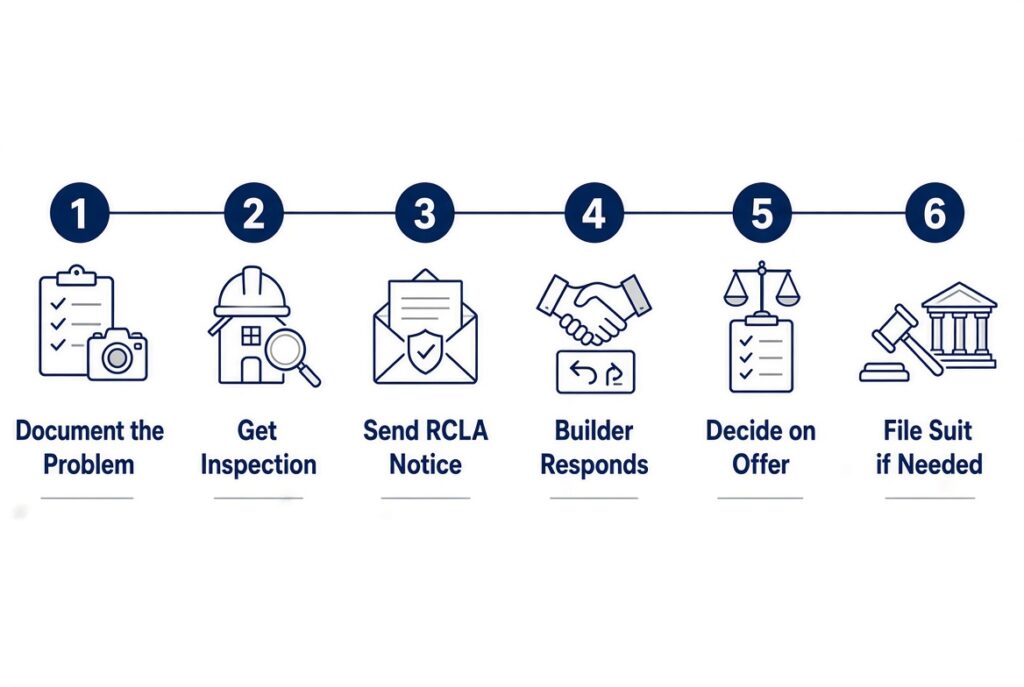
- Document everything right away. Take photos and videos the moment you notice a problem. Write down the date. This becomes your evidence trail, and the earlier you start it, the stronger your case.
- Get an independent inspection. Hire your own contractor or engineer, someone with no connection to your builder, to look at the defect and estimate repair costs.
- Send the RCLA notice. Mail a detailed, certified letter describing every defect to your builder. This starts the legal clock and is required before you can sue.
- Wait for the builder’s response. They have the right to inspect your property, generally within 35 days, and then a window to make a written repair or settlement offer.
- Decide whether the offer is fair. If it’s reasonable, taking it is often faster and cheaper than court. If it’s not, you generally have 25 days to explain in writing why you’re rejecting it, which gives the builder one more chance at a counteroffer.
- File suit if needed. Once the 60-day notice period passes and the builder hasn’t made things right, you can move forward with a lawsuit or arbitration. One thing worth knowing: if your claim is worth more than $7,500, either side can ask the court to order mediation before the case goes any further, according to the Texas State Law Library’s guide on construction defects. Mediation just means a neutral third party helps both sides try to reach an agreement without a trial.
A quick word of caution: if you reject a repair offer that a court later decides was actually reasonable, your potential recovery, including attorney’s fees, can end up limited to that original offer. This is exactly the kind of judgment call where talking to an attorney before you respond to the builder’s offer is worth it.
Texas Construction Defect Statute of Limitations
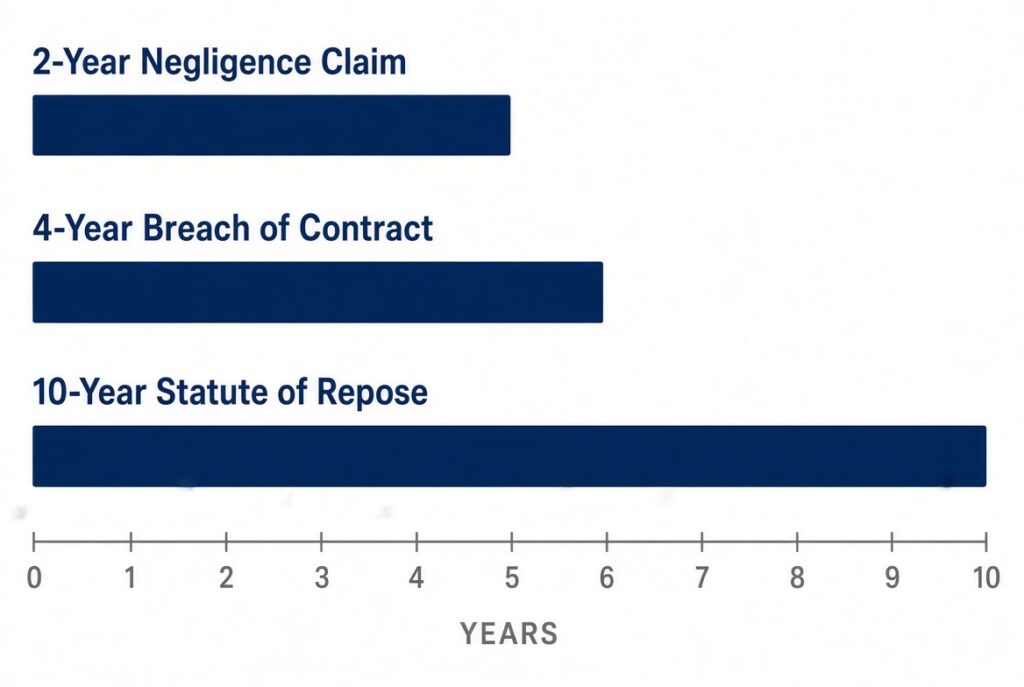
Direct answer: Most Texas construction defect claims must be filed within 2 years (negligence) or 4 years (breach of contract) from when you discovered the problem, with an outer limit of 10 years from construction under the statute of repose.
Texas actually has two separate clocks running on your claim, and it’s easy to mix them up. Here’s how they compare:
| Type of Deadline | Time Limit | Starts Counting From |
| Negligence claim | 2 years | When you discovered, or reasonably should have discovered, the defect |
| Breach of contract / warranty | 4 years | When you discovered, or reasonably should have discovered, the defect |
| Statute of repose | 10 years | Date the home was substantially completed, regardless of when you found the defect |
The statute of repose is the strict outer boundary. Even if you just discovered a hidden defect, if your home was finished more than 10 years ago, you likely can’t sue over it anymore. A 2023 Texas law (HB 2024) created some narrower exceptions to this 10-year window for certain newer homes with specific warranty terms. The exact details vary by case, so if your home is getting close to that 10-year mark, don’t wait. Talk to an attorney about whether an exception might apply to you.
Suing a Builder vs. Suing a Contractor
People often use “builder” and “contractor” like they mean the same thing, but the distinction can matter for your claim.
| Builder | Contractor | |
| Typical role | Oversees the whole project, often the original seller of a new home | Hired for a specific job, like framing, roofing, or plumbing |
| Who you sue | The company you originally contracted with | Whoever specifically did the defective work, which might be a sub the builder hired |
| RCLA applies? | Yes | Yes, if they’re a “contractor” under Chapter 27’s definition |
In practice, your builder is often responsible even if a subcontractor did the actual defective work, because the RCLA’s definition of “contractor” is broad and includes the company you signed a contract with. If a specific sub, like an electrician or a foundation company, did clearly negligent work, you may also have a separate claim against them directly.
What Compensation Can You Recover?
Direct answer: Under the RCLA, you can generally recover the reasonable cost of repairs, any damaged personal property, consulting or engineering fees, temporary housing during repairs, lost home value if the defect is structural, and attorney’s fees.
I’m not going to give you a made-up dollar range here, because the honest truth is it depends entirely on the size of your defect, your repair estimates, and your documentation. Anyone quoting you a specific settlement figure for a case they haven’t seen is guessing. What the law does guarantee is a defined list of recoverable categories, spelled out in Chapter 27, so at least you know what’s on the table.
See also: For a broader sense of how settlement outcomes actually get decided in Texas civil cases, our piece on your chances of winning a personal injury lawsuit covers similar ground on realistic expectations.
Eligibility Checklist — Do You Have a Case?
Before you spend money on an attorney, run through this quick self-check:
- The problem is a genuine defect, not routine wear and tear or normal minor settling
- You have photos, videos, or an inspection report documenting it
- You’re within the statute of limitations (2 or 4 years from discovery, and under 10 years from construction)
- You have a written contract, or can show who the responsible builder or contractor was
- You haven’t already signed a release or full settlement covering this specific issue
If you checked most of these boxes, it’s worth a consultation with a construction defect attorney. If your home is coming up on that 10-year repose deadline, treat this as urgent rather than something to think about later.
Do You Need a Construction Defect Attorney?
You’re not legally required to hire an attorney to send an RCLA notice. Plenty of homeowners write their own. But construction defect law has enough moving parts, the notice requirements, the damages caps, the deadline interplay, that a mistake early on can genuinely shrink what you’re able to recover later.
A good rule of thumb: if the repair cost is a few thousand dollars and the builder seems cooperative, you can often handle the notice yourself. If you’re looking at tens of thousands in structural repairs, or the builder is stonewalling you, it’s worth getting a lawyer involved before you send anything.
See also: Not every attorney handles cases the way you’d expect. Our guide on signs of a bad attorney is worth a read before you hire anyone.
Myth vs. Fact: What the Internet Gets Wrong About This Case
Myth: There’s a confirmed class action lawsuit against Texas Built Construction with settlement payouts of $15,000 to $150,000.
Fact: No such class action has been verified. Those figures come from unsourced content, not any confirmed court record.
Myth: Texas builders only get 45 days to respond to a defect notice.
Fact: The RCLA requires at least 60 days’ notice before you can file suit, and the builder’s inspection and offer windows run separately within that period.
Myth: If your home is over a few years old, you’re automatically out of time to sue.
Fact: You generally have 2 to 4 years from when you discovered the defect, not from when the house was built, as long as you’re within the 10-year statute of repose.
FAQ of Texas Built Construction
1. Is there a lawsuit against Texas Built Construction?
No confirmed homeowner class action exists as of this writing. Real court records show subcontractor nonpayment lawsuits against TBC Holdings Group, LLC, plus BBB complaints, but not a defect-based class action.
2. What is the Residential Construction Liability Act (RCLA) in Texas?
It’s a state law, found in Chapter 27 of the Texas Property Code, that requires homeowners to notify their builder of defects in writing and give them a chance to inspect and repair before a lawsuit can be filed.
3. How long do I have to file a construction defect lawsuit in Texas?
Generally 2 years for negligence claims or 4 years for breach of contract claims, both measured from when you discovered the defect, and never more than 10 years from when the home was completed.
4. Do I have to notify my builder before suing them in Texas?
Yes. The RCLA requires written notice by certified mail at least 60 days before you can file a lawsuit or start arbitration.
5. What compensation can I recover in a Texas construction defect case?
Repair costs, damaged personal property, engineering and consulting fees, temporary housing during repairs, lost home value for structural defects, and attorney’s fees, as defined under Chapter 27.
6. Will homeowners insurance cover construction defects?
Usually not. Most policies exclude faulty workmanship itself, though they may cover secondary damage, like water cleanup after a pipe bursts.
7. What’s the difference between suing a builder and suing a contractor in Texas?
Your builder is typically responsible for the overall project, even for a subcontractor’s mistakes, since the RCLA’s definition of “contractor” is broad. You may also have a separate claim against a specific sub who did clearly negligent work.
8. Can I still sue if I’m not the original homeowner?
Yes. The RCLA protects subsequent buyers, not just the original purchaser, for qualifying construction defects.
Final Thoughts
If you searched for a Texas Built Construction lawsuit hoping for a simple answer, here it is: there’s no confirmed class action right now, but there are real complaints and real court cases on record, and Texas law gives you clear rights if you’re dealing with a defective home from this or any other builder. Document everything, send your RCLA notice on time, and don’t wait until you’re close to a deadline to get advice.
If you’re dealing with a serious defect, talk to a licensed Texas construction attorney who can review your specific contract, timeline, and damages before you take your next step.

Dirk Wasserthal is the Founder and Lead Writer of LegalDiaries.com, an independent legal information platform. He specializes in Mass Torts, Women’s Rights, and emerging legal issues, delivering clear, well-researched, and trustworthy content across Criminal Law, Family Law, Personal Injury, and more. Dirk’s mission is simple — make the law understandable for everyone.