


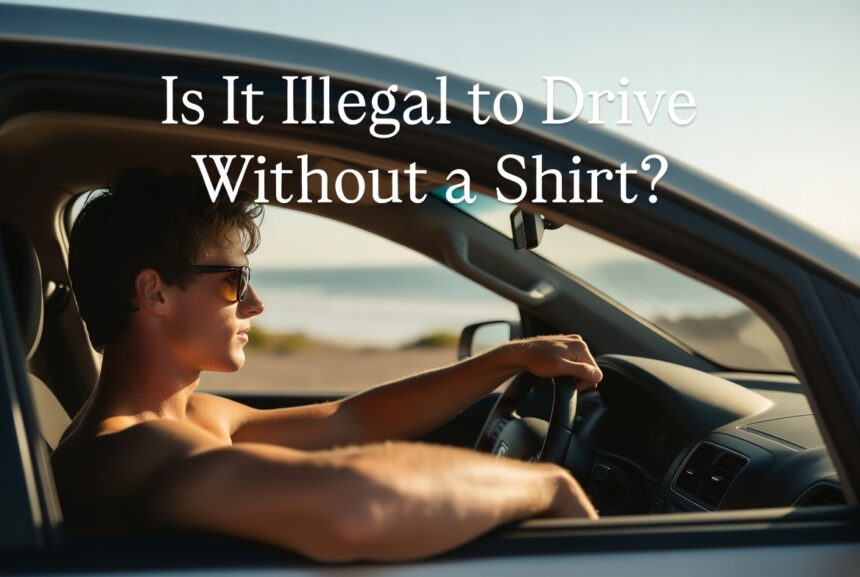
Is it illegal to drive without a shirt? For almost everyone, in almost every state, no. You can pull out of the beach parking lot shirtless, drive home from the gym, or just want the AC on your bare skin, and you’re not breaking a traffic law.
- The Short Answer
- Where the “No Shirt, No Service” Myth Comes From
- The Real Legal Risk: Public Indecency Laws (Mainly for Women)
- Myth vs. Fact
- Two Ways “Not Illegal” Can Still Get You in Trouble
- What About Passengers?
- Commercial Drivers, Truckers, and Rideshare: Different Rules?
- What to Do If You’re Pulled Over While Shirtless
- Why You Might Still Want a Shirt On
- Related Driving Attire Myths
- Frequently Asked Questions
- The Bottom Line
But “not illegal” isn’t the same as “zero risk.” A few real situations can turn a shirtless drive into a genuine problem, and most articles on this topic either skip them or get a key detail wrong. I checked the actual statutes instead of repeating what everyone else has already posted, so you’re getting the current, accurate version here including a few angles most competitors don’t cover at all, like commercial drivers and what happens if you’re actually pulled over.
The Short Answer
There’s no federal law and no state traffic code that requires you to wear a shirt while driving. Car insurers, police departments, and the DMV don’t have a dress code for drivers. Full stop.
What can get you in trouble isn’t a driving law at all. It’s a public indecency law, a statute about what you can and can’t do in public generally, whether you’re in a car, on a sidewalk, or in your own front yard. And those laws apply differently depending on whether you’re a man or a woman.
Where the “No Shirt, No Service” Myth Comes From
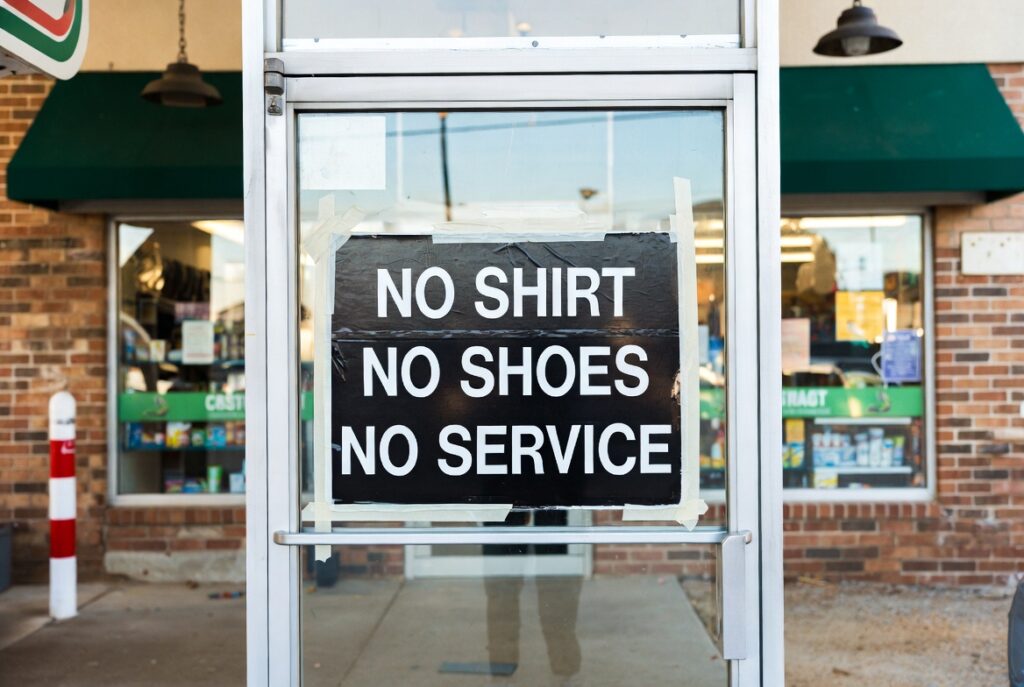
If you’ve ever wondered whether this is illegal, there’s a good chance it’s because of the “No Shirt, No Shoes, No Service” signs you’ve seen your whole life. Here’s the thing worth knowing: that’s a store policy, not a law. Businesses get to set dress requirements for people who walk through their doors, because it’s their property. It has nothing to do with police, traffic law, or your car.
That sign can stop you from walking into the convenience store shirtless. It has zero power over what you’re wearing on the drive there.
The Real Legal Risk: Public Indecency Laws (Mainly for Women)
This is the part that actually matters, and it’s also where most competing articles are stuck on outdated information.
Every state has some version of a public indecency or indecent exposure law. Almost all of them are written around exposing genitals, so a shirtless man essentially never runs into a legal issue anywhere in the country. Male toplessness is legal in all 50 states.
For women, it’s more complicated. Here’s a correction worth knowing: most sites still list Tennessee, Indiana, and Utah as the three states that flatly ban female toplessness. That’s outdated.
Indiana and Tennessee are the two states with statutes that clearly and currently define an exposed female breast as public nudity, separate from genital exposure. Tennessee’s law (Tennessee Code § 39-13-511) spells this out directly, and Indiana’s statute uses nearly identical language.
Utah is where the correction matters most. Utah has a “lewdness” law, its term for this kind of public nudity statute that’s historically been read to cover this too. But in 2019, a federal appeals court (the 10th Circuit, which covers Utah along with Colorado and several other states) struck down a nearly identical topless ban in Fort Collins, Colorado, on constitutional grounds. That ruling genuinely muddied whether Utah’s law would hold up if challenged today. The statute is technically still on the books, but its enforceability is unsettled. That’s very different from “banned,” and it’s worth knowing if you’re a woman driving through Utah.
About a dozen other states have no clear yes-or-no answer written into law at all. That leaves it up to local police discretion and city ordinances, and some cities have their own decency rules that are stricter than what the state allows.
State-by-State Snapshot
| State(s) | Female toplessness law | What this means for driving |
| Indiana, Tennessee | Explicitly banned by statute | A woman driving topless here could realistically face an indecent exposure charge |
| Utah | Banned on paper, but enforceability is legally uncertain since a 2019 federal ruling | Legally gray not a safe assumption either way |
| Colorado, Wyoming, New Mexico, Kansas, Oklahoma | Protected under the same 2019 federal ruling | Female toplessness is legally protected in these states |
| All other states | No state ban, but local city ordinances may vary | Generally fine, but worth a quick check somewhere unfamiliar |
| Men, everywhere | Never restricted | No legal risk anywhere in the U.S. |
Myth vs. Fact
Myth: Driving shirtless is against traffic law.
Fact: No state traffic code says anything about shirts. This one’s confused with public indecency law, which is a completely different legal category.
Myth: You’ll get a ticket just for being shirtless while driving.
Fact: A ticket for shirtless driving, by itself, doesn’t exist anywhere in the U.S. Any citation would come from a different law entirely, like distracted driving or public indecency.
Myth: It’s illegal in three states — Tennessee, Indiana, and Utah.
Fact: Only Tennessee and Indiana have laws that clearly stand today. Utah’s law is still on the books, but a 2019 court ruling left its enforceability genuinely unclear.
Myth: Truck drivers and rideshare drivers legally have to wear a shirt.
Fact: No federal or state law requires it. Employer dress codes are a completely separate thing from the law, and they’re the real reason most professional drivers keep a shirt on.
Two Ways “Not Illegal” Can Still Get You in Trouble
It can give police a reason to look closer
An officer doesn’t need shirtless driving to be a crime in order to use it as a reason to pull you over. If something about it looks unusual, driving shirtless in near-freezing weather, or swerving a little, that can create reasonable suspicion that something else is going on, like impairment.
Once you’re stopped, anything else the officer notices becomes fair game. An open container in the cupholder, the smell of marijuana, an outstanding warrant for an unpaid ticket. None of that has anything to do with your shirt, but the stop is what opened the door.
It could come up if you’re ever in an accident
This is the part nobody talks about clearly enough. If you’re shirtless and you get into a crash, even one that isn’t your fault, an insurance adjuster or opposing attorney might try to frame it as evidence that you were being careless or distracted. It’s not a strong legal argument on its own, since driving shirtless isn’t illegal, but insurance companies don’t need a strong argument. They just need a detail that makes a claim harder to settle cleanly.
If you’re ever navigating something like that, it helps to understand generally how fault gets determined and argued in a personal injury claim before you talk to an adjuster, so you’re not caught off guard by how these small details get used.
What About Passengers?
The same rules apply. Public indecency laws cover anyone visible inside the vehicle, not just the person driving. So if you’re a woman riding through Indiana or Tennessee without a top, the passenger seat doesn’t give you any extra protection the driver’s seat wouldn’t.
Commercial Drivers, Truckers, and Rideshare: Different Rules?
This is a gap almost nobody covers, and it’s a real question if you drive for a living.
The Federal Motor Carrier Safety Administration (FMCSA), which sets the federal rules for commercial drivers, doesn’t say a word about clothing anywhere in its regulations. Its rules focus on hours of service, vehicle maintenance, medical qualifications, and drug testing. Nothing in there requires a shirt.
So legally, a long-haul trucker crossing the country in July can drive shirtless the same as anyone else. Where it actually changes is employment, not law:
- Trucking companies almost always require professional appearance in their employment agreements. Break the dress code, and you can face discipline or lose the job, but it’s a company rule, not a citation.
- Rideshare and delivery drivers face customer-facing standards. Uber, Lyft, and delivery platforms can deactivate an account over appearance complaints, since it’s their platform and their rules.
- CDL holders with no employer restrictions, like independent owner-operators, are free to make their own call.
None of this is regulated by traffic law or federal transportation code. It’s entirely a workplace issue, which is worth knowing before you assume “professional driver” automatically means “shirt required by law.”
What to Do If You’re Pulled Over While Shirtless
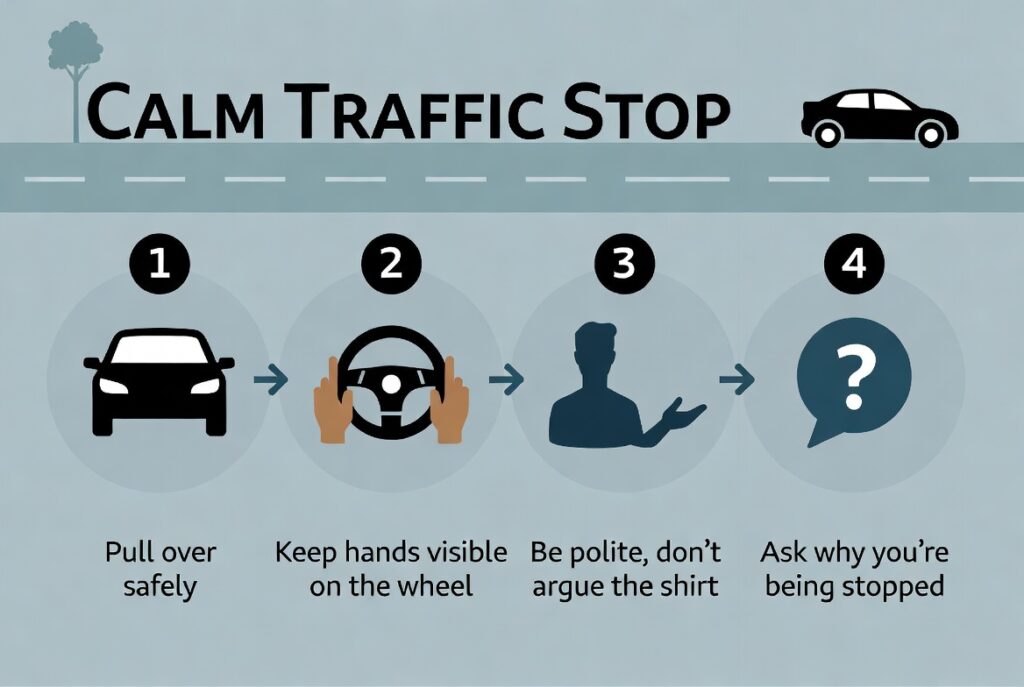
If it does happen, staying calm matters more than the shirt does.
- Pull over safely and put the car in park before you do anything else.
- Keep your hands visible on the steering wheel while you wait for the officer to approach.
- Stay polite and don’t argue about the shirt itself. Save any pushback for a lawyer or a courtroom, not the roadside.
- Ask why you’re being stopped, calmly and directly, so you know what you’re actually dealing with.
- Answer only what’s asked. You don’t have to explain your outfit choices or offer up extra information.
- Get the citation details in writing if you’re issued one, so you know exactly what you’re being charged with and can look into it afterward.
Why You Might Still Want a Shirt On
This part has nothing to do with the law and everything to do with practical safety.
A shirt is a thin but real layer of protection in a crash. It can reduce how badly a seatbelt scrapes your skin on impact, and it offers some buffer against broken glass or road debris. It sounds minor until it’s actually happening to you.
Quick example: picture spilling a cold drink on your bare chest while driving. The instinctive flinch jerking away from the cold, twisting toward the door is exactly the kind of split-second reaction that’s caused real accidents. With a shirt on, that same spill barely registers.
Related Driving Attire Myths

Shirtless driving tends to get lumped in with other myths: barefoot driving, flip-flops, driving in heels. None of these are illegal either, for the same core reason: states regulate how you drive, not what you’re wearing while you do it, outside of public decency law.
If you like knowing exactly where the legal line actually sits instead of going off what a gas station sign implies, it’s worth applying that same skepticism elsewhere. Whether jaywalking is actually illegal in California is a good example; the real answer is much narrower than the myth everyone repeats. The same goes for driving with headphones on, which is technically legal almost everywhere but can still get flagged if it visibly affects how you’re driving.
For contrast, it’s worth seeing what an actual strict, enforced vehicle law looks like. Texas’s window tint laws are specific, measurable, and ticketed constantly, which is a very different category from a myth law like this one.
Frequently Asked Questions
1. Is it illegal to drive without a shirt in any U.S. state? No. No state has a law that directly bans driving shirtless for men, and only Indiana and Tennessee currently ban it for women through public indecency statutes.
2. Can a police officer pull me over just for not wearing a shirt? Not on its own. It can factor into the decision to pull you over if it looks unusual enough to raise suspicion of something else, like impairment.
3. Is it different for women than for men when driving without a shirt? Yes. Male toplessness is legal everywhere in the U.S. Female toplessness is explicitly illegal in Indiana and Tennessee, and legally uncertain in Utah after a 2019 federal court ruling.
4. Can driving shirtless affect a car accident claim? It’s not illegal, so it can’t be the direct cause of fault. But insurers or opposing lawyers sometimes frame unusual behavior as evidence of distraction, so it’s not entirely off the table in a dispute.
5. Can truck drivers or CDL holders legally drive without a shirt? Yes, legally. Federal trucking regulations don’t mention clothing at all. Employer dress codes are what actually require a shirt for most professional drivers, not the law.
6. Does this apply to passengers too, not just the driver? Yes. Public indecency laws apply to anyone visible inside the vehicle, not only whoever’s behind the wheel.
7. Is driving barefoot or in flip-flops also illegal? No, the same logic applies. No state requires specific footwear to drive, though it’s worth being cautious if bare feet make the pedals harder to control safely.
The Bottom Line
Driving without a shirt is legal almost everywhere in the country, for almost everyone. The two clear exceptions are Indiana and Tennessee for women, with Utah sitting in a legal gray area that’s genuinely unsettled right now. The real risk was never the shirt itself. It’s what a stop can turn into once an officer has a reason to look closer, or what a lawyer can try to spin it into after an accident. On a normal hot day running to the store, you’re fine. If it’s becoming more of a regular habit, or you drive for a living, it’s worth knowing exactly where you actually stand.
This article is for general information only and isn’t legal advice. Laws and enforcement practices change, and local ordinances vary by city and county. If you’re facing an actual citation or dispute, talk to a licensed attorney in your state about your specific situation.

Dirk Wasserthal is the Founder and Lead Writer of LegalDiaries.com, an independent legal information platform. He specializes in Mass Torts, Women’s Rights, and emerging legal issues, delivering clear, well-researched, and trustworthy content across Criminal Law, Family Law, Personal Injury, and more. Dirk’s mission is simple — make the law understandable for everyone.