




The European Law Students Association (ELSA) is a student-run group that connects law students across Europe through internships, competitions, and legal training. If you are a law student wondering whether it is worth your time, the short answer is that it depends on how much you put into it. ELSA does not hand you a career. It hands you a door, and you have to walk through it.
- What Is the European Law Students Association (ELSA)?
- The History of ELSA: From Five Students to a Global Network
- How ELSA Is Structured: Local, National, and International Levels
- What Does ELSA Actually Do? Core Programs and Activities
- Student Trainee Exchange Programme (STEP), Now Called ELSA Traineeships
- ELSA Moot Court Competitions
- ELSA Law Schools
- ELSA Delegations
- Legal Research Groups and the ELSA Law Review
- ELSA’s Ties to the UN, Council of Europe, and WIPO
- Who Can Join ELSA, and How Do You Do It?
- Why Law Students Join ELSA
- Is ELSA Legitimate and Worth Joining?
- Myth vs Fact: Common Misconceptions About ELSA
- ELSA vs Other Law Student Organizations
- Frequently Asked Questions
- Final Thoughts: Is ELSA Right for You?
This matters because law school can feel isolating. You read cases alone. You study alone. ELSA exists to pull you out of that and put you in a room, sometimes literally in Strasbourg or Geneva, with students and professionals from dozens of countries.
What Is the European Law Students Association (ELSA)?
Ans: The European Law Students’ Association (ELSA) is an international, independent, non-political, non-profit organization run by and for law students and young lawyers. Founded in 1981, it works through Local, National, and International groups across Europe, offering traineeships, moot court competitions, and academic programs to help students build real legal skills.
A few quick facts to ground you before we go further. ELSA was founded in Vienna in 1981. Its headquarters sits in Brussels, Belgium. According to ELSA’s own about page, the organization exists to develop skills, connect students across legal systems, and prepare members for professional life in an international environment. The page also notes that ELSA’s current Patron, Siniša Rodin, is a sitting judge at the Court of Justice of the European Union, which is a fairly strong credibility signal for a student organization.
Membership numbers you will see quoted online range from about 50,000 to 70,000 members, and country counts range from 41 to 44. This is not sloppy reporting. It is because ELSA is a living, growing network, and different sources capture the count at different points in time. Treat any specific number you see, including the ones in this article, as a snapshot, not a permanent fact.
What “non-political” and “non-profit” actually mean here. Non-political means ELSA does not take sides on political parties or government policy. It does not lobby for or against specific laws. Non-profit means any money it raises goes back into running programs, not into paying shareholders or owners. There are no owners. It is entirely student-run.
The History of ELSA: From Five Students to a Global Network
ELSA started small. Five law students from Austria, Hungary, Poland, and West Germany founded it in Vienna on May 4, 1981. Think about that lineup for a second. This was still the Cold War. Students from a country behind the Iron Curtain and students from Western Europe sat down together and built something that would outlast the wall that divided them.
That origin story is not just trivia. It explains why ELSA’s founding purpose leans so hard on mutual understanding and cultural diversity. The people who built it were literally bridging a political divide that most of their governments could not.
From there, the growth was steady rather than explosive. Here is a rough timeline of ELSA’s biggest recognition milestones, based on details confirmed by Wikipedia’s entry on ELSA:
In 1994, ELSA received Consultative Status with UNESCO. In 1997, it earned Special Consultative Status with the UN’s Economic and Social Council, known as ECOSOC. In 1998, ELSA sent an observer delegation to the Rome conference where the International Criminal Court was created. In 2000, the Council of Europe granted ELSA Participatory Status, which was deepened into a full Human Rights Partnership in 2008. In 2005, ELSA gained Observer Status with the World Intellectual Property Organization, known as WIPO.
None of these are just titles for a resume. Each one opened a door for actual students to sit in rooms where international law gets discussed and shaped, not just studied from a textbook.
How ELSA Is Structured: Local, National, and International Levels
ELSA works like a pyramid, and understanding the layers helps you figure out where you actually fit in.
At the bottom is your Local Group. This is the ELSA chapter at your specific university, like ELSA Leiden or ELSA Tilburg. This is where you actually join, pay any local dues, and show up to events. Almost everything you will personally experience as a member happens here.
Above that sits the National Group, which coordinates all the Local Groups in one country. ELSA the Netherlands, for example, oversees every Dutch Local Group.
At the top is ELSA International, based in Brussels. This is the coordinating body for the entire network. It runs the big international programs, including STEP, the moot courts, and the delegations, and is governed by an International Board elected each year at the International Council Meeting, where representatives from every National Group gather to vote.
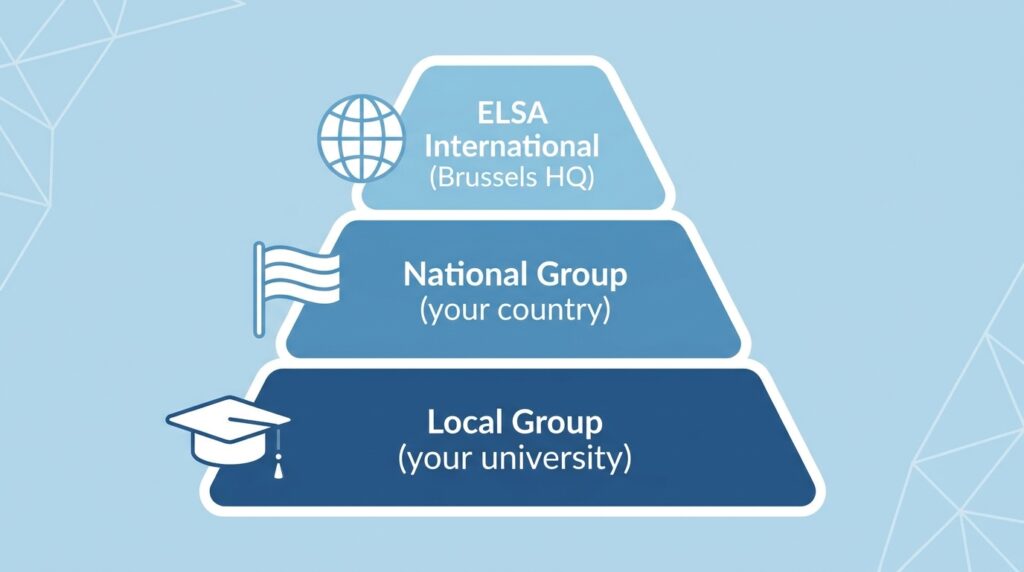
If you are trying to picture your day-to-day experience, think of it like a franchise. The International level sets the big programs and standards. Your Local Group is where you actually clock in, meet people, and do the work.
What Does ELSA Actually Do? Core Programs and Activities
This is where most people’s real interest lives, so let’s go program by program.
Student Trainee Exchange Programme (STEP), Now Called ELSA Traineeships
STEP used to be the name of ELSA’s flagship internship program. It has since been rebranded as ELSA Traineeships, though you will still see STEP used interchangeably in older materials and in some National Groups.
Here is how it works in plain terms. Law firms, companies, and organizations across Europe, and sometimes beyond, offer paid or unpaid internship positions to ELSA members. You apply through your Local Group, get matched, and if selected, you travel to the host country for the placement. Your Local Group and the host’s local ELSA team help with practical things like finding housing.
Imagine a third-year student in Poland who wants human rights experience. She applies through ELSA Traineeships, gets matched with a small human rights organization in another country, and spends her summer doing real casework instead of another unpaid coffee-run internship at home. That is the intended outcome, though results vary by placement.
One thing worth flagging honestly: visa and work permit rules for an international placement depend entirely on the destination country and your own nationality. This is not something ELSA or this article can answer in general terms. If you are weighing an international placement, treat visa questions the same way you would treat any other student visa issue, which is a legal question worth getting right before you commit. If you want a sense of how seriously visa status gets treated in legal and policy circles right now, our piece on the Homeland Security student visa lawsuit shows how much can be at stake when student visa status is handled carelessly.
ELSA Moot Court Competitions
A moot court competition is a simulated court case. You are not arguing a real dispute. You are given a fictional legal problem, and you write briefs and argue both sides in front of judges, just like real litigation.
ELSA runs two major ones. The first is the John H. Jackson Moot Court Competition, which focuses on World Trade Organization law. It used to be called the ELSA Moot Court Competition in WTO Law before being renamed in 2018. This is not a small student exercise. According to the World Trade Organization’s own coverage of the 2026 edition, 77 universities from around the world competed, with the University of Nairobi Faculty of Law winning the final round held at WTO headquarters in Geneva.
The second is the Helga Pedersen Moot Court Competition, formerly known as the European Human Rights Moot Court Competition, or EHRMCC. This one simulates a case before the European Court of Human Rights. Per the Council of Europe’s official announcement of the 2026 edition, the final round took place in Strasbourg, with teams arguing a fictional case touching on cybercrime and the use of artificial intelligence in courts.
Both competitions are named after real people. Helga Pedersen was a Danish judge and the first female judge appointed to the European Court of Human Rights, which is why the competition carries her name.

ELSA Law Schools
These are short, intensive study programs, usually run in the summer or winter, where students travel to a host country to study a specific legal topic for a week or two, often at a discounted rate compared to a normal study-abroad program.
ELSA Delegations
ELSA sends student delegations to observe sessions at bodies like the United Nations, the Council of Europe, and WIPO. This is a direct result of the consultative and observer status ELSA has earned over the decades, discussed more below.
Legal Research Groups and the ELSA Law Review
Legal Research Groups, often shortened to LRGs, are small teams of students who research a specific legal issue, often in partnership with an outside institution, and produce a written report. The ELSA Law Review is the organization’s academic journal, where students and young lawyers can get published work under their own name, which is a genuinely useful thing to point to later when applying for jobs or further study.
See also: If you are aiming for a legal career after graduation and want to understand basic professional terminology first, our guide on the difference between an attorney and a lawyer is a good place to start.
ELSA’s Ties to the UN, Council of Europe, and WIPO
It is worth slowing down on this section because it is the part most competing articles gloss over or state without proof.
ELSA holds Special Consultative Status with the UN’s Economic and Social Council, granted in 1997. You can confirm this directly by looking at ELSA’s listing in the UN’s own civil society database. Consultative status is not just a badge. It gives an organization limited access to UN bodies, the ability to submit written statements, and in some cases, the ability to send observers to certain sessions.
ELSA also has a partnership with the Council of Europe, formalized as a Human Rights Partnership in 2008. This is the relationship that produces the Helga Pedersen Moot Court Competition mentioned earlier.
Finally, ELSA has held Observer Status with WIPO, the World Intellectual Property Organization, since 2005.
What does this mean for you as a student, practically speaking? It means the delegations program is not just a resume line. Students selected for a UN or Council of Europe delegation are observing real international proceedings, not a mock version of them.
Who Can Join ELSA, and How Do You Do It?
Ans: Membership is open to law students and recent graduates through a Local Group at their university. There is no single international membership fee. You join and pay any dues through your Local or National Group, and those amounts vary by country, so check with the group nearest you.
Here is a straightforward path to actually joining, since most competing guides only say to just join without saying how.

First, search for an ELSA Local Group at your specific university. Most law schools in ELSA’s network have one, and a quick search of ELSA plus your university name usually finds it.
Second, if your university does not have a group, look for your country’s National Group instead, since some countries allow direct national membership or can point you to the closest chapter.
Third, reach out to that Local Group directly, usually through a website, Instagram, or Facebook page, and ask about their next general meeting or induction event.
Fourth, once you attend and pay any local membership dues, since these are set locally and not by ELSA International, you are in. From there, program access such as STEP, moot court teams, and delegations usually opens up to you as a member.
Can non-law students join? Generally, ELSA is built for law students and young lawyers, but some Local Groups do welcome students from related fields or allow limited participation in specific events. This varies enough by Local Group that your best move is to just ask them directly.
Why Law Students Join ELSA
Three benefits come up again and again when you look at what actual members say about the experience.
Skill building that classes don’t teach. Legal writing courses teach you how to write a memo. A moot court competition teaches you how to write a memo, then defend it out loud, under pressure, in front of judges who will interrupt you. That is a different skill entirely.
Real international exposure. A law student in Zagreb studying alongside a law student in Lisbon at an ELSA Summer Law School is getting something a comparative law textbook cannot replicate.
Something concrete to put on a resume. A published piece in the ELSA Law Review, a completed traineeship, or a moot court finish are all specific, checkable accomplishments. That said, be careful not to overstate this. Employers value what you actually did in these programs, not just the fact that you were a member.
The value of this kind of committee experience is not just theoretical. In a Law Society of Scotland blog post about ELSA Aberdeen, one member serving as Secretary-General described her chapter as “a truly friendly, approachable and supportive family,” which is the kind of honest, first-hand impression you rarely get from an official program page.
If your longer-term goal is running your own practice someday, the professional habits you build here, things like research discipline, deadline management, and working with international teams, carry over directly. Our guide on how to start a law firm covers what that path looks like once you are past the student stage.
Is ELSA Legitimate and Worth Joining?
Ans: Yes. ELSA is a recognized NGO with UN ECOSOC consultative status, a formal Council of Europe partnership, and WIPO observer status. It has operated continuously since 1981. Whether it is worth it for you personally depends almost entirely on how actively you participate in its programs.
Legitimacy and personal value are two different questions, and it is worth answering both honestly. On legitimacy, the paper trail is real and verifiable through the UN’s own records, not just ELSA’s marketing. On personal value, the honest answer is that ELSA rewards effort. A student who applies for STEP, competes in a moot court, and shows up to events will get far more out of this than a student who pays dues and never engages further.
Myth vs Fact: Common Misconceptions About ELSA
Myth 1: ELSA is a political organization or tied to the European Union government.
Fact: ELSA is explicitly non-political and is not part of the EU government or any national government. Its partnerships with bodies like the Council of Europe and the UN are cooperative relationships, not government control.
Myth 2: You have to be an EU citizen to join ELSA or apply for its programs.
Fact: Membership is based on being enrolled at a university with an ELSA Local Group, not on EU citizenship. Students from many non-EU countries participate through their local university chapters.
Myth 3: ELSA is basically a paid staffing agency that places you in a job.
Fact: ELSA Traineeships, formerly STEP, is a matching and support structure between students and host organizations. Pay, hours, and terms are set by the host organization itself, not by ELSA, and not every placement is paid.
Myth 4: ELSA only helps students who want to work at EU institutions or in international law.
Fact: ELSA’s programs span human rights, trade law, intellectual property, and general commercial law, among other fields. Many members go on to standard domestic legal careers and still found the experience useful.
ELSA vs Other Law Student Organizations
ELSA is not the only student-run legal network out there, and it helps to know where it fits. In Asia, a similar organization called the Asian Law Students’ Association, or ALSA, runs comparable programs, including academic activities, competitions, and exchanges, for law students across Asian countries. ELSA and ALSA cooperate with each other on some projects, according to ELSA’s own network materials.
The practical difference for you is simple. If you study in Europe, ELSA is almost certainly your relevant network. If you study in Asia, ALSA may be the more directly useful one. Some students engage with both, particularly if they are interested in careers that cross both regions.
Whichever network you are part of, the same advice about traineeships applies everywhere. Not every host organization runs a well-managed placement. Before committing to any internship, whether through ELSA or on your own, it is worth learning the warning signs of a badly run legal workplace so you can spot a poor fit before you have committed months to it.
Frequently Asked Questions
1. What does ELSA stand for?
Ans: ELSA stands for the European Law Students’ Association, an international, non-political, non-profit organization for law students and young lawyers founded in 1981.
2. How do I join ELSA?
Ans: Find the ELSA Local Group at your university, contact them through their website or social media, attend an induction or general meeting, and pay any local membership dues. There is no separate international membership fee.
3. Is ELSA free to join?
Ans: There is no ELSA International membership fee, but individual Local and National Groups may charge their own dues, and those amounts vary by country.
4. What is STEP in ELSA?
Ans: STEP, the Student Trainee Exchange Programme, is ELSA’s traineeship program that matches law students with internship placements at law firms, companies, and organizations abroad. It is now officially called ELSA Traineeships.
5. What is the ELSA Moot Court Competition?
Ans: It usually refers to the John H. Jackson Moot Court Competition, a simulated WTO dispute settlement case, or the Helga Pedersen Moot Court Competition, a simulated human rights case before the European Court of Human Rights.
6. Can non-law students join ELSA?
Ans: ELSA is primarily built for law students and young lawyers, though some Local Groups allow limited participation from students in related fields. Check with your specific Local Group.
7. How many countries is ELSA in?
Ans: Reported figures range from 41 to 44 countries depending on the source and the year cited, since the network continues to grow and change over time.
8. When was ELSA founded?
Ans: ELSA was founded on May 4, 1981, in Vienna, by five law students from Austria, Hungary, Poland, and West Germany.
9. Is ELSA affiliated with the EU or any government?
Ans: No. ELSA is independent and non-political. It holds cooperative status with bodies like the UN, the Council of Europe, and WIPO, but it is not controlled by any government or the EU.
10. Is ELSA worth it for a law career?
Ans: For students who actively participate in traineeships, competitions, or research groups, it generally adds real, checkable experience to a resume. Passive membership without participation adds much less value.
Final Thoughts: Is ELSA Right for You?
ELSA is not a magic career shortcut, and nobody running the organization would tell you otherwise. What it is, is a genuinely large, genuinely international structure that gives law students access to real internships, real competitions, and real relationships with people who will end up practicing law all over Europe and beyond.
If you are still deciding, the lowest-risk first step is small. Find your Local Group, go to one event, and see how the room feels. That single step tells you more than any article, including this one, ever could.
This article provides general information only and is not legal advice. Laws vary by state and change over time. Do not rely on this content as a substitute for advice from a qualified, licensed attorney in your jurisdiction. For guidance on your specific situation, consult a licensed attorney directly

Dirk Wasserthal is the Founder and Lead Writer of LegalDiaries.com, an independent legal information platform. He specializes in Mass Torts, Women’s Rights, and emerging legal issues, delivering clear, well-researched, and trustworthy content across Criminal Law, Family Law, Personal Injury, and more. Dirk’s mission is simple — make the law understandable for everyone.