


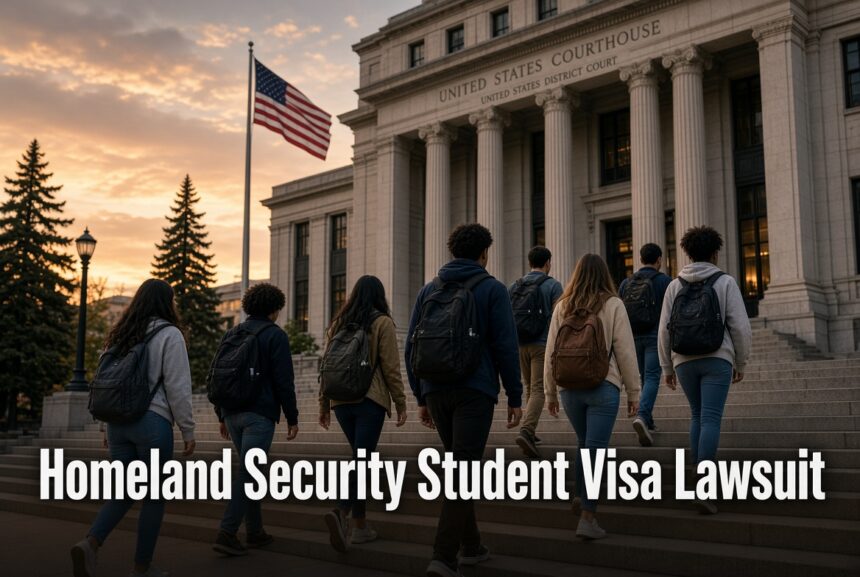
The homeland security student visa lawsuit isn’t really one lawsuit. It’s a wave of them, filed since spring 2025, after the government quietly deleted the immigration records of thousands of students. If you’re searching this term, you probably already know something feels wrong. Maybe it happened to you, or to a friend, or you’re just trying to figure out if your own status is safe.
- What Actually Happened — SEVIS, Explained
- Why DHS Says It Terminated Thousands of Records
- Why Students Sued — The Legal Arguments Behind Every Case
- No Due Process — No Notice, No Hearing
- No Valid Legal Basis — Visa Revocation Isn’t the Same as Losing Student Status
- The April 2025 Reversal — and Why the Lawsuits Didn’t Stop
- The Major Cases, Explained — A Full Roundup
- Pasula v. DHS (New Hampshire, Maine, Rhode Island, Puerto Rico)
- The University of Iowa Case
- Liu v. Secretary of DHS (Dartmouth)
- The Harvard International Student Ban Case
- AAUP v. Rubio — The Free Speech Angle
- The Massachusetts SEVIS Case — March 2026 Ruling
- Is the Lawsuit Still Going On in 2026?
- The Bigger Change: DHS Just Ended “Duration of Status”
- Myth vs. Fact: Homeland Security Student Visa Lawsuit
- What to Do If Your SEVIS Record Gets Terminated
- Frequently Asked Questions
- The Bottom Line
I’ve spent years covering how everyday people get pulled into fights with big federal agencies, and this one has more moving parts than most. So let’s slow down and walk through it together, no legal degree required.
Here’s what you’ll get from this article: what actually happened, why students sued, which cases matter most, what changed in 2026, and exactly what to do if this hits your own SEVIS record.
What Actually Happened — SEVIS, Explained
What Is SEVIS and Why It Controls Your Legal Status
Every international student on an F-1 visa has a file in a system called SEVIS short for the Student and Exchange Visitor Information System. Think of it as your official “proof of student” record. As long as it says active, you’re legally allowed to study, work under Optional Practical Training (OPT), and stay in the country.
Your school updates this record. So does the government. When someone flips your SEVIS status to “terminated,” the system treats you as if you’re no longer a student even if you’re still enrolled, still attending class, still doing everything right.
That distinction matters more than it sounds like it should. A visa lets you travel into the country. Your student status is what lets you stay and study once you’re here. They’re not the same thing, and for decades, one didn’t automatically wipe out the other.
How the Mass Terminations Started in Spring 2025
Starting around March 2025, immigration officials began mass-terminating SEVIS records. Not one or two at a time thousands, in a matter of weeks. By mid-April, more than 210 colleges had identified over 1,400 affected students. Some counts later climbed past 1,800.
Most students got no letter first. No email. No hearing. Many found out from a professor, a classmate, or by checking their own record out of nervous curiosity. Imagine building your whole life around a degree, then discovering with zero warning that the government considers you illegal to be here.
Why DHS Says It Terminated Thousands of Records
DHS didn’t do this randomly. According to sworn testimony in federal court, the agency ran an operation it called the Student Criminal Alien Initiative. Between 10 and 20 Immigration and Customs Enforcement (ICE) employees spent weeks combing through a database of 1.3 million international student names, cross-checking them against the FBI’s National Crime Information Center.
Out of those 1.3 million names, about 6,400 came back with some kind of hit. No convictions hit. Traffic stops. Dismissed charges. Old police contact that never led anywhere. Those 6,400 names went to the State Department, which revoked roughly 3,000 visas and told DHS to terminate the matching SEVIS records.
One exchange from a Washington, D.C. courtroom captures just how thin the justification really was. A federal judge asked ICE’s assistant director, point blank, whether the government had really assigned over a dozen employees to comb through 1.3 million names for minor police contacts while claiming budget cuts elsewhere. The official’s answer was a flat “yes.” The judge didn’t hide her frustration, calling out what she saw as the government’s disregard for the students and communities it had invited in.
That’s not a dramatized retelling it happened in open court, and it became one of the defining moments of this entire story. You can read the full breakdown of how this testimony played out in the Iowa students’ case against DHS.
Why Students Sued — The Legal Arguments Behind Every Case
Once the terminations hit, lawsuits started landing in federal courts across the country, sometimes several in the same week. Nearly every one of them made two core arguments.
No Due Process — No Notice, No Hearing
Federal law generally says the government has to warn you and give you a real chance to respond before it takes away your legal status, not after the fact. Students argued DHS skipped that step entirely. No notice. No hearing. No explanation, in most cases, at all.
No Valid Legal Basis — Visa Revocation Isn’t the Same as Losing Student Status
This is the part that surprises a lot of people. Under the actual rules, SEVIS termination is only supposed to happen for specific reasons like dropping below a full course load, working without authorization, or being convicted of a violent crime carrying more than a year’s sentence.
A visa revocation, by itself, isn’t one of those reasons. Students argued DHS was treating a State Department visa decision as if it automatically ended their student status, when the actual regulations never said that. For most of the students represented in these lawsuits, none of the real disqualifying reasons applied at all.
The April 2025 Reversal — and Why the Lawsuits Didn’t Stop
By mid-April 2025, courts across the country were issuing emergency orders against DHS, one after another. On April 25, 2025, the agency reversed course and began restoring SEVIS records nationwide.
You’d think that would end things. It didn’t. Courts have repeatedly ruled that when a government fixes a problem because a judge forced it to, that doesn’t automatically make the lawsuit “moot” legal-speak for pointless. DHS has tried this mootness argument case after case, and judges keep rejecting it, because the underlying question of whether the terminations were ever lawful hasn’t actually been answered.
The Major Cases, Explained — A Full Roundup
There’s no single case to point to here. Think of it more like a family of related lawsuits, each chipping away at a different piece of the same problem.
Pasula v. DHS (New Hampshire, Maine, Rhode Island, Puerto Rico)
Filed April 18, 2025, this was a class action brought by the ACLU and the law firm Shaheen & Gordon on behalf of more than 100 students. A class action just means one lawsuit represents a whole group of people harmed the same way, instead of each person filing separately similar to how large product-defect cases work.
The case argued the terminations violated due process and that visa revocation alone wasn’t legal grounds to end student status. It settled in August 2025, with the government agreeing to restore the affected students’ status. You can read the full case summary on the ACLU of Maine’s case page.
The University of Iowa Case
Four Iowa students and graduates sued in April 2025 after their status was pulled with no explanation. A judge ordered DHS to keep their records active and to backdate an “active” notation so no other agency would mistakenly try to deport them.
DHS pushed back repeatedly, arguing the injunction was too broad. The judge disagreed every time. By August 2025, DHS was asking the court to dismiss the case as moot, the same argument that’s failed in similar cases elsewhere.
Liu v. Secretary of DHS (Dartmouth)
A Dartmouth College student had his F-1 status terminated with no criminal record, no protest activity, and no explanation. The ACLU of New Hampshire took his case to force reinstatement of a smaller, quieter case, but one that shows this wasn’t limited to students with any kind of political or criminal history at all.
The Harvard International Student Ban Case
In May 2025, DHS tried something far bigger: stripping Harvard’s entire certification to host any international students, putting more than 7,000 people’s status at risk in one move. A federal judge blocked it. When the administration tried a different legal route to the same result, the same judge blocked that too. The case is now on appeal.
AAUP v. Rubio — The Free Speech Angle
Faculty and student groups argued the terminations weren’t just sloppy paperwork; they were a deliberate effort to punish students for political speech, especially around Israel-Palestine protests. In September 2025, a federal judge agreed the policy was unconstitutional and unlawfully vague. A remedy order followed in January 2026, though part of it is currently paused while an appeals court reviews it.
The Massachusetts SEVIS Case — March 2026 Ruling
This is the most recent major development. On March 20, 2026, a federal court in Massachusetts refused to dismiss a lawsuit brought by the National Immigration Project, the Presidents’ Alliance on Higher Education and Immigration, and a coalition of Massachusetts colleges. The court let the core claims move forward, including challenges to how the State Department revokes visas based on database matches with no individual review at all.
As one of the attorneys on the case put it, the ruling means the government can’t quietly avoid judicial review just by fixing what it broke. That’s a meaningful signal for every case still working through the courts. The National Immigration Project’s press release on the ruling has the full details, including the specific claims the court allowed to move forward.
Is the Lawsuit Still Going On in 2026?
Yes. As of mid-2026, several of these cases are still active under appeal, in discovery, or awaiting rulings on the merits. Nothing has produced one final, nationwide answer on whether the original terminations were lawful. If your case sounds like any of the ones above, it’s worth checking whether a current class action already covers your situation.
The Bigger Change: DHS Just Ended “Duration of Status”
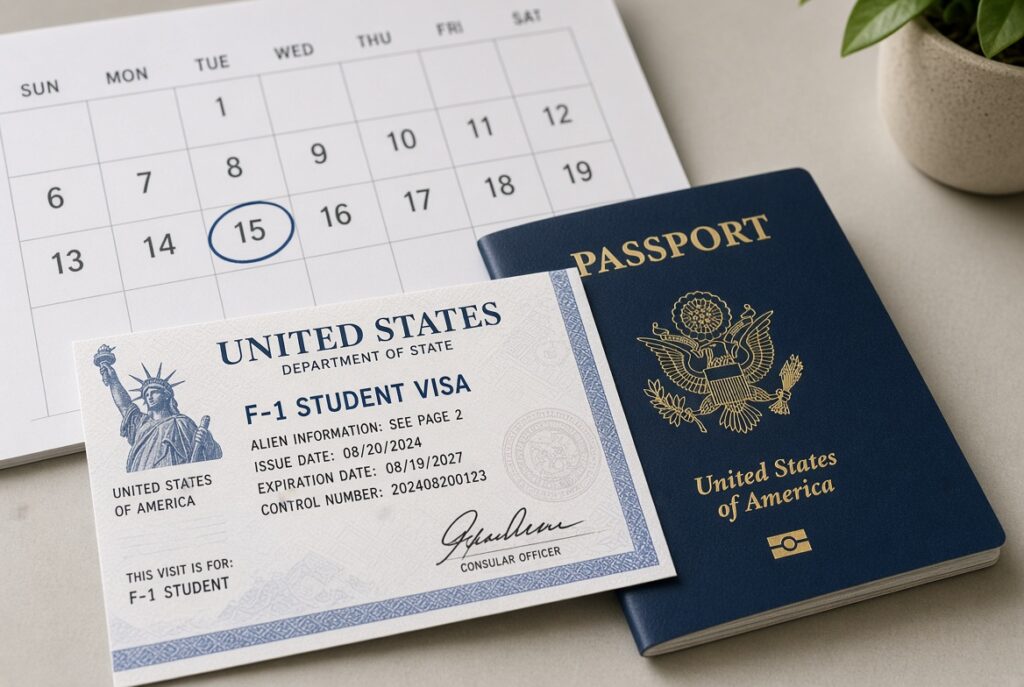
Separate from all the lawsuits, DHS made a massive policy change that affects nearly every international student going forward lawsuit or no lawsuit.
For more than 30 years, F-1 and J-1 students were admitted for “duration of status” meaning you could stay as long as you followed your program’s rules, with no fixed expiration date. On July 17, 2026, DHS published a final rule in the Federal Register ending that system entirely.
What Changes for Students After September 15, 2026
Starting September 15, 2026, most F-1 students will be admitted for a fixed period tied to their program length, capped at four years not indefinite duration of status. According to DHS’s own official guidance, students who need more time will have to file a formal Extension of Stay application with USCIS before their admission period runs out.
A few other changes are packed into the same rule:
| Change | Before | After Sept. 15, 2026 |
| Admission period | Duration of status (open-ended) | Fixed, up to 4 years |
| Post-completion grace period | 60 days | 30 days |
| Extending your stay | Automatic while in status | Formal application to USCIS required |
| Graduate program changes | More flexible | Restricted, exceptions only in limited cases |
Does This Affect Students Already in the U.S.?
Yes, eventually. If you were already admitted under duration of status before the effective date, you get a transition period generally until the program end date listed on your I-20, capped at four years from when the rule kicks in. Anyone entering or re-entering the country after September 15, 2026 falls under the new fixed-period rules right away.
This isn’t a lawsuit yet. But a change this large, affecting well over a million students, tends to end up in court eventually worth watching if you’re planning your next few years around it.
Myth vs. Fact: Homeland Security Student Visa Lawsuit
Myth: A dismissed charge or old traffic stop can’t affect my student status.
Fact: It already has, for thousands of students. DHS treated minor police contact even charges that were dropped as grounds to flag and terminate SEVIS records, even though the actual rules don’t support that.
Myth: If my visa gets revoked, I automatically lose my student status too.
Fact: Visa and student status are legally different things. A revoked visa affects your ability to travel; it isn’t, by itself, valid grounds to end your F-1 status.
Myth: Once DHS restored the SEVIS records in April 2025, the whole issue was resolved.
Fact: Restoring records didn’t settle whether the original terminations were legal. Several major cases are still working through the courts in 2026 for exactly that reason.
Myth: I have to leave the country immediately if my SEVIS status gets terminated.
Fact: Leaving too fast can hurt your legal options. Talk to an immigration attorney before you make that call. Some students who left were later seen as having self-deported, which complicated their case.
What to Do If Your SEVIS Record Gets Terminated
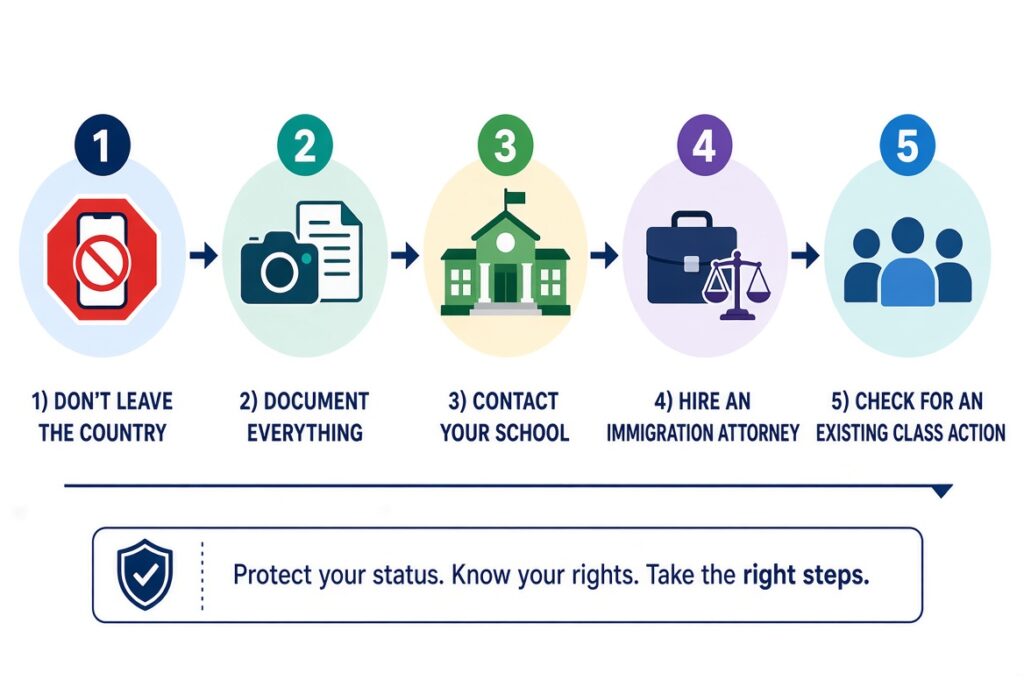
If this is happening to you right now, here’s the practical path not the theory.
- Don’t leave the country before talking to a lawyer. Leaving too early can be read as giving up your case voluntarily.
- Screenshot everything. Your SEVIS printout, any emails, and the date you found out. Courts have leaned heavily on exactly this kind of paper trail.
- Contact your school’s international student office today. They’ve likely seen this exact situation before and may already know which lawsuit or legal group is handling cases like yours.
- Hire an immigration attorney not just any attorney. This area moves fast and the details matter. It helps to understand the difference between an attorney and a lawyer before you start calling firms, and to know the common signs of a bad attorney so you don’t waste time or money on the wrong one.
- Ask if an existing class action already covers you. A lot of affected students didn’t file their own case; they joined one already moving through the courts. Ask your school or a local ACLU affiliate whether your situation fits an active case.
Frequently Asked Questions
1. Why did Homeland Security revoke international student visas?
DHS ran student names through a criminal database as part of what it called the Student Criminal Alien Initiative, then terminated SEVIS records for students flagged often over dismissed charges or minor police contact, not convictions.
2. Is the DHS student visa lawsuit still going on in 2026?
Yes. Several major cases, including the Massachusetts SEVIS lawsuit, remain active in 2026, with courts still deciding whether the original terminations were lawful.
3. Can DHS terminate my F-1 status without telling me?
It’s not supposed to. Federal law generally requires notice and a chance to respond first, which is the exact argument at the center of most homeland security student visa lawsuit filings.
4. What is SEVIS and why does it matter for my visa status?
SEVIS is the government database that tracks your F-1 student status. If it says “terminated,” you’re treated as out of status even if you’re still fully enrolled.
5. Did the students who sued DHS win their case?
Several did. Pasula v. DHS settled with reinstated status in August 2025, and multiple other cases have produced injunctions or rulings favoring students, though not every case has reached a final outcome yet.
6. What should I do if my SEVIS record is terminated?
Document everything, contact your school’s international office, and talk to an immigration attorney before making any decisions about leaving the country.
7. Is a visa revocation the same as losing student status?
No. They’re legally distinct. Courts in the homeland security student visa lawsuit cases have repeatedly noted that a visa revocation alone isn’t valid grounds to terminate F-1 student status.
8. What is the new DHS rule ending “duration of status”?
It’s a July 2026 federal rule that replaces open-ended student status with a fixed admission period, capped at four years, starting September 15, 2026.
9. How many international students had their visas revoked?
Estimates range from around 1,400 to over 1,800 students nationally during the spring 2025 wave, across more than 200 colleges and universities.
10. Can I stay in the U.S. while my case is being decided?
In several of the major cases, courts ordered DHS to keep student status active while litigation continued but this depends entirely on your specific situation, so check with an attorney.
The Bottom Line
This story isn’t finished. Courts are still sorting out whether the original terminations were legal, and a brand-new rule is about to change how every future international student is admitted in the first place. If there’s one pattern worth taking from all of this, it’s that the students who came out ahead were the ones who documented everything and got real legal help fast, not the ones who waited to see what would happen next.
This article is for general information only and isn’t legal advice. Immigration cases depend heavily on individual facts, and outcomes vary by court and judge and talk to a licensed immigration attorney about your specific situation.

Dirk Wasserthal is the Founder and Lead Writer of LegalDiaries.com, an independent legal information platform. He specializes in Mass Torts, Women’s Rights, and emerging legal issues, delivering clear, well-researched, and trustworthy content across Criminal Law, Family Law, Personal Injury, and more. Dirk’s mission is simple — make the law understandable for everyone.