




SEO for personal injury lawyers is one of the most misunderstood corners of legal marketing, mostly because nearly everything written about it is written by someone trying to sell it to you. This article isn’t a pitch. Legal Diaries covers the legal industry. We don’t run SEO campaigns for law firms, which means we have no reason to inflate the timeline, oversell the results, or bury the parts that are genuinely hard.
- What Is SEO for Personal Injury Lawyers?
- Do Personal Injury Lawyers Actually Need SEO?
- Organic vs. Paid Search for Personal Injury Firms
- Keyword Research for Personal Injury Lawyers
- E-E-A-T for Law Firms: The Section Every Competitor Skims
- Attorney Bios, Bar Credentials, and Real Signals of Expertise
- Advertising Ethics Rules You Can’t SEO Your Way Around
- On-Page Content That Actually Converts
- Local SEO and Google Business Profile for Personal Injury Firms
- Technical SEO Priorities, Ranked by Actual Impact
- Link Building for Personal Injury Law Firms
- Showing Up in AI Overviews and AI Search
- How Long Does Personal Injury SEO Take, and What Does It Cost?
- DIY vs. Hiring an SEO Agency and How to Vet One If You Do
- Frequently Asked Questions
- Final Thoughts
What you’ll get here: a straight explanation of how personal injury SEO actually works in 2026, including the parts most guides skip entirely how AI Overviews are reshaping what “ranking #1” even means, where the ethics rules around attorney advertising quietly limit what you can do, and an honest answer to whether you need an agency at all. By the end, you’ll know enough to either do this yourself or ask a lot better questions of whoever you hire.
What Is SEO for Personal Injury Lawyers?
SEO for personal injury lawyers is the practice of improving a law firm’s website and online presence so it shows up when someone searches for legal help after an accident or injury. That’s the simple version. The complicated version is that personal injury sits inside a Google classification called YMYL “Your Money or Your Life” a category reserved for content that could affect someone’s health, safety, or financial security if it’s wrong.
Google holds YMYL pages to a noticeably higher bar than, say, a recipe blog or a travel site. That bar is called E-E-A-T: Experience, Expertise, Authoritativeness, and Trust. A personal injury site with vague author bios, no visible attorney credentials, and thin content isn’t just “less optimized” it’s actively working against the trust signals Google is specifically built to check for on legal and medical queries.
This is also why personal injury is different from generic local-business SEO. You’re not just competing for clicks. You’re competing in a niche where the wrong click costs a competitor thousands of dollars, which changes everything about how aggressive the competition gets.
Do Personal Injury Lawyers Actually Need SEO?
Yes and the case for it is stronger than most guides bother to make. Personal injury consistently ranks as one of the most expensive advertising categories on Google. According to an analysis of the top 5,000 highest-cost keywords on Google Ads, legal services led every other industry, representing close to 19% of all the priciest search terms tracked, more than double the next-closest category, education (FraudBlocker, 2026).
Personal injury specifically sits at the top of that pile. Industry benchmarking puts personal injury cost-per-click in the $50–$200+ range, with competitive urban markets pushing “car accident lawyer near me” toward $150–$300 per click, and mass-tort terms like mesothelioma occasionally crossing $900 per click (My Legal Academy, 2026).
That math is exactly why organic search matters more here than almost anywhere else. If a click on paid search can run $150 and up, a page that ranks organically for the same term isn’t just “free traffic” it’s the difference between a sustainable client-acquisition channel and one that bleeds budget the moment you stop paying.
Worth knowing too: the Bureau of Labor Statistics projects lawyer employment to grow just 4% from 2024 to 2034 modestly, and well below the older, higher figure still floating around in some marketing guides (BLS, 2026). The client pool isn’t expanding fast enough to make competition for visibility any gentler over time.
Organic vs. Paid Search for Personal Injury Firms
| Factor | Organic (SEO) | Paid Search (PPC) |
| Cost per click | $0 direct cost (time/content investment) | $50–$300+ for competitive PI terms |
| Time to results | 6–12+ months to build | Immediate, but stops when spend stops |
| Longevity | Compounds over time | Resets to zero without budget |
| Trust signal to users | Higher users skip labeled ads | Lower users increasingly ad-blind |
| Best for | Long-term case volume, brand authority | Filling gaps while SEO builds, testing new markets |
Neither replaces the other. Firms that rank well organically and run disciplined PPC campaigns tend to outperform firms doing only one but if you can only fund one long-term, SEO is the one that doesn’t evaporate the day the budget runs dry.

Keyword Research for Personal Injury Lawyers
Keyword strategy for personal injury breaks down into three tiers, and treating them all the same is where most firms waste their content budget.
Informational keywords are used by people who haven’t decided to hire anyone yet. Think “what to do after a car accident” or the exact question our own piece on the difference between an attorney and a lawyer answers searches driven by confusion or curiosity, not urgency to buy. These won’t convert immediately, but they build the trust that gets someone to remember your firm three weeks later when they are ready to call.
Navigational keywords are searches for a specific firm or service by name. Someone already knows who you are and is trying to find you.
Transactional keywords are the ones with the price tags attached: “personal injury lawyer near me,” “best car accident attorney [city].” High intent, brutal competition, the terms every firm in your market is fighting over.
Case-Type Keywords Aren’t Interchangeable
This is where most generic SEO advice quietly falls apart. “Personal injury lawyer” is not one keyword problem, it’s several, and treating them the same is a mistake.
A car accident query is high-volume and brutally competitive nationwide. A slip and fall search tends to have lower volume but also lower competition, which makes it a realistic entry point for smaller firms. Medical malpractice keywords carry enormous commercial value per click but demand content that demonstrates real subject-matter depth thin pages get filtered out fast in a category this sensitive. Dog bite and wrongful death terms are narrower still, which is exactly why one of Consultwebs’ own case studies shows a firm ranking #1 for “dog bite lawyer” specifically, rather than trying to out-muscle the entire industry for “personal injury lawyer” as a phrase.
The practical takeaway: don’t build one page and hope it ranks for everything. Build separate, genuinely deep content for each case type your firm actually handles, and treat pages like our chances of winning a personal injury lawsuit breakdown as the model content built to answer a real question first, not to stuff a keyword.
E-E-A-T for Law Firms: The Section Every Competitor Skims
Every agency guide mentions E-E-A-T. Almost none of them explain what it looks like in practice for a law firm, and even fewer touch the part that actually constrains what you’re allowed to say.
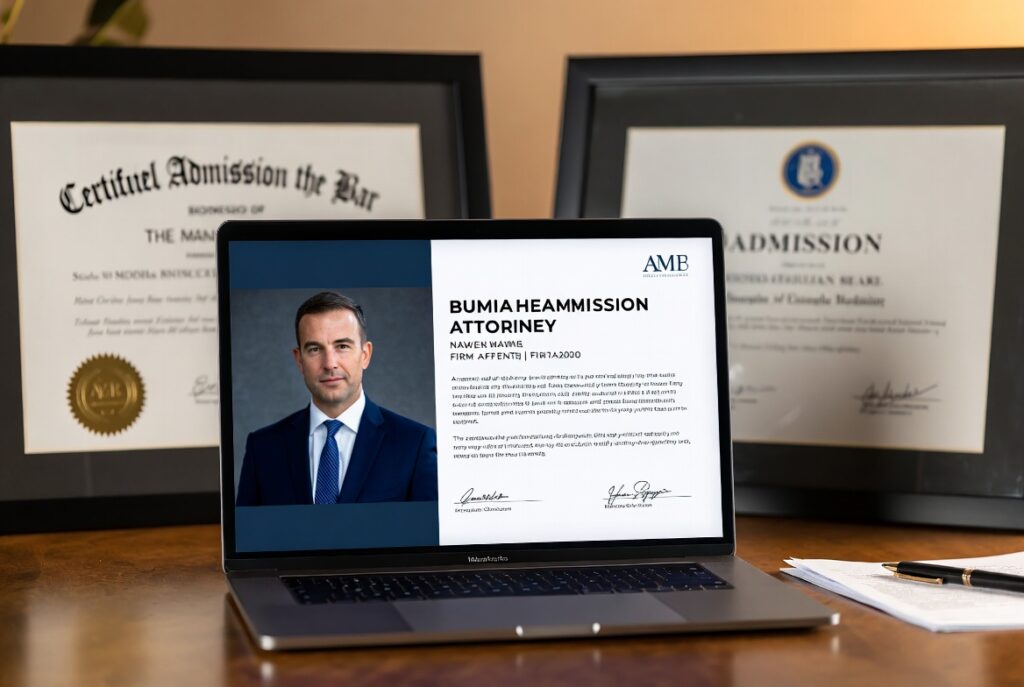
Attorney Bios, Bar Credentials, and Real Signals of Expertise
Google wants to see that the person behind the content is a real, qualified human not a marketing department. That means:
- Full attorney bios with bar admission state and number, law school, years practicing, and notable case types handled.
- Author attribution on content blog posts and practice-area pages should be tied to a named attorney or reviewed by one, not published anonymously.
- Structured data (schema markup) identifying attorneys as Person and the firm as LegalService, so search engines can parse your credentials programmatically, not just read them.
- Consistent credentials across platforms your Google Business Profile, LinkedIn, and website should tell the same story.
If you want a fast gut-check on whether a firm’s site is doing this well, flip it around: read our piece on signs of a bad attorney. Nearly every red flag in that list vague credentials, no verifiable track record, generic promises is also, not coincidentally, a weak E-E-A-T signal to Google. The same things that make a firm hard to trust make it hard to rank.
Advertising Ethics Rules You Can’t SEO Your Way Around
Here’s the section no marketing agency wants to write, because it puts a ceiling on what their content strategy can promise: attorney advertising is regulated, and the rules don’t bend for SEO.
Under ABA Model Rule 7.1, a lawyer can’t make a false or misleading communication about their services and critically, a technically true statement can still violate the rule if it omits context needed to keep it from being misleading (American Bar Association). That single sentence has real teeth for content marketing:
- Case results and settlement amounts need context (case-specific facts, disclaimers that past results don’t guarantee future outcomes) the kind of bare “$2.5 million verdict!” A headline that reads great for engagement can be a compliance problem without it.
- Testimonials are restricted or require disclaimers in a number of states, which matters a lot when “add client reviews” is standard advice in every generic SEO guide.
- Superlatives like “best” or “top-rated” without substantiation invite scrutiny in most jurisdictions.
State bars vary in how strictly they enforce this, so the actual compliance work always needs a lawyer’s sign-off, not a marketer’s guess. But the SEO implication is straightforward: build your trust signals around verifiable specific case types, years of experience, bar credentials, process transparency rather than leaning on the kind of unverified superlatives that both Google’s E-E-A-T systems and your state bar are increasingly skeptical of. It’s a rare case where the ethical path and the ranking path point the same direction.
On-Page Content That Actually Converts
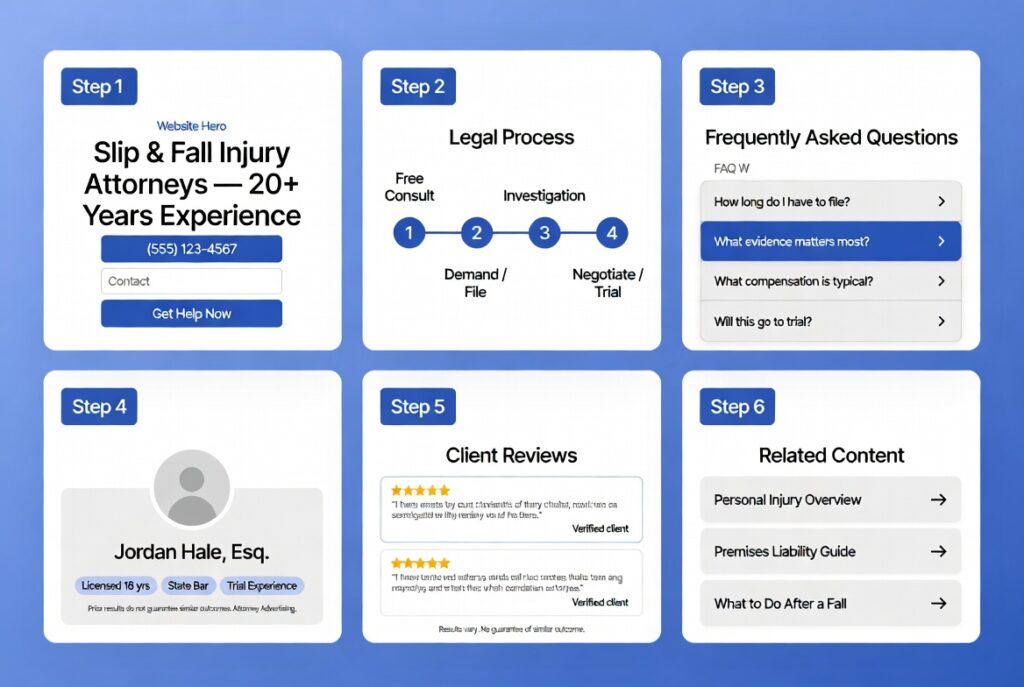
Anatomy of a High-Converting Practice Area Page
“Create quality practice area pages” is common advice and mostly useless without a structure behind it. Here’s the one that consistently works:
- Above the fold: a clear statement of the case type, the firm’s specific experience with it, and a visible way to make contact (phone number, form) no scrolling required to take action.
- A real explanation of the legal process for that case type what happens after someone hires you, in plain language.
- Case-type-specific FAQs addressing the actual questions people have (compensation ranges framed responsibly, statute of limitations, what evidence matters).
- Attorney credentials and case history, compliant with the ad rules above.
- Client reviews, formatted and disclaimed per your jurisdiction’s rules.
- Internal links to related content a slip-and-fall page should link to your general personal injury overview, and vice versa.
Skip any one of these and the page reads thin. Skip several and it reads like every other agency-built template which Google’s helpful-content systems are specifically tuned to discount, since they’re trained partly on spotting exactly that pattern.
FAQ and Schema Markup That Wins Featured Snippets
FAQPage schema markup wraps your on-page FAQ content in a format search engines can lift directly into rich results and AI-generated answers. It’s a small technical addition with outsized upside: a well-marked-up FAQ section is one of the few remaining formats that reliably earns a featured snippet and gets pulled into AI Overviews (more on that below) meaning the same content works double duty across both the old search results and the new AI-driven ones.
Blog Content, Case Studies, and Legal Guides
Beyond practice-area pages, the content that builds long-term authority includes genuine legal guides, ethically-framed case studies, and blog posts answering the informational questions your future clients are actually typing into Google before they’re ready to hire anyone. This is slower-burn content, but it’s what turns a website from “a place to submit a contact form” into a resource people actually trust before they need you.
Two formats worth adding once the basics are solid: video content (a short attorney-recorded explainer builds trust faster than the same text, and increasingly shows up in its own search results) and, in markets with a meaningful Spanish-speaking population, genuinely localized Spanish content not machine-translated pages, but real translated practice-area content and FAQs. Few competitors bother doing this properly, which makes it one of the higher-ROI gaps left to fill.
Local SEO and Google Business Profile for Personal Injury Firms
Local SEO determines whether your firm shows up in the map pack the three listings with pins that appear above the regular organic results for local searches. For a personal injury firm, this is often where the highest-intent traffic lands, because “car accident lawyer [city]” is inherently a local query.
The fundamentals: claim and fully complete your Google Business Profile, keep your name, address, and phone number (NAP) identical across every directory and platform, and treat your profile as a living asset: photos, updated hours, and an accurate service description all factor in.
Multi-Location Firms and the Duplicate Content Trap
Firms operating across multiple cities or states run into a problem single-location firms never see: duplicate content. It’s tempting to build a city landing page for every market you serve by copying the same template and swapping the city name. Google recognizes this pattern immediately, and pages that are 90% identical to each other tend to cannibalize one another instead of all ranking.
The fix is more work but it’s the only one that holds up: each city page needs genuinely unique content, local case results (compliantly framed), local court and venue information relevant to that jurisdiction, local testimonials, and language specific to that market. A page that just says “Serving [City] with the same great service” everywhere isn’t a local SEO asset. It’s a liability.
Generating Reviews Without Violating Ad Rules
Reviews are one of the strongest local ranking signals and one of the most litigated areas of legal advertising at the same time. The safe approach: ask every client for a review as a standard part of case closeout, never offer anything of value in exchange for one (a straightforward ethics violation in most states), and respond to every review good or bad professionally. Responding to reviews is itself a minor but real ranking signal, since it shows an active, monitored profile.
Technical SEO Priorities, Ranked by Actual Impact
Not all technical SEO advice deserves equal attention. Here’s what actually moves the needle for a personal injury site, in rough priority order:
Core Web Vitals: LCP, INP, and CLS Explained
Google measures page experience through three specific metrics known as Core Web Vitals:
- LCP (Largest Contentful Paint): how long it takes the main content of a page to load. Slow-loading hero images or videos on a homepage are a common culprit.
- INP (Interaction to Next Paint): how quickly the page responds when someone clicks or taps something. Bloated JavaScript and third-party chat widgets are frequent offenders.
- CLS (Cumulative Layout Shift): whether elements jump around as the page loads the “I was about to tap the phone number and an ad loaded in and I hit something else” problem.
These matter more for law firms than most industries because so much personal injury traffic is mobile, often from someone searching immediately after an incident on a phone with mediocre signal. A slow, jumpy site isn’t a minor annoyance at that moment, it’s a lost lead.
Site Architecture, Crawling, and Indexing
Beyond page speed, make sure Google can actually find and understand your content: a clean URL structure, an updated XML sitemap, no orphaned pages that nothing links to, and no accidental no index tags left over from a site migration (this happens far more often than it should).
Link Building for Personal Injury Law Firms
Backlinks other sites linking to yours remain one of the clearest authority signals Google uses, and this hasn’t meaningfully changed even as AI search has reshaped everything else. Nearly all top-ranking sites have them; a widely-cited Semrush backlink analysis found that over 92% of top-100-ranking domains had at least one backlink pointing to the page in question, a number that’s held up as a rough industry benchmark since.
Which Legal Directories Are Actually Worth It in 2026
Not every legal directory is worth the listing fee. The ones that still carry genuine authority tend to be the established, vetted ones think Legal 500, Chambers, and state or local bar association directories rather than the low-quality mass directories that exist mainly to sell listings to firms desperate for backlinks. A link from a directory nobody actually uses doesn’t fool Google any more than it fools a prospective client.
Beyond directories, the highest-value links tend to come from genuine media coverage, guest contributions to legitimate legal or local publications, and partnerships with community organizations, the same relationship-building that’s always mattered in local business, just translated into a digital signal.
Showing Up in AI Overviews and AI Search

This is the section that’s genuinely missing from almost every other guide on this topic, and it’s arguably the most consequential shift happening in personal injury SEO right now.
AI Overviews Google’s AI-generated summaries that now appear above traditional search results have fundamentally changed what a click even looks like. A large longitudinal study covering 2.43 billion search impressions across 53 brands found that organic click-through rate on queries triggering an AI Overview collapsed from 1.76% to 0.61% by late 2025, then partially recovered to around 2.4% by early 2026 as Google adjusted how it displays links inside the summaries (Seer Interactive, via Search Engine Land, 2026). Separately, Pew Research found that when an AI summary appears, users click through to any source only about 8% of the time, compared to roughly 15% when no summary is shown.
The part that actually matters for strategy, though: brands cited inside the AI Overview see meaningfully more clicks than brands that aren’t even on the same search result page. Being the source Google’s AI pulls from is starting to matter as much as being the blue link someone scrolls past to get there.
Practical implications for personal injury content:
- Write in a format AI systems can lift cleanly. Direct, well-structured answers to specific questions and the same FAQ and schema approach from earlier are exactly what gets pulled into AI-generated summaries.
- Original data and firsthand specifics travel further than generic explanations. AI systems tend to synthesize generic content into their own summary without crediting a source; specific, verifiable information (actual case-type experience, actual local knowledge) is harder to fully absorb without attribution.
- Don’t abandon ranking for the sake of citation. The two aren’t separate goals pages that rank well in traditional organic results are still the primary pool AI Overviews pull citations from.
None of this means traditional SEO is obsolete. It means the finish line moved from “rank #1” to “be the source that gets cited,” and almost nobody writing about personal injury SEO right now is saying that plainly.
How Long Does Personal Injury SEO Take, and What Does It Cost?
Nobody enjoys this answer, but it’s the honest one: meaningful organic results typically take 6 to 12 months, sometimes longer in the most competitive metro markets. Anyone promising page-one rankings in six weeks is either talking about a keyword nobody’s searching for or setting you up for disappointment.
Cost varies enormously based on whether you’re doing this in-house or hiring out, but budgeting realistically means accounting for content creation, technical maintenance, and link building as three distinct, ongoing line items, not a one-time project with an end date.
DIY vs. Hiring an SEO Agency and How to Vet One If You Do
This is the question every competitor on this topic is structurally incapable of answering honestly, because they’re the vendor. We’re not, so here’s a straight answer.
DIY makes sense if: you’re a solo practitioner or small firm with genuine time to invest, you or someone on staff can write credibly about your practice areas, and you’re realistic that this will take a real chunk of ongoing hours, not a weekend project. If you’re still in the early stages of starting a law firm, building foundational SEO habits from day one clean site structure, real attorney bios, a habit of publishing useful content is far cheaper than retrofitting it later.
Hiring out makes sense if: you’re in a competitive metro market where you’re realistically competing against firms with dedicated marketing budgets, or your time is worth more spent on cases than on content calendars and schema markup.
If you do hire an agency, vet them like you’d vet an expert witness:
- Ask for specific, verifiable past results not just percentage increases, but actual keyword rankings you can check yourself.
- Ask who writes the content, and whether it’s reviewed by someone with actual legal knowledge. Thin generic content is exactly what modern search systems are built to discount.
- Ask how they handle ad-rule compliance on case results and testimonials if they don’t have a real answer, that’s a real problem.
- Avoid long-term contracts with no exit. A firm confident in its results shouldn’t need to lock you in.
- Ask what happens to your content and rankings if you leave. You should own your website and its content outright, not rent it from your marketing vendor.
Frequently Asked Questions
1. What is SEO for personal injury lawyers?
It’s the practice of optimizing a law firm’s website and content so it ranks well in Google’s organic search results for terms potential clients use when searching for legal help after an accident or injury.
2. How much does SEO cost for a personal injury law firm?
Costs vary widely depending on market competitiveness and whether work is done in-house or outsourced, but realistic budgets treat it as an ongoing monthly investment in content, technical maintenance, and link building not a one-time expense.
3. How long does it take to see SEO results for a law firm?
Most firms should expect 6 to 12 months before seeing meaningful ranking improvements, with highly competitive metro markets sometimes taking longer.
4. What are the best keywords for personal injury lawyers?
There’s no single best keyword, the right mix depends on case type (car accident, slip and fall, medical malpractice, etc.), location, and whether you’re targeting informational or transactional search intent.
5. Is SEO worth it for a personal injury attorney?
Yes, particularly because personal injury paid search clicks are among the most expensive in any industry, making organic rankings a comparatively durable, cost-effective channel over time.
6. What is local SEO for personal injury lawyers?
Local SEO focuses on ranking in Google’s map pack and local results for geographically-tied searches, primarily through a fully optimized Google Business Profile, consistent business information across the web, and genuine local content.
7. How many backlinks does a law firm need?
There’s no fixed number quality and relevance matters far more than volume. What’s consistent is that the overwhelming majority of top-ranking pages have at least some backlinks pointing to them.
8. What’s the ROI of SEO vs. PPC for personal injury lawyers?
PPC delivers faster but temporary results tied directly to spend, while SEO takes longer to build but continues generating traffic without an ongoing per-click cost, most competitive firms run both rather than choosing one.
9. Can AI Overviews hurt a law firm’s website traffic?
Yes, in the sense that overall click-through rates on queries with AI Overviews are lower than on those without but firms whose content gets cited inside the AI Overview see meaningfully higher click-through than those that aren’t cited at all.
10. How much do personal injury keywords cost per click on Google Ads?
Personal injury keywords commonly run $50 to $200 or more per click, with some competitive urban markets and mass-tort terms pushing well beyond that.
11. Do personal injury lawyers need a marketing agency for SEO?
Not always solo and small firms with time to invest can build strong foundational SEO in-house, though firms in highly competitive markets often find dedicated agency support worthwhile once the workload outpaces available time.
Final Thoughts
Personal injury SEO isn’t complicated in concept, it’s demanding in execution, and it’s now happening on two fronts at once, traditional rankings and AI-generated answers, where the strategies mostly overlap but occasionally pull in different directions. The firms that will keep winning cases from organic search aren’t the ones chasing every algorithm update. They’re the ones building genuinely useful, genuinely credible content, structured in a way both people and machines can trust and staying honest about how long that actually takes.

Dirk Wasserthal is the Founder and Lead Writer of LegalDiaries.com, an independent legal information platform. He specializes in Mass Torts, Women’s Rights, and emerging legal issues, delivering clear, well-researched, and trustworthy content across Criminal Law, Family Law, Personal Injury, and more. Dirk’s mission is simple — make the law understandable for everyone.