



Kennedy funding lawsuit searches have surged among commercial real estate investors and developers evaluating Kennedy Funding, a private hard-money lender based in Englewood, New Jersey. The lender has closed over $4 billion in loans, yet its history of civil litigation, upfront fee disputes, and online complaints draws intense scrutiny. If you’re considering a bridge loan or land acquisition financing from Kennedy Funding, understanding the fee structure, the major court cases, and the experiences behind the “Kennedy Funding ripoff report” chatter will help you protect your capital before you sign anything. This guide unpacks the full picture in 2026 court rulings, borrower feedback, what the fees really look like, and a due diligence checklist you won’t find elsewhere.
- Who Is Kennedy Funding? (Kennedy Funding New Jersey)
- 1. East Fork Investment Group / Legasus of North Carolina (2009)
- 2. Omni Credit Alliance v. Kennedy Funding (2008–2010)
- 3. Quimera Holding Group SAC v. Kennedy Funding Financial LLC (2020–2025)
- 4. Additional Litigation and Media Coverage
- What Do “Kennedy Funding Ripoff Report” Claims Say?
- Kennedy Funding Reviews and Real Borrower Feedback
- How Kennedy Funding’s Fees Typically Work
- Comparison: Kennedy Funding Fee Structure vs. Other Commercial Lenders
- Unique Practical Guidance Competitors Rarely Cover
- Legal Rights When a Private Loan Does Not Close
- Due Diligence Checklist Before Paying Any Fee
- Red Flags That Predict a Fee Dispute
- What to Do If You’ve Already Paid a Fee and the Loan Is Stalling
- Kennedy Funding in 2026: What’s the Current Landscape?
- Myths vs. Reality – Kennedy Funding Lawsuit Misconceptions
- Detailed FAQ – Kennedy Funding Lawsuit and Borrower Questions
- Balanced Bottom Line
Who Is Kennedy Funding? (Kennedy Funding New Jersey)
Kennedy Funding Inc. (also doing business as Kennedy Funding Financial LLC) is a direct private lender focused on commercial bridge loans, land loans, acquisition financing, and hard-to-place development deals. The company operates from its headquarters at 267 South Dean Street, Englewood, New Jersey 07631, and can be reached at 201-342-8500. Leadership includes CEO/President Kevin Wolfer and Gregg Wolfer. The official Kennedy Funding website continues to announce newly closed loans in 2026, confirming the company remains active.
Although the firm has funded over $4 billion, it is not Better Business Bureau accredited. The BBB profile for Kennedy Funding Inc. currently shows “Not Rated” and includes a historical alert about a separate entity “Kennedy Funding Group” that allegedly copied branding to solicit personal loans. Kennedy Funding reported the identity theft to authorities. Always check the latest BBB Kennedy Funding profile before engaging. Always verify you are dealing with the legitimate Kennedy Funding New Jersey office and not a similarly named copycat.
Key takeaway: Kennedy Funding is a real, long-operating commercial lender in New Jersey. Its operational longevity does not automatically override the fee-related lawsuit pattern.

1. East Fork Investment Group / Legasus of North Carolina (2009)
East Fork Investment Group, LLC (also associated with Legasus of North Carolina) filed a sweeping complaint against Kennedy Funding, Inc. in the U.S. District Court for the District of New Jersey (Case No. 2:09-cv-01193) in March 2009. The complaint, running over 100 pages, alleged breach of contract and related claims after the borrower paid substantial commitment fees and the financing never materialized. You can access official court records through PACER federal court records.
This case is one of the foundational references for anyone researching the “Kennedy funding ripoff report” because the fee structure and borrower expectations became central. While some claims settled or were resolved over time, the 2009 litigation remains a key talking point in online forums.
2. Omni Credit Alliance v. Kennedy Funding (2008–2010)
Omni Credit Alliance, Inc. sued Kennedy Funding seeking the return of $260,000 in application and commitment fees after the loan failed to fund. Following a bench trial, the district court ordered rescission of the agreement, determining both parties had acted with questionable conduct and had breached the implied covenant of good faith and fair dealing. Kennedy Funding appealed, but the Third Circuit largely affirmed the lower court’s reasoning.
This case directly highlights the cost of a Kennedy funding due diligence fee and Kennedy funding commitment fee that are not tied to a successful closing. The court’s willingness to order the return of fees, even when the borrower was not blameless, shows that fee disputes can succeed under New Jersey law.
3. Quimera Holding Group SAC v. Kennedy Funding Financial LLC (2020–2025)
Quimera Holding Group, a Peruvian real-estate company, signed a loan agreement with Kennedy Funding, but the collateral exhibit was left blank. No funds were advanced. Quimera sued to recover millions in commitment fees, alleging breach of contract. The district court initially granted summary judgment against Kennedy Funding. However, in 2025 the U.S. Court of Appeals for the Third Circuit vacated that decision and remanded the case, finding that genuine factual disputes existed regarding what collateral was actually agreed upon. The full opinion is available through the Third Circuit.
The Quimera case illustrates a crucial lesson: blank or incomplete collateral descriptions can lead to years of litigation and uncertain fee recovery. Even when a borrower feels wronged, the outcome depends heavily on what the written documents prove.
4. Additional Litigation and Media Coverage
Other lawsuits, including those involving Stone Harbor Estates and Professional Cleaning, also centered on commitment fee disputes. A 2010 Wall Street Journal article highlighted Kennedy Funding’s litigation activity and allegations of advance-fee practices in New Jersey courts.
Together, these cases establish a clear pattern of advance-fee litigation that every prospective borrower must weigh carefully. To understand the contract principles at stake, resources like Cornell LII contract principles provide a solid foundation.
What Do “Kennedy Funding Ripoff Report” Claims Say?
Across consumer complaint boards, BiggerPockets threads, and independent review sites, the term kennedy funding ripoff report appears consistently with three repeated grievances:
- Large non-refundable due diligence and commitment fees demanded early in the process, often before full underwriting.
- Loans that never closed despite significant upfront payments.
- Poor communication and lack of transparency once the fee is paid.
These are not findings of a single regulatory action; they are aggregated borrower accounts. However, when the same complaints align with federal court dockets like those from East Fork Investment Group and Omni Credit Alliance the volume of anecdotal data becomes harder to dismiss.
Kennedy Funding Reviews and Real Borrower Feedback
Kennedy funding reviews fall into two distinct camps.
Positive experiences: Some borrowers report that Kennedy Funding closed deals others turned down raw land, complex acquisition loans, and quick bridge financing. These borrowers praise the company’s willingness to fund when banks said no, and they accept the higher fees as the price of speed and flexibility.
Negative experiences: Others describe paying $25,000 to $100,000 or more in upfront fees, only to have the loan stall, collapse, or be declined after the due diligence process. The most common frustration is that the Kennedy funding due diligence fee was solicited before any meaningful underwriting and without a clear path to a closing.
Case scenario: A developer in Florida needed $5 million for a land acquisition. After a phone consultation, Kennedy Funding requested a $50,000 non-refundable commitment fee to start the process. The developer paid, provided documents, but after months of review, the loan was denied for insufficient collateral. The fee was lost, and the developer had no recourse because the contract clearly stated the fee was non-refundable. This scenario, repeated with variations, is the backbone of many negative reviews.
The takeaway: Kennedy funding reviews are polarized, but the fee structure and documentation determine which side a borrower lands on.
How Kennedy Funding’s Fees Typically Work
Private lenders often charge several fees. Kennedy Funding’s model, as described in multiple lawsuits and borrower accounts, typically includes:
| Fee Type | Typical Timing | Usually Refundable? | Purpose |
| Application / Due Diligence Fee | Early stage, after preliminary information | Often non-refundable | Covers initial underwriting and document review |
| Commitment Fee | After term sheet or commitment letter | Frequently non-refundable | Locks in the lender’s commitment to fund |
| Appraisal / Legal Fees | During due diligence | Sometimes credited at closing | Third-party costs passed through |
Critical distinction: Many competing bridge and hard-money lenders do not require large non-refundable fees until much later in the process, and some will credit the due diligence fee toward the points at closing. Kennedy funding fees, especially the Kennedy funding commitment fee, often become a sunk cost the moment you wire funds.
Always ask: If the loan fails to close for reasons beyond my control, is any fee refundable? Get the answer in writing and have it reviewed by an attorney. A verbal assurance carries zero weight in court.

Comparison: Kennedy Funding Fee Structure vs. Other Commercial Lenders
| Feature | Kennedy Funding | Typical Hard Money Lender | Traditional Bank |
| Upfront Due Diligence Fee | $5,000–$50,000+ (often non-refundable) | $0–$2,500 (often credited at closing) | $0–$500 (application fee only) |
| Commitment Fee | 1%–3% of loan amount, non-refundable | Rare; or refundable under certain conditions | None or nominal |
| Speed to Closing | 2–4 weeks advertised | 1–3 weeks | 45–90 days |
| Collateral Flexibility | Accepts raw land, complex deals | Accepts non-owner-occupied, fix-and-flip | Strict underwriting |
| Regulatory Oversight | Light (private lender) | Light to moderate | Heavy (federal and state) |
What this means for you: If your deal is high-risk or time-sensitive, Kennedy Funding’s flexibility might be appealing. But the non-refundable fee exposure is substantially higher than industry norms. Never pay a Kennedy funding due diligence fee without a detailed, written explanation of what it covers and under what circumstances if any it can be refunded.
Unique Practical Guidance Competitors Rarely Cover
Legal Rights When a Private Loan Does Not Close
Under New Jersey law and general contract principles, borrowers may have claims for:
- Breach of contract (if the lender failed to perform as agreed)
- Rescission (undoing the contract and returning fees, as in the Omni Credit case)
- Breach of the implied covenant of good faith and fair dealing
- New Jersey Consumer Fraud Act remedies, if the facts support a consumer transaction (commercial loans may not always qualify, but courts sometimes apply the Act to certain lending practices)
Outcomes depend entirely on the written agreement. Understanding the difference between an attorney and a lawyer and hiring counsel with commercial lending dispute experience is non-negotiable. You can start with self-help resources like the New Jersey courts self-help center, but nothing replaces a qualified lawyer reviewing your specific documents.

Due Diligence Checklist Before Paying Any Fee
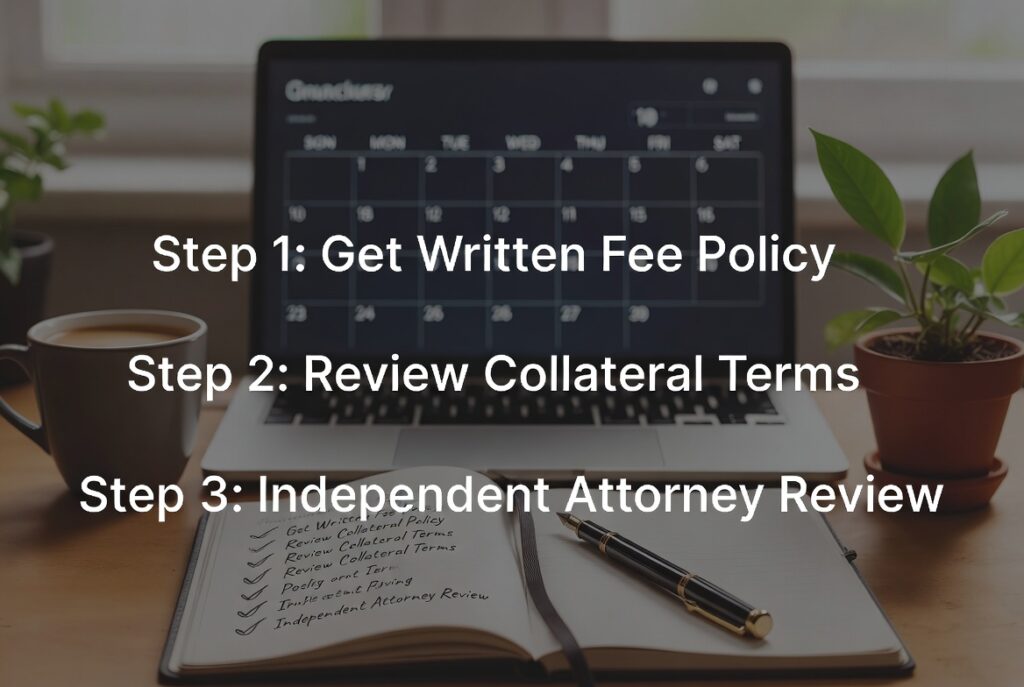
1. Request a written fee schedule with refund conditions, if they won’t put it in writing, walk away.
2. Confirm the commitment letter identifies the collateral precisely, with legal descriptions matching the property documents. A blank collateral exhibit, like in the Quimera case, is a massive red flag.
3. Ask directly: “If the loan does not close for reasons outside my control, what portion of my fees will be refunded?” Get the answer in writing.
4. Engage an independent real estate attorney to review every document before you sign or wire money.
5. Compare at least three other private lenders and their fee models. If the non-refundable fee is far above market, that extra cost must be justified by a higher probability of closing.
6. Verify you are dealing with the actual Englewood, New Jersey company, not a copycat. Check the official website and call the published phone number.
7. Check public court records (PACER federal court records, state court databases) for recent lawsuits involving the lender.
Red Flags That Predict a Fee Dispute
- Pressure to wire the due diligence fee within 48 hours “to lock the rate.”
- Verbal promises that the fee is “fully refundable” that are absent from the written agreement.
- Reluctance to share a sample commitment letter before you pay.
- Collateral descriptions that are vague or left blank.
- Inability to provide recent borrower references who closed similar deals.
What to Do If You’ve Already Paid a Fee and the Loan Is Stalling
1. Document everything, emails, texts, wire confirmations, call notes.
2. Send a formal written demand for a status update and a clear timeline, referencing the commitment letter.
3. Consult an attorney immediately if the lender misses the closing deadline or requests additional non-refundable fees.
4. Do not pay more money in hopes of salvaging the deal without legal review.
5. Explore potential claims including breach of contract and rescission, especially if collateral terms were never finalized. The ABA commercial lending resources can help you understand your legal footing.
Kennedy Funding in 2026: What’s the Current Landscape?
The company remains active and continues to promote closed loans on its website. The 2025 Quimera Holding Group appellate decision did not end the litigation; it sent the case back for trial, meaning fee-dispute risk is still very present in 2026. No regulatory agency has shut down Kennedy Funding, and it continues to operate from its New Jersey headquarters.
What this means for you: Operational status does not guarantee that your experience will be smooth. The historical pattern of advance-fee litigation is still relevant. In 2026, borrowers have access to more online information than ever, which makes thorough vetting easier but only if you use it before wiring money.
Myths vs. Reality – Kennedy Funding Lawsuit Misconceptions
Myth: “If a lender has been sued, it must be a scam.”
Reality: Lawsuits in commercial lending are common and do not automatically mean fraud. However, a pattern of similar claims about upfront fees that never resulted in a funded loan warrants extra caution, not dismissal.
Myth: “The BBB rating proves a company is safe.”
Reality: Kennedy Funding’s BBB profile is “Not Rated,” and the BBB is a private organization, not a government regulator. A lack of rating does not confirm legitimacy or illegitimacy.
Myth: “A non-refundable commitment fee is always standard for hard money loans.”
Reality: Many reputable hard money lenders charge minimal upfront fees, and some do not charge a commitment fee at all until underwriting is complete. Kennedy Funding’s fee model is at the high end of the spectrum.
Myth: “If I pay the fee, the loan will definitely close.”
Reality: The fee does not guarantee funding. Dozens of borrower accounts and court records show fees paid and deals that died.
Detailed FAQ – Kennedy Funding Lawsuit and Borrower Questions
Q-1: Is Kennedy Funding a legitimate company?
A: Yes, Kennedy Funding is a legitimate, long-operating commercial private lender based in Englewood, New Jersey, with billions in funded loans. However, legitimate status does not eliminate the history of fee-related lawsuits and online complaints.
Q-2: What is the Kennedy Funding ripoff report about?
A: The phrase “Kennedy funding ripoff report” typically refers to aggregated online complaints alleging that borrowers paid large non-refundable due diligence and commitment fees for loans that never closed. While not a single official report, the pattern matches themes found in multiple court cases.
Q-3: What are Kennedy Funding’s typical fees?
A: Kennedy Funding fees include a non-refundable due diligence fee (often $5,000 to $50,000+), a non-refundable commitment fee (1% to 3% of the loan amount), and third-party appraisal/legal fees. The commitment fee and due diligence fee are frequently the subject of disputes.
Q-4: Has Kennedy Funding been sued for not returning fees?
A: Yes. The Omni Credit Alliance lawsuit resulted in a court order for rescission and return of $260,000 in fees. The East Fork Investment Group and Quimera Holding Group cases also centered on commitment fees for loans that did not fund.
Q-5: Can I get my commitment fee back if the loan doesn’t close?
A: It depends on the contract terms and the reason the loan failed. If the contract says the fee is non-refundable and the lender acted in good faith, recovery is difficult. However, if the lender breached the agreement or acted unfairly, courts have ordered refunds, as in Omni Credit Alliance.
Q-6: What happened in the Quimera Holding Group lawsuit?
A: Quimera Holding Group paid millions in commitment fees, but the collateral exhibit was blank. The district court initially ruled against Kennedy Funding, but in 2025 the Third Circuit vacated that decision, sending the case back because facts about the collateral were disputed. The case is ongoing.
Q-7: Is Kennedy Funding still operating in 2026?
A: Yes, Kennedy Funding continues to originate commercial loans and maintains its New Jersey office. Before engaging, always verify you are dealing with the legitimate Englewood entity.
Q-8: Where can I find real Kennedy Funding reviews?
A: Reviews appear on BiggerPockets, private lending forums, and consumer complaint sites. Look for detailed accounts that mention specific fee amounts, timelines, and whether the loan closed. Be wary of overly generic or anonymous posts.
Q-9: Should I pay a Kennedy Funding due diligence fee?
A: Only after you have a written fee schedule, a clear refund policy, a complete commitment letter with precise collateral, and an independent attorney’s review. Compare with other lenders and never pay more than you are willing to lose if the deal falls through.
Q-10: Does the BBB profile say Kennedy Funding is a scam?
A: The BBB profile shows “Not Rated” and an alert about a copycat entity. It does not currently label Kennedy Funding Inc. as a scam, but it also does not endorse it. Always corroborate multiple sources.
Balanced Bottom Line
Kennedy Funding is a real, functioning private lender in New Jersey with a substantial portfolio of closed loans. Simultaneously, the public court record from the 2009 East Fork Investment Group complaint through the 2010 Omni Credit Alliance decision to the ongoing Quimera Holding Group litigation in 2025 demonstrates a recurring theme of advance-fee and commitment-fee litigation when loans are not funded.
The existence of lawsuits does not mean every Kennedy Funding deal is doomed. It means that any borrower who considers paying a non-refundable fee must treat that payment as high-risk cash, demand written clarity on every term, and hire experienced legal counsel before wiring a dollar.
If you’re evaluating civil litigation risks more broadly, understanding how evidence and documentation influence outcomes similar to what we cover in our overview of chances of winning a personal injury lawsuit can help you appreciate the importance of solid paperwork in any fee-disputed scenario. Likewise, our article on conservatorship vs power of attorney shows how specific legal instruments can protect your financial interests, a principle that applies to structuring loan commitments.
Final advice: No amount of flexibility or speed justifies losing tens of thousands of dollars on a loan that never funds. Vet the lender, negotiate the fees, and get it in writing.
Disclaimer: This article summarizes publicly available court records, company information, news reports, and borrower discussions for informational purposes only. It is not legal advice. Always consult a qualified attorney about your specific situation before paying fees or signing loan documents.

Dirk Wasserthal is the Founder and Lead Writer of LegalDiaries.com, an independent legal information platform. He specializes in Mass Torts, Women’s Rights, and emerging legal issues, delivering clear, well-researched, and trustworthy content across Criminal Law, Family Law, Personal Injury, and more. Dirk’s mission is simple — make the law understandable for everyone.