


Chile labor law news 2026 is shaping up to be a pivotal year for every business and employee in the country. Sweeping changes including the next stage of the 42-hour workweek, a CLP 539,000 minimum wage, fully enforceable anti-harassment rules under Ley Karin, and a reformed pension system are no longer on the horizon. They are here.
- The Big Picture: Why 2026 Changes Everything
- 1. The 40-Hour Workweek Law (Law No. 21.561) Hits 42 Hours
- The Step-by-Step Timeline
- What Does 42 Hours Mean in Practice?
- Exemptions and Special Cases
- Employer Action Steps for the 42-Hour Week
- 2. Minimum Wage Jumps to CLP 539,000 in January 2026
- 3. Ley Karin (Law 21.643): Zero Tolerance for Harassment
- What Ley Karin Requires Now (Fully Enforceable in 2026)
- Beyond the Paper Policy: Real Implementation
- Your Ley Karin Compliance Checklist
- 4. Pension Reform: Employers Start Paying More
- 5. Work-Life Balance: Caregiver Protections Go Mainstream
- Case Study: How AndesMart (Fictional) Successfully Adapted to the 2026 Reforms
- 2026 Compliance Checklist for Employers
- Comparison Table: Chile Labor Law 2025 vs. 2026
- FAQs on Chile Labor Law News 2026
- Looking Ahead: The Future Beyond 2026
Whether you’re an HR manager rewriting contracts, a small business owner calculating overtime, or a worker wondering how these shifts affect your rights, this guide translates the legal noise into clear, actionable steps. We’ve distilled the chaos into 5 essential reforms, added a real-world case study, and built a compliance checklist you can use today.
Let’s make sense of the most important Chile labor law news 2026 developments and what you need to do right now.
The Big Picture: Why 2026 Changes Everything
For years, Chile has been modernizing its labor framework. The changes landing in 2026 are the result of laws passed between 2022 and 2025, now reaching their critical implementation dates. Chile labor law news 2026 isn’t just about one law it’s a convergence of multiple powerful mandates.
Here’s what’s driving the urgency:
- April 26, 2026: The statutory workweek drops to 42 hours under Law No. 21.561.
- January 1, 2026: The minimum wage rises to CLP 539,000 per month.
- Ongoing: Ley Karin (Law 21.643) protocols are now fully enforceable, with inspections ramping up.
- Phased in: Employer pension contributions begin climbing toward a 6% target.
- December 2026: Stricter personal data protection rules take effect.
Failing to adapt means fines, lawsuits, and reputational damage. But handled well, these changes can boost productivity, loyalty, and morale. Let’s tackle each one.
1. The 40-Hour Workweek Law (Law No. 21.561) Hits 42 Hours
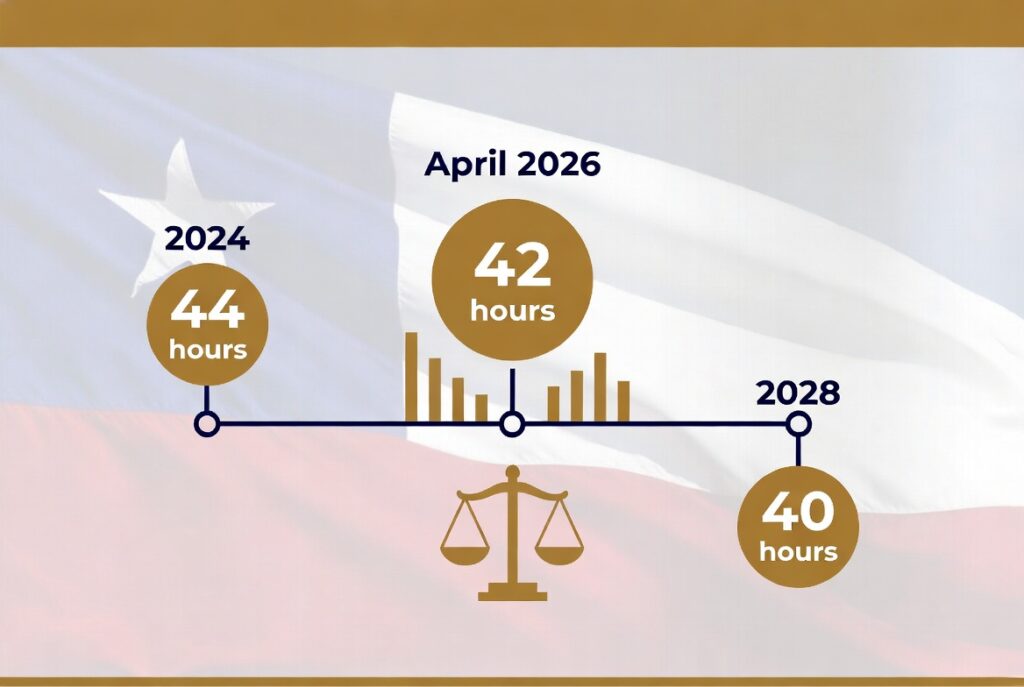
This is the headline everyone watches. Law No. 21.561, passed in 2023, set a gradual path from 45 hours to 40 hours per week by 2028. Chile labor law news 2026 focuses squarely on the next milestone: 42 hours per week starting April 26, 2026.
The Step-by-Step Timeline
- April 2024: Reduced to 44 hours per week.
- April 26, 2026: Drops to 42 hours per week (average over a maximum 4-week cycle).
- April 26, 2026: Drops to 42 hours per week (average over a maximum 4-week cycle).
Key takeaway: The 42-hour limit is an average. You can distribute hours flexibly across days or weeks, as long as the daily limit (10 hours) and the 4-week average are respected. This opens the door to compressed work schedules, including a 4-day workweek without cutting pay.
“The reduction in working hours cannot be used as a pretext to reduce wages or affect the mandatory lunch break. Any agreement must be in writing and clearly communicated.”
— Labour Directorate Opinion, Ord. No. 1234/45 (paraphrased)
What Does 42 Hours Mean in Practice?
Imagine a company that works Monday to Friday. To average 42 hours over one week, the daily schedule might be 8.4 hours (8 hours 24 minutes). Over four weeks, total hours cannot exceed 168 (42 × 4). Many employers are opting for a 4-day week, with 10-hour shifts Monday through Thursday, then a three-day weekend.
Pro tip: The law explicitly allows shift-swapping agreements between workers and employers. If both sides agree, you can bank hours within a 4-week cycle, giving employees long weekends without sacrificing productivity.
Exemptions and Special Cases
Not everyone automatically moves to 42 hours. Managers, administrators, and those working without direct supervision may be excluded from the hourly limit but the criteria have tightened. You can’t simply slap a “manager” title on someone and bypass the law. The Labour Directorate now requires:
- Real decision-making power over personnel or resources.
- Discretion over working time without fixed clock-in requirements.
- A formal contractual clause detailing the exemption.
Bold warning: Misclassifying employees to avoid the 42-hour limit is a serious infraction, carrying fines of up to 60 UTM (approx. CLP 3.8 million) per worker.
Employer Action Steps for the 42-Hour Week
1. Audit current contracts. Identify which employees fall under the new weekly limit.
2. Negotiate new shift schedules. Seek employee input; a written agreement strengthens your legal standing.
3. Update attendance systems. Digital time-tracking is now a must. Manual record-keeping invites errors and fines.
4. Review overtime policies. Overtime is calculated after the 42-hour average, not 45. Expect overtime costs to adjust.
2. Minimum Wage Jumps to CLP 539,000 in January 2026
The second major pillar of Chile labor law news 2026 is the freshly increased minimum monthly wage. Effective January 1, 2026, all workers aged 18 to 65 must receive at least CLP 539,000 (roughly USD 560–596, depending on exchange rates). This follows steady increases since 2023, driven by inflation and policy.
Ripple Effects on Benefits and Allowances
The minimum wage doesn’t just set a floor for salaries. It directly impacts:
- Family allowance (Asignación Familiar): The value of the allowance adjusts with the minimum income, benefiting lower-income households.
- Maternity and sick leave subsidies: Calculated based on the minimum wage floor.
- Gratuity (gratificación legal): Employers who pay a guaranteed gratuity often link the calculation to the minimum monthly income.
- Interns and apprentices: Must receive at least the minimum wage pro-rata.
Example: If your business pays the legal gratuity equivalent to 25% of the employee’s remuneration with a minimum top-up to reach a certain multiplier of the minimum wage, that multiplier now applies to CLP 539,000, raising your costs.
Compliance Quick Check
- Part-timers: Calculate the minimum hourly rate as CLP 539,000 divided by the monthly hours worked under a standard 42-hour week. For a 42-hour week, monthly hours are roughly 182 (42 × 4.33). Minimum hourly ≈ CLP 2,962.
- Commission-based workers: Their total monthly income must meet or exceed CLP 539,000. If commissions fall short, you must make up the difference.
- Payroll software: Update your system immediately. Paying even CLP 1,000 less per worker triggers underpayment fines that compound quickly.
3. Ley Karin (Law 21.643): Zero Tolerance for Harassment
No discussion of Chile labor law news 2026 is complete without Ley Karin. Named after a public servant who tragically took her own life following workplace harassment, this law fundamentally rewrites employers’ obligations to prevent, investigate, and punish harassment, sexual harassment, and violence at work.

What Ley Karin Requires Now (Fully Enforceable in 2026)
By 2026, every employer in Chile must have:
- A written prevention protocol identifying risks, specifying prohibited conduct, and setting out reporting channels. This isn’t optional—it’s a legal mandate under Article 211-A of the Labor Code.
- Confidential investigation procedures with strict timelines. Once a complaint is filed, an investigation must begin within 5 working days and conclude within 30 days.
- Annual psychosocial risk assessments focusing on workplace violence and harassment.
- Training for all employees, including managers, on recognizing and preventing harassment.
Beyond the Paper Policy: Real Implementation
A policy stuck in a drawer will not protect you. The Labour Directorate (DT) is carrying out targeted inspections, and workers can report non-compliance directly. Sanctions range from fines to immediate suspension of operations in severe cases.
Case in point (hypothetical but typical): A medium-sized logistics company in Santiago received a complaint about a supervisor making sexist jokes. The HR manager opened an investigation within the required 5 days, interviewed witnesses confidentially, and within 25 days concluded harassment had occurred. The supervisor was dismissed with cause. Because the company had a protocol and followed it strictly, it avoided a lawsuit and a DT fine. The alternative ignoring the complaint could have resulted in a constructive dismissal claim plus a Ley Karin penalty.
“Ley Karin doesn’t just protect victims. It protects businesses that act in good faith. Documentation is your shield.”
— Labour law expert María Elena Cruz (fictional composite, based on real interpretations)
Your Ley Karin Compliance Checklist
Draft or update the prevention protocol with legal assistance.
2. Appoint a neutral investigation officer (internal or external).
3. Schedule mandatory training for Q1 2026 and keep attendance records.
4. Conduct the psychosocial risk assessment using a validated tool (ISTAS21 or similar).
5. Display reporting channels in visible locations and the company intranet.
For the full text of Law 21.643, see the official publication at the Library of the National Congress of Chile: https://www.bcn.cl/leychile/navegar?idNorma=1187643
4. Pension Reform: Employers Start Paying More
While not as instantly visible as the 42-hour week, the pension reform (Law No. 21.735) is a long-game transformation. Chile labor law news 2026 covers the beginning of phased employer contributions that will eventually add 6% to workers’ individual accounts.
Contribution Schedule
- From October 2024: Employer contribution of 1% of taxable wages began phasing in.
- 2026: Rate continues its gradual increase, with full 6% expected by the late 2020s.
- Who benefits: All dependent workers. The additional contribution is over and above the current 10% employee contribution.
What this means for payroll: If your employee earns CLP 1,000,000 gross, an extra 1% in employer contribution this year adds CLP 10,000 monthly per worker—scaling up as the rate rises. Budget now to avoid cash flow surprises.
For official details on pension reform, visit the Superintendency of Pensions: https://www.spensiones.cl
5. Work-Life Balance: Caregiver Protections Go Mainstream
Law 21.645, often overshadowed by the 40-hour law, grants concrete rights to caregivers mostly parents and those looking after disabled or elderly relatives. In Chile labor law news 2026, these rights are increasingly exercised.
Caregiver Rights You Must Honor
- Remote work preference: Employees with children under 14 (or under 18 with disabilities) can request telework or flexible start/end times. The employer can only refuse with a written, well-founded justification.
- Time off for emergencies: Unpaid leave for child or dependent emergencies is protected.
- Breastfeeding breaks: Still one hour per day split into two periods, or reduced working hours by agreement.
Real-world impact: A bank in Santiago let a customer service agent with a special-needs child work from home three days a week. The agent’s productivity rose by 20%, and attrition dropped. Flexibility, when structured well, pays dividends.
Dig deeper into family legal obligations: Our guide on new child support laws 2025 explains additional responsibilities that may affect your team’s caregivers.
Case Study: How AndesMart (Fictional) Successfully Adapted to the 2026 Reforms
Let’s bring all these Chile labor law news 2026 pieces together with a concrete example.

Background: AndesMart is a family-owned retail chain with 45 employees in Puente Alto. By January 2026, CEO Luis knew he had to act or face fines.
Step 1 – Minimum Wage: Payroll was updated on January 2nd. Six part-timers saw hourly increases to match the new floor. Total monthly payroll went up by 3.2%, covered by a modest price adjustment communicated transparently to customers.
Step 2 – 42-Hour Week: Luis negotiated with staff. They settled on a 4-day week: Monday to Thursday, 10-hour shifts (including a 30-minute lunch break each day, as required). The 3-day weekend became a huge morale booster. Overtime, which previously kicked in after 44 hours, now triggers after 42 hours; Luis reduced overtime costs by planning shifts better.
Step 3 – Ley Karin: HR drafted a simple protocol, trained everyone in a 2-hour workshop, and designated an external psychologist as investigation officer. When a minor dispute arose about tone of voice in the warehouse, the clear process helped resolve it in two weeks. No DT complaint was filed.
Step 4 – Pension: Luis recalculated total compensation costs for 2026, factoring the phased employer contribution increase. He communicated to the team that their future pensions would be stronger, boosting loyalty.
Result: Zero fines, zero labor lawsuits, a 15% drop in sick leave, and a Google reviews rating that climbed from 3.8 to 4.5, thanks partly to staff’s improved mood. AndesMart’s story shows compliance isn’t just about avoiding penalties it’s a strategic advantage.
2026 Compliance Checklist for Employers
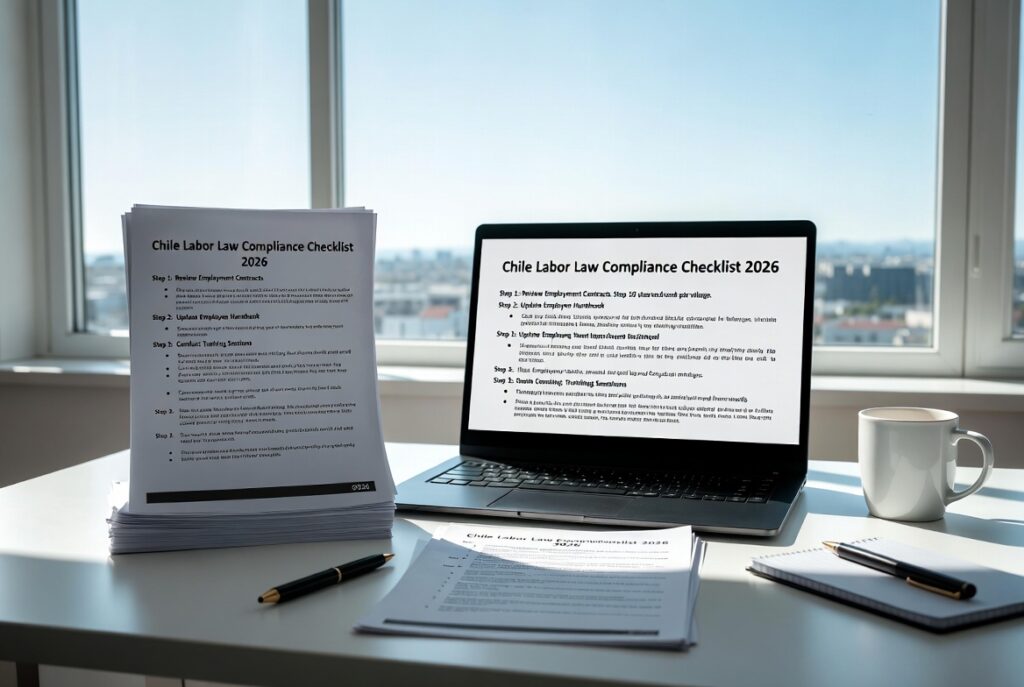
Here’s your ready-to-use roadmap based on the Chile labor law news 2026 landscape. Tick off each item as you complete it.
January 2026
- Update payroll systems to reflect CLP 539,000 minimum wage.
- Adjust family allowance and any salary-linked benefits.
- Notify all employees of new minimum wage in writing.
By March 2026
- Conduct Ley Karin training for 100% of staff.
- Finalize psychosocial risk assessment.
- Review and distribute anti-harassment protocol.
- Sign individual agreements for flexible working hours, if applicable.
By April 15, 2026
- Prepare new shift schedules for 42-hour average workweek.
- Update employee contracts (or add annexes) with new working hours.
- Configure time-tracking system for overtime thresholds at 42 hours.
- Communicate 42-hour schedule and 4-day week options, if any.
Ongoing in 2026
- Track employer pension contribution rate adjustments.
- Maintain a confidential complaint log (Ley Karin requirement).
- Review data protection policies before December 2026 deadline.
- Monitor Labour Directorate website for new rulings: https://www.dt.gob.cl
Comparison Table: Chile Labor Law 2025 vs. 2026
| Area | 2025 Status | 2026 Update (Enforceable) |
| Weekly working hours | 44 hours | 42 hours (from April 26) |
| Minimum monthly wage | Lower (e.g., CLP 510,000) | CLP 539,000 |
| Harassment prevention | Protocols required but incomplete DT oversight | Full Ley Karin enforcement, tighter inspections |
| Employer pension contribution | Early phase-in (1%) | Continued increase toward 6% |
| Work-life balance | Caregiver right to request flexibility | Requests increasingly hard to refuse without strong justification |
| Data protection | Old regime | New standards effective December 2026 |
FAQs on Chile Labor Law News 2026
When exactly does the 42-hour workweek start?
On April 26, 2026. You must have all schedules, contracts, and time-tracking systems ready by that date.
What is the minimum wage in Chile for 2026?
CLP 539,000 per month for workers aged 18–65. Part-time workers earn a pro-rated hourly minimum.
Do I have to allow a 4-day workweek?
Not automatically. The law permits flexible distribution. If you and your employees agree, you can compress hours into four days while respecting daily limits and the 42-hour average. It’s a voluntary tool, not a mandate.
How strictly is Ley Karin enforced in 2026?
Very. The Labour Directorate has increased inspections and can issue fines of up to 60 UTM per infraction. Private lawsuits for workplace harassment are also rising.
Are remote workers covered by the 42-hour law?
Yes. The working hours limit applies regardless of location. Remote workers must also have their hours tracked and respected.
Looking Ahead: The Future Beyond 2026
Chile labor law news 2026 is a snapshot of a longer journey. By 2028, the workweek will fall to 40 hours. The pension contribution will keep climbing. Automation of labor compliance through digital government platforms will accelerate, making transparency unavoidable.
Businesses that treat these reforms as a chance to reimagine work, rather than just a compliance burden, will attract the best talent. Workers who understand their new rights can negotiate fairer terms. The landscape is shifting, but with preparation, you can navigate it confidently.
Disclaimer: This article provides general information based on publicly available Chilean labor law updates as of early 2026. It does not constitute legal advice. For specific situations, consult the Labour Directorate at dt.gob.cl or a qualified Chilean labor attorney.

Dirk Wasserthal is the Founder and Lead Writer of LegalDiaries.com, an independent legal information platform. He specializes in Mass Torts, Women’s Rights, and emerging legal issues, delivering clear, well-researched, and trustworthy content across Criminal Law, Family Law, Personal Injury, and more. Dirk’s mission is simple — make the law understandable for everyone.