


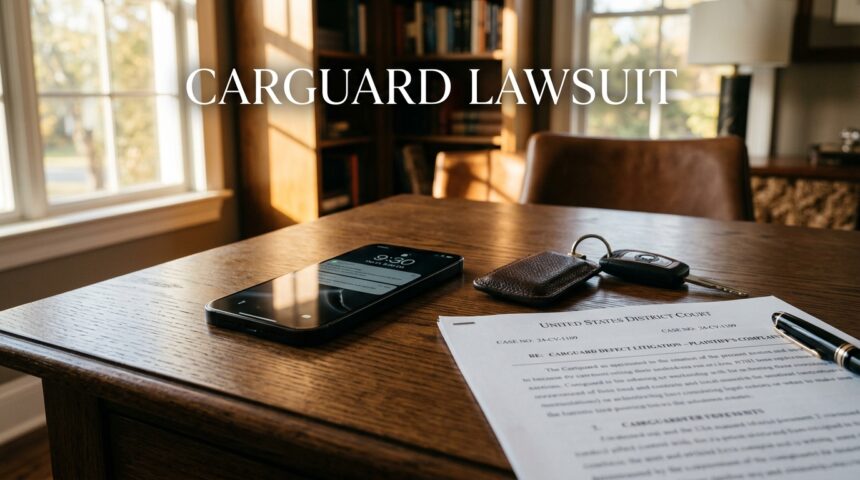
The CarGuard lawsuit is not one single case. It is actually two very different legal fights that happen to share the same company name.
- Who Is CarGuard Administration?
- The Two Completely Different “CarGuard Lawsuit” Stories
- The Actual Court Cases: A Timeline
- Is There a CarGuard Class Action Settlement Right Now?
- Do You Qualify? Two Very Different Eligibility Tests
- Myth vs Fact
- What to Do If You Think You Have a Claim
- How This Compares to Other Robocall and Auto Class Actions
- Frequently Asked Questions
- The Bottom Line
Here is the short version. There is no confirmed class action settlement open for CarGuard claims right now. What exists instead are separate lawsuits over illegal robocalls, plus a steady stream of individual complaints about denied extended warranty claims.
This matters because the answer to “can I get money from this” depends entirely on which problem you actually had. A robocall claim and a denied repair claim follow completely different rules. Let’s walk through both, so you know exactly where you stand.
Who Is CarGuard Administration?
CarGuard Administration is a company that sells vehicle service contracts. Most people just call these extended warranties.
A vehicle service contract is a promise to pay for certain repairs after your car’s factory warranty runs out. You pay a monthly fee or a lump sum, and in exchange, the company covers specific mechanical problems if something breaks. The Federal Trade Commission actually defines the difference between a warranty and a service contract pretty clearly. A warranty comes free with your car. A service contract is something you buy separately, and it’s sold by all kinds of companies, not just the manufacturer.
CarGuard does not always call you directly to sell these plans. Like a lot of companies in this space, it leans on outside marketing firms and telemarketers to bring in customers. That setup is exactly where most of the legal trouble started.
Picture it this way. Imagine a bakery that hires a delivery driver to hand out flyers. If that driver runs red lights while delivering the flyers, is the bakery responsible? That question, stretched over years of lawsuits, is basically the entire CarGuard legal story.
The Two Completely Different “CarGuard Lawsuit” Stories
Almost every article you’ll find online blends two totally separate problems together. Let’s pull them apart.
Track one is about the phone. This is the CarGuard TCPA lawsuit side of things. TCPA stands for the Telephone Consumer Protection Act, a federal law that makes it illegal to send automated or prerecorded sales calls to your cell phone without your permission. You do not need to have ever bought a CarGuard warranty to have this kind of claim. If your phone rang with a recorded voice pitching an “extended warranty,” that alone can be enough.
Track two is about the contract. This is the CarGuard extended warranty lawsuit and claim denial side. These are complaints from people who actually bought a plan, then had a repair claim turned down. Maybe the company said the damage was a pre-existing condition. Maybe a maintenance record was missing. This is closer to a breach of contract dispute than anything involving the TCPA.
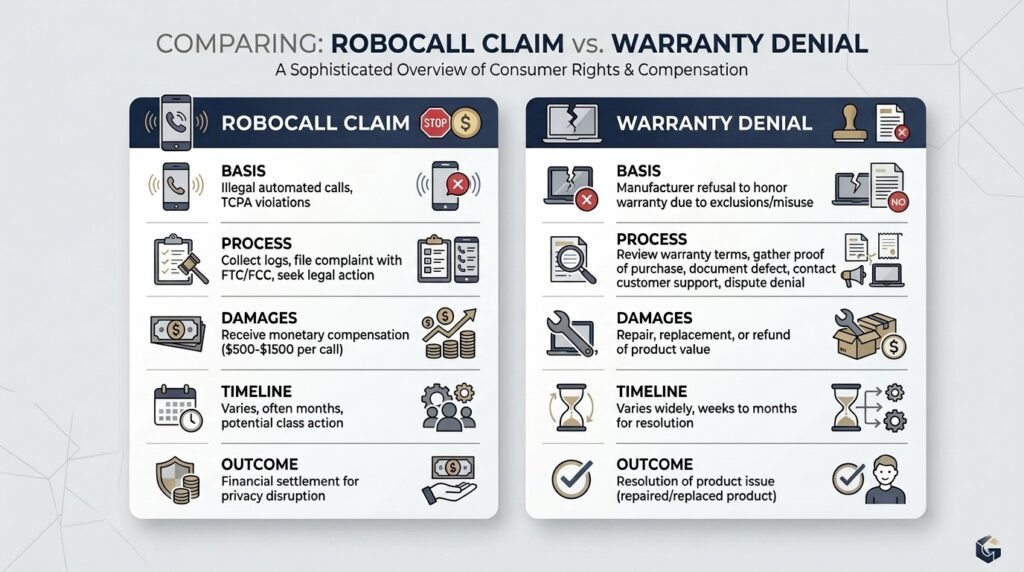
Here’s a quick way to sort yourself into the right bucket. Did your problem start with an unwanted phone call, or did it start with a claim you filed getting rejected? That one question decides almost everything else in this article.
The Actual Court Cases: A Timeline
A lot of blog posts throw around names like Baccari, Barrett, and Fleming without explaining what actually happened in each case. Let’s go through them one at a time, using the real court records.
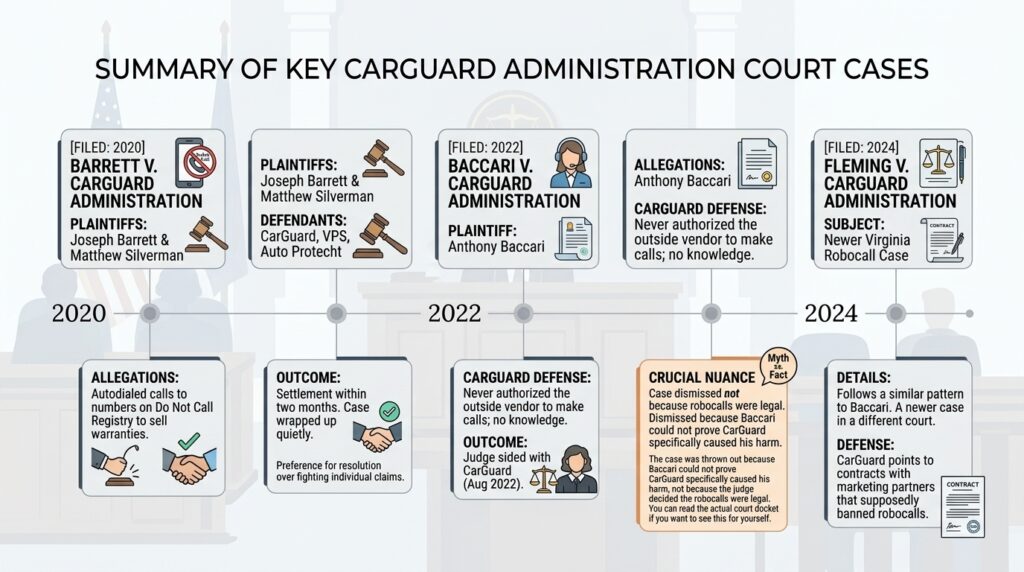
Barrett v. CarGuard Administration, filed in 2020. Joseph Barrett and Matthew Silverman sued CarGuard along with two of its marketing partners, Vehicle Protection Specialists and Auto Protecht. They said the companies made autodialed calls to numbers on the Do Not Call Registry to sell CarGuard warranties. Within about two months, the parties reached a settlement and the case wrapped up quietly. This was one of the earliest signs that CarGuard preferred to resolve individual robocall claims rather than fight them.
Baccari v. CarGuard Administration, filed in 2022. Anthony Baccari said he got telemarketing calls about auto warranties even though his number was on the Do Not Call Registry. He argued CarGuard should be on the hook for calls placed by an outside vendor working on its behalf. CarGuard pushed back, saying it had never told the vendor to make those calls and had no idea it was happening. The judge sided with CarGuard in August 2022, but here’s the part most articles skip. The case was thrown out because Baccari could not prove CarGuard specifically caused his harm, not because the judge decided the robocalls were legal. You can read the actual court docket if you want to see this for yourself.
Fleming v. CarGuard Administration, filed in 2024. This is a newer robocall case, filed in a different court in Virginia. It followed a similar pattern to Baccari, with CarGuard again pointing to its contracts with marketing partners that supposedly banned robocalling.
Why CarGuard’s Defense Keeps Working
There’s a legal idea called vicarious liability. It basically asks whether a company should be blamed for what its hired partners do.
Here’s an everyday way to think about it. Say a restaurant hires a delivery app to bring food to customers. If that driver speeds through a school zone, is the restaurant liable? Courts usually say no, as long as the restaurant never told the driver to speed and had no clue it was happening.
CarGuard has used this exact argument again and again. It shows written contracts that supposedly banned its marketing partners from robocalling, then says it had no idea the calls were happening. That defense worked in the Baccari case. It’s a big reason no single lawsuit has snowballed into one giant class settlement covering everyone.
Is There a CarGuard Class Action Settlement Right Now?
No. There is no confirmed, court-approved class action settlement you can file a claim against today.
If you’ve seen a website promising a CarGuard lawsuit settlement with a claim form and a payout calculator, treat it with real suspicion. As of this writing, there simply is no active claims process for you to submit anything to. What actually exists is a mix of individual lawsuits, some private settlements that never became public class settlements, and ongoing complaints to regulators.
This could change. If a court eventually certifies a bigger class, or CarGuard decides it’s cheaper to settle everything at once than fight dozens of separate cases, a real settlement could appear. When that happens, it will come with an official claim form, a court notice, and a real deadline.
Here’s the part that matters most for your wallet right now. If you get a call, text, or email claiming your CarGuard settlement is ready and asking for your bank account number or a processing fee, that is a scam. The FTC has written extensively about the classic “your car’s warranty is about to expire” script, and scammers love piggybacking on real lawsuit headlines to sound legitimate. No legitimate settlement ever asks you to pay a fee to release your own money.
Do You Qualify? Two Very Different Eligibility Tests
Since these are two separate legal problems, they have two separate sets of rules for who qualifies.
If Your Problem Is Robocalls
You likely have a claim if most of these are true for you.
- You got a prerecorded or auto-dialed call promoting a CarGuard warranty
- You never gave written permission to be called
- Your number was on the National Do Not Call Registry when the calls came in, or you asked them to stop and they kept calling anyway
- The calls happened within the last four years, which is the general deadline for filing this type of claim under federal telemarketing law. This deadline is called a statute of limitations, and it’s just the window you have to file before losing the right to.
Under the TCPA, each call that broke the rules can be worth 500 dollars in statutory damages, and up to three times that if the caller knew what it was doing was illegal. You don’t need to prove you lost any money. The unwanted call itself is the harm the law is protecting you from.
Let’s say Marcus got four calls in one month from a robotic voice about his expiring warranty, even though he had registered his number on the Do Not Call list two years earlier. He never wrote anything down at the time and worries he waited too long. He hasn’t. If those calls happened within the last four years, he still has a live claim, and even a rough memory of the dates can help an attorney evaluate it. If you’re worried you don’t have enough documentation to move forward, our guide on class action lawsuits without proof walks through what actually counts as evidence.
If Your Problem Is a Denied Warranty Claim
This one gets judged case by case, not as a class.
- Was the reason for the denial actually written in your contract, or does it contradict what the salesperson told you
- Do you have your contract, the denial letter, and your maintenance records
- Did CarGuard describe your coverage differently on the phone than what the paperwork actually says
These cases usually rest on state consumer protection law and basic contract law, though a federal law called the Magnuson-Moss Warranty Act also sets some baseline rules for how written warranties and service contracts have to be honored. Many CarGuard contracts also include an arbitration clause, a section requiring disputes to go through a private arbitrator instead of a courtroom. Whether you have that clause changes your options a lot, so it’s worth having someone check your specific contract. Since state consumer protection laws vary quite a bit here, a local attorney will know your state’s exact filing deadline and process better than any general article can.
Myth vs Fact
Myth 1: Baccari’s case was dismissed, so the robocalls must not have been illegal.
Fact: The judge dismissed the case because Baccari couldn’t prove CarGuard specifically caused his harm. The judge never ruled on whether the robocalls themselves broke the law.
Myth 2: You have to have bought a CarGuard warranty before you can sue over the calls.
Fact: TCPA claims are based on receiving an illegal call, not on being a paying customer. You can qualify even if you never bought anything from CarGuard.
Myth 3: There’s a settlement fund out there right now that you can file a claim against.
Fact: No confirmed, court-approved class action settlement currently exists for CarGuard claims. Anyone telling you otherwise, especially over an unsolicited call, is likely running a scam.
What to Do If You Think You Have a Claim
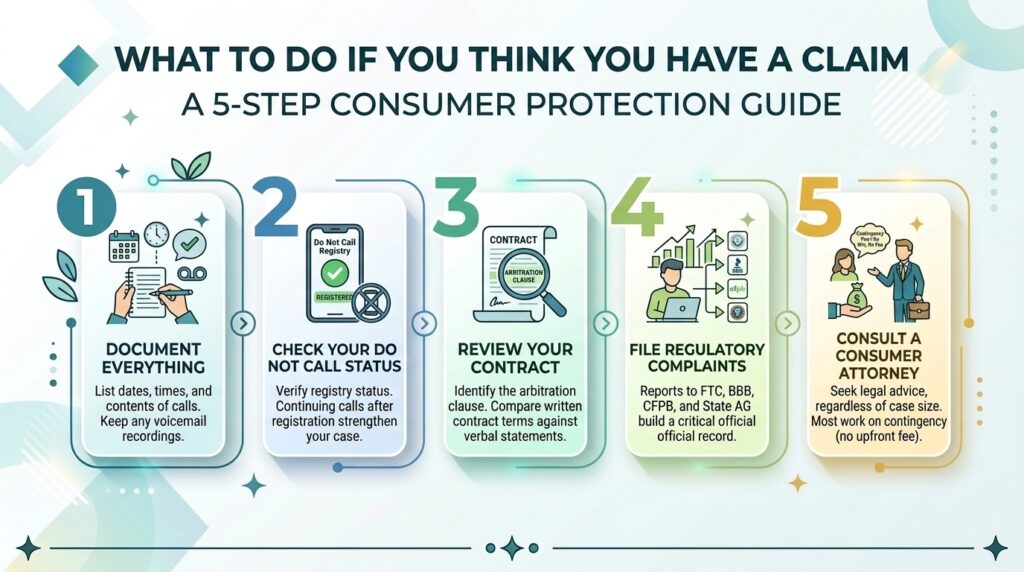
- Write down everything you remember about the calls. Dates, times, what the caller said, and any voicemails you still have.
- Check your Do Not Call status. If your number was registered and you kept getting calls anyway, that strengthens your case.
- Pull out your contract if you’re a customer. Look for an arbitration clause and compare the written terms against whatever you were told on the phone.
- File complaints with regulators. Reports to the FTC, the Better Business Bureau, the Consumer Financial Protection Bureau, and your state attorney general won’t get you a personal payout, but they build a record that can support future action.
- Talk to an attorney before assuming your case is too small. Most consumer protection and TCPA attorneys work on contingency, meaning you pay nothing unless they win money for you. If you’re not sure how to tell a good one from a bad one, our piece on signs of a bad attorney is worth a read before you sign anything.
How This Compares to Other Robocall and Auto Class Actions
CarGuard isn’t operating alone here. The extended warranty industry gets more robocall complaints than almost any other telemarketing category.
If you want to see what a finished TCPA settlement actually looks like once one gets approved, take a look at the Cash App spam text lawsuit settlement. It shows the notice, the claim form, and the payout schedule that a real CarGuard settlement would eventually need too.
On the vehicle side, cases like the Ford F-150 oil consumption lawsuit and the GM CP4 pump class action lawsuit show the typical path from scattered individual complaints to a certified class. CarGuard’s litigation is still earlier in that process than either of those cases.
Frequently Asked Questions
1. What is the CarGuard lawsuit about?
Ans: The CarGuard lawsuit actually refers to two separate legal problems. One involves illegal robocalls under the TCPA, and the other involves denied extended warranty claims. They have different rules for who qualifies and how you file.
2. Is CarGuard a scam?
Ans: CarGuard is a legally operating company, not an unlicensed scam. The complaints against it, like aggressive telemarketing and denied claims, are common across the extended warranty industry, though a pattern of them can still support a real legal claim.
3. Is there an active CarGuard class action settlement I can join right now?
Ans: No. There is no confirmed, court-approved class action settlement open for claims as of this writing. Be cautious of anyone who tells you otherwise, especially over an unsolicited call or text.
4. Was the CarGuard TCPA lawsuit dismissed?
Ans: The Baccari case was dismissed in 2022, but only because the plaintiff couldn’t prove CarGuard specifically caused his harm. The court never ruled that the robocalls were legal.
5. Can I sue CarGuard for robocalls even if I never bought a warranty?
Ans: Yes. A TCPA claim is based on receiving an illegal call, not on being a paying customer, so you can qualify without ever purchasing anything from CarGuard.
6. How much compensation can I get from a CarGuard lawsuit?
Ans: For robocalls, statutory damages typically run 500 dollars per call, and up to three times that for willful violations. For a denied warranty claim, the amount depends on the value of the repair that was refused.
7. What is the deadline to file a CarGuard TCPA claim?
Ans: The general federal deadline is four years from the date of the last illegal call. State law claims for denied warranty coverage have their own deadlines that vary by state, so check with a local attorney.
8. Do I need a lawyer to file a claim?
Ans: You don’t need one to simply file a complaint with a regulator, but a lawyer significantly improves your odds in an actual lawsuit. Most consumer protection attorneys take these cases on contingency, so you pay nothing upfront.
9. Is CarGuard still in business?
Ans: Yes, CarGuard Administration continues to operate and sell vehicle service contracts as of this writing.
The Bottom Line
The CarGuard lawsuit isn’t one tidy story with a settlement check waiting at the end. It’s an ongoing mix of robocall litigation and individual warranty disputes, with no single resolution in sight yet.
If unwanted calls are your issue, start writing down what you remember today, since that four-year clock is still running. If a denied repair is your issue, your contract and your paperwork will decide your case far more than any class action notice ever will. Either way, the smartest move is building your own record now rather than waiting on a settlement announcement that hasn’t happened.
If you believe you have a claim, talk to a licensed consumer protection or TCPA attorney in your state. They can look at your specific situation and tell you what your real options are.
This article provides general information only and is not legal advice. Laws vary by state and change over time. Do not rely on this content as a substitute for advice from a qualified, licensed attorney in your jurisdiction. For guidance on your specific situation, consult a licensed attorney directly.

Dirk Wasserthal is the Founder and Lead Writer of LegalDiaries.com, an independent legal information platform. He specializes in Mass Torts, Women’s Rights, and emerging legal issues, delivering clear, well-researched, and trustworthy content across Criminal Law, Family Law, Personal Injury, and more. Dirk’s mission is simple — make the law understandable for everyone.