




Romeo and Juliet Law refers to legal provisions also known as close-in-age exemptions that protect consensual sexual relationships between teenagers or young adults who are close in age from being prosecuted as statutory rape. These laws acknowledge that not every relationship involving a minor is exploitative, especially when the partners are peers navigating normal adolescent experiences.
- Origin of the Term “Romeo and Juliet Law”
- Why Romeo and Juliet Laws Exist
- How Romeo and Juliet Laws Typically Work
- Romeo and Juliet Law in Texas
- Romeo and Juliet Law in Florida
- Romeo and Juliet Law by State – United States Overview
- POCSO Act and the Proposed Romeo-Juliet Clause in India
- International Perspective – Romeo and Juliet Laws Around the World
- The Psychology and Sociology of Close-in-Age Relationships
- Romeo and Juliet Law for Same-Sex Couples
- Myths vs Facts About Romeo and Juliet Laws
- Related Legal Concepts in Modern Relationships
- What to Do If You or Your Child Is Being Investigated
- Frequently Asked Questions (FAQ)
- Final Thoughts
In today’s world, where teens mature at different rates, Romeo and Juliet Law strikes a crucial balance between protecting children from predators and avoiding overly harsh punishments for young love. Whether you are a concerned parent, a teenager, or someone facing a legal situation, understanding Romeo and Juliet Law is essential in 2026.
Origin of the Term “Romeo and Juliet Law”

The name comes directly from William Shakespeare’s tragic play Romeo and Juliet, where Juliet is famously just 13 years old. Modern lawmakers adopted this cultural reference to humanize legal protections for young couples in similar situations.
Romeo and Juliet Law does not lower the overall age of consent. Instead, these provisions create smart, limited exceptions for cases where the age difference is small and the relationship is genuinely consensual.
Why Romeo and Juliet Laws Exist
Strict statutory rape laws are vital for protecting minors from adult predators. However, without close-in-age exemptions, an 18-year-old could face severe felony charges, prison time, and lifetime sex offender registration simply for a consensual relationship with a 16- or 17-year-old classmate.
Romeo and Juliet laws were created to:
- Prevent the over-criminalization of normal teenage romance
- Recognize the developmental reality of adolescent brain development
- Reduce misuse of harsh laws by disapproving parents or for personal vendettas
- Allow prosecutors to focus on genuine exploitation cases
Without these provisions, countless young people could suffer life-altering consequences for mutual, non-coercive experiences.
How Romeo and Juliet Laws Typically Work
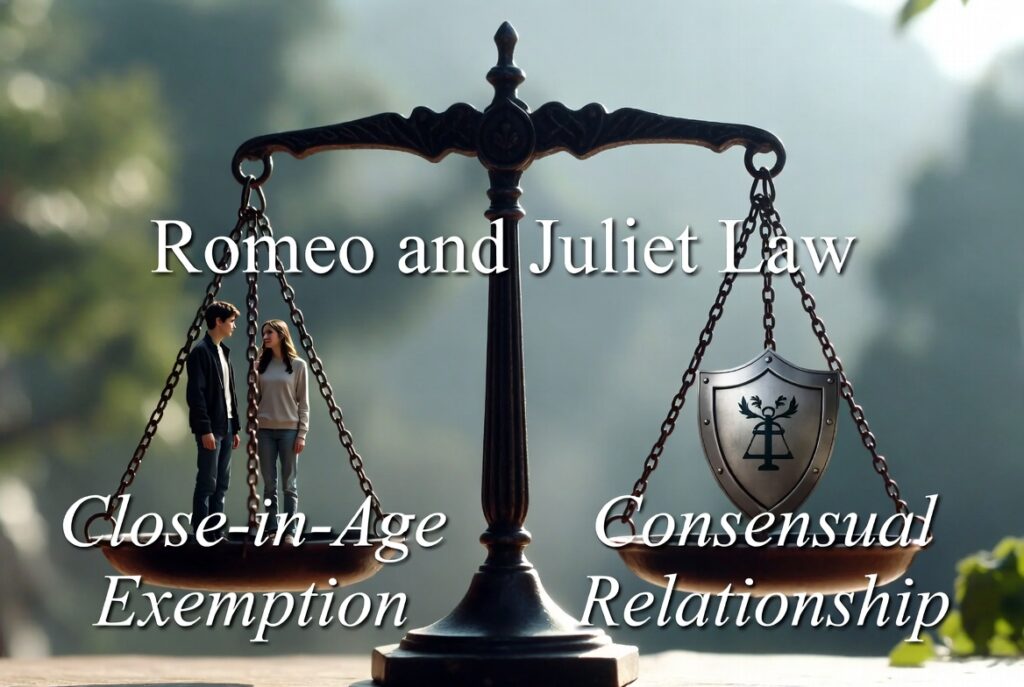
Romeo and Juliet laws generally function in one of three ways:
- Full Defense — The sexual activity is not considered a crime if all conditions are met.
- Affirmative Defense — The accused must prove in court that the relationship qualifies for exemption.
- Registration Relief — The act may still lead to charges, but the offender can seek removal from the sex offender registry.
Common requirements across jurisdictions include:
- Fully consensual activity with no force, coercion, drugs, or manipulation
- Small age gap (usually 2 to 4 years)
- Younger partner above a minimum age (often 14 or 15)
- No position of authority (teacher, coach, guardian, etc.)
Important note: These protections under Romeo and Juliet Law are narrow and highly fact-specific.
Romeo and Juliet Law in Texas
Texas has one of the most robust Romeo and Juliet frameworks in the United States. The age of consent is 17. The younger person must be at least 14 years old, and the older partner no more than 3 years older for full prosecution defense (up to 4 years for relief from sex offender registration). The law was significantly updated in 2011.
Read the official Texas Penal Code provisions here.
Real-world example: An 18-year-old senior dating a 16-year-old junior in high school will generally be protected under Romeo and Juliet Law in Texas if the relationship is consensual and there are no aggravating factors. Without this law, the older teen could face 2 to 20 years in prison and fines up to $10,000.
Romeo and Juliet Law in Florida
Florida sets the age of consent at 18. Its Romeo and Juliet Law provision, enacted in 2007, primarily provides sex offender registration relief rather than a complete defense. The maximum age gap is 4 years, and the younger person must be between 14 and 17 years old.
Official Florida Senate Report on the law
Romeo and Juliet Law by State – United States Overview
As of 2026, approximately 30+ U.S. states have enacted some form of close-in-age exemption under Romeo and Juliet Law. Rules vary significantly by state.
Here is a helpful comparison table:
| State | Age of Consent | Maximum Age Gap | Minimum Younger Age | Type of Protection |
| Texas | 17 | 3–4 years | 14 | Full defense + registration relief |
| Florida | 18 | 4 years | 14 | Registration relief |
| Colorado | 17 | 4 years | 15 | Strong exemption |
| California | 18 | None formal | — | Prosecutorial discretion |
| New York | 17 | Limited | 15+ | Penalty reduction |
For a comprehensive state-by-state overview:
Age of Consent in the United States – Wikipedia
POCSO Act and the Proposed Romeo-Juliet Clause in India
In India, the Protection of Children from Sexual Offences (POCSO) Act, 2012 sets a strict age of 18 with no built-in close-in-age exemption. This has caused concern about criminalizing normal adolescent relationships.
On January 9, 2026, the Supreme Court of India in the case State of Uttar Pradesh v. Anurudh strongly urged the government to introduce a “Romeo-Juliet clause” as part of Romeo and Juliet Law reforms to distinguish between exploitation and genuine consensual teen romance.
Read the Supreme Court observations covered by NDTV
International Perspective – Romeo and Juliet Laws Around the World
Close-in-age exemptions are not limited to the United States. Many countries have adopted progressive approaches:
- Canada: Up to 5-year exemption
- Germany: Age of consent 14, with higher scrutiny for partners over 21
- Australia: Varies by state but generally includes close-in-age defenses
These international models demonstrate a global trend toward more nuanced, developmentally informed laws.

The Psychology and Sociology of Close-in-Age Relationships
Scientific understanding of adolescent brain development shows that the prefrontal cortex — responsible for impulse control and long-term thinking — continues developing well into the mid-20s. Romeo and Juliet Law helps align legal systems with current developmental science by avoiding the criminalization of consensual peer relationships, which can lead to stigma, interrupted education, anxiety, depression, and damaged future opportunities.
Romeo and Juliet Law for Same-Sex Couples
Following landmark rulings such as Lawrence v. Texas (2003) and State v. Limon (2005), most modern interpretations of Romeo and Juliet Law are gender-neutral. Same-sex couples generally receive the same protections as opposite-sex couples.
Myths vs Facts About Romeo and Juliet Laws
Myth: These laws make it legal for any adult to date a minor.
Fact: Protections are strictly limited to small 2–4 year age gaps.
Myth: Romeo and Juliet laws only apply to heterosexual couples.
Fact: They are generally inclusive and gender-neutral.
Myth: If the younger person “agrees,” there is no crime.
Fact: Consent rules are complex and age of consent still applies outside exemptions.
Related Legal Concepts in Modern Relationships
Understanding Romeo and Juliet Law can be part of a broader awareness of how law intersects with relationships. For insights into evolutionary and social dynamics that influence relationships and legal outcomes, see our guide on Briffault’s Law.
Family-related legal matters often overlap with relationship issues. For the latest updates on family obligations, you may also want to read about New Child Support Laws 2025.
What to Do If You or Your Child Is Being Investigated
If you or your child is facing investigation related to a close-in-age relationship, follow these critical steps:

- Contact a qualified criminal defense attorney immediately — ideally one experienced in sex offense and juvenile cases.
- Do not discuss the case with anyone (including friends or social media) except your lawyer.
- Gather and preserve evidence of ages, consent, and relationship context.
- Seek professional family counseling support alongside legal help.
Early action is often the difference between a resolved matter and long-term consequences.
Frequently Asked Questions (FAQ)
Q: What is Romeo and Juliet law in simple terms?
It provides legal protection for consensual sexual relationships between teenagers who are close in age, preventing them from being treated as statutory rape.
Q: Does the Romeo and Juliet law apply to an 18-year-old and 15-year-old?
It depends on the specific state or country. In Texas it may qualify, while in other places it might not.
Q: Can Romeo and Juliet law help remove someone from the sex offender registry?
Yes, in states like Texas and Florida, qualifying individuals can petition for removal or relief.
Q: Is there a Romeo and Juliet clause in India’s POCSO Act?
Not yet formally enacted, but the Supreme Court made a strong recommendation in January 2026.
Q: Do these laws protect relationships where one person is in a position of authority?
No. Teachers, coaches, and guardians are almost always excluded from protections.
Q: Are Romeo and Juliet laws the same in every state?
No. Each state has its own rules regarding age gaps, minimum ages, and types of protection.
Final Thoughts
Romeo and Juliet laws represent a compassionate and intelligent evolution in how societies handle adolescent relationships. They protect young people from unnecessary lifelong consequences while maintaining strong safeguards against real abuse and exploitation.
As laws continue to evolve with important developments in India and ongoing refinements across the United States staying informed remains crucial for parents, teens, and educators alike.
This article is for educational and informational purposes only. It is not legal advice. Laws are complex and change frequently. Always consult a licensed attorney in your jurisdiction for advice specific to your situation.
For more quality, informative content, Go to Legal Diaries

Dirk Wasserthal is the Founder and Lead Writer of LegalDiaries.com, an independent legal information platform. He specializes in Mass Torts, Women’s Rights, and emerging legal issues, delivering clear, well-researched, and trustworthy content across Criminal Law, Family Law, Personal Injury, and more. Dirk’s mission is simple — make the law understandable for everyone.