



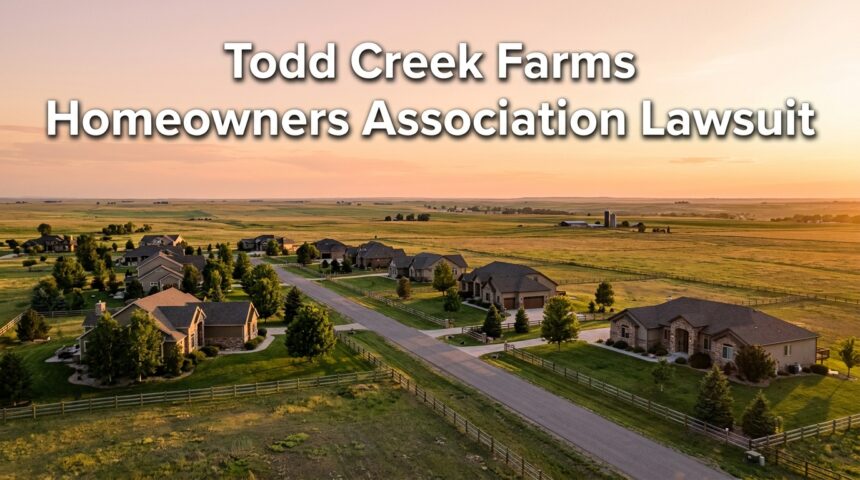
The Todd Creek Farms homeowners association lawsuit is a real dispute unfolding in a rural community outside Brighton, Colorado, where a group of homeowners sued their own HOA board. The short version is this: homeowners accused board members of putting personal interests ahead of the community, and the HOA later filed for Chapter 11 bankruptcy while the case was still active. If you live in Todd Creek Farms, or you just moved into any HOA and want to know what a fight like this actually looks like from the inside, this case is worth understanding in full.
- At a Glance: Key Facts About the Todd Creek Farms Homeowners Association Lawsuit
- What Is Happening at Todd Creek Farms
- Timeline of the Todd Creek Farms Homeowners Association Lawsuit
- November 2022: The Board Term Swap
- 2023: Homeowners File Suit
- Late 2024: The HOA Sends a Litigation Update
- July 2025: The HOA Files for Chapter 11
- Where the Case Stands Now
- The Fiduciary Duty Claim, Explained
- What Is a Derivative Lawsuit
- The Method Landscaping Contract Controversy
- Who Is Who in the Case
- Why Did the Todd Creek Farms Homeowners Association File for Chapter 11 Bankruptcy
- Can a Homeowners Association Legally File for Bankruptcy
- Why the Dollar Figures Do Not Match Across Reports
- What This Means for Homeowners’ Dues and Assessments
- Is It Common for an HOA to Go Bankrupt
- Myth vs Fact About HOA Lawsuits and Bankruptcy
- What Any HOA Homeowner Can Learn From This Case
- Frequently Asked Questions
- Final Thoughts on the Todd Creek Farms Homeowners Association Lawsuit
Cases like this matter beyond one neighborhood. Every homeowner who pays HOA dues is trusting a small group of neighbors to spend that money honestly and follow the rules. When that trust breaks down, the fallout touches everyone on the street, not just the people who filed the lawsuit.
At a Glance: Key Facts About the Todd Creek Farms Homeowners Association Lawsuit
Here is the short version before we get into the details.
| Detail | What We Know |
|---|---|
| Location | Todd Creek Farms, a rural subdivision near Brighton, Colorado |
| Community size | Around 370 lots across roughly 750 acres |
| Homeowners suing the HOA | Reported as 21 in earlier coverage, later reported as 31 |
| Main claims | Breach of fiduciary duty tied to a board term change and a landscaping contract |
| Bankruptcy filing | Chapter 11, filed July 15, 2025 |
| Case number | Filed in the United States Bankruptcy Court, District of Colorado, case number 1:25 bk 14385 |
| Legal fees reported | Figures range from about 100,000 dollars to over 900,000 dollars depending on the source and time period covered |
We will explain every one of these numbers, and why they do not always match, as we go.
What Is Happening at Todd Creek Farms
Todd Creek Farms sits in Adams County, a stretch of land northeast of Denver with a country feel, large lots, and, unusually for a homeowners association, some oil and gas royalty income shared among residents. It is the kind of place people move to for space and quiet, not courtroom drama.
That changed starting in late 2022, when a disagreement over how long certain board members should serve turned into something bigger. By 2023, a group of homeowners had filed suit, accusing the board of steering money and decisions in ways that helped a small circle of insiders rather than the community as a whole.
Picture this scenario. You bought a home in Todd Creek Farms because you wanted room to breathe and a low key HOA. Two years later, you get a notice that legal fees from a lawsuit you never asked for are eating into the association’s budget, and now there is talk of bankruptcy. That is the exact position many residents found themselves in.
Timeline of the Todd Creek Farms Homeowners Association Lawsuit
Following this case in order makes it much easier to understand, since claims and numbers have shifted as it dragged on.

November 2022: The Board Term Swap
According to reporting from CBS Colorado, the dispute traces back to a change in board member terms made in November 2022. Homeowners later claimed this swap extended certain board members’ time in office by about two years without proper community input, which became a key piece of the fiduciary duty claim discussed below.
2023: Homeowners File Suit
By 2023, a group of homeowners filed a lawsuit against the HOA board. The suit alleged the board breached its duty to the community, pointing to the term extension and to a landscaping contract that had ballooned far beyond its original price.
Late 2024: The HOA Sends a Litigation Update
As legal costs climbed, the Todd Creek Farms board posted a public litigation update to residents. The board described the lawsuit as coming from a small number of homeowners and said it had already spent close to 100,000 dollars defending itself, on top of a steep rise in its insurance deductible.
July 2025: The HOA Files for Chapter 11
On July 15, 2025, Todd Creek Farms Homeowners Association filed for Chapter 11 bankruptcy in the United States Bankruptcy Court, District of Colorado. You can view the official court filing on govinfo.gov, the federal government’s own public record of the case. Reported legal fees by this point had climbed into the hundreds of thousands of dollars, with some reports citing figures near 800,000 to 900,000 dollars since the lawsuit began.
Where the Case Stands Now
A Chapter 11 filing does not end a lawsuit. It generally pauses most legal action against the person or organization that files, while a bankruptcy court sorts out debts and finances. Homeowners who want to track the case directly can follow the docket through a public court records service such as PacerMonitor, which lists filings as they are added.
The Fiduciary Duty Claim, Explained
A breach of fiduciary duty claim, in plain terms, means someone accuses a person in a position of trust of putting their own interests, or someone else’s, ahead of the people they are supposed to protect.
HOA board members are volunteers, but they still take on a real legal responsibility once they accept a seat on the board. They are expected to act in the best interest of the whole community, not to steer contracts, terms, or money toward themselves or their friends.
In the Todd Creek Farms case, homeowners argued the board crossed that line twice. First, by extending board terms in a way plaintiffs say bypassed normal elections. Second, by approving a landscaping contract that grew far beyond its original bid, allegedly benefiting the board president personally.
This is not unlike the type of claim seen in other trust based disputes, such as the Edward Jones Kingsview Advisors lawsuit, where clients accused financial advisors of putting their own compensation ahead of client interests. The underlying legal idea is the same. Someone entrusted with authority over other people’s money is expected to use it honestly.
What Is a Derivative Lawsuit
A derivative lawsuit is a case filed on behalf of an organization, such as an HOA, rather than by one person suing purely for personal harm. The people filing it are standing in for the organization itself, because they believe its own leaders will not sue themselves.
This matters for Todd Creek Farms because homeowners were not simply suing for money out of their own pockets. They were arguing that the HOA itself had been harmed by its own board, and that someone needed to step in and hold the board accountable on the community’s behalf.
Think of it this way. If a company’s own executives were stealing from the company, you would not expect those same executives to sue themselves. A derivative lawsuit lets an outside party, in this case a group of homeowners, step into that gap.
If you are weighing whether a claim like this could hold up, it helps to understand what courts actually require as proof, which we cover in our guide on class action lawsuits filed without solid proof. The same basic principle applies to derivative claims. Allegations alone rarely carry a case. Evidence does.
The Method Landscaping Contract Controversy
One of the most specific and numbers heavy parts of this case involves a landscaping company called Method Landscaping Services.

According to the Robinson and Henry law firm, the original landscaping bid for Todd Creek Farms came in around 27,000 dollars. Homeowners allege the final contract ballooned to somewhere between 215,000 and 219,000 dollars, a jump of roughly eight times the original quote.
Plaintiffs claim board president Jason Pardikes had a personal financial connection to the landscaping arrangement, potentially benefiting by 100,000 to 150,000 dollars. Method Landscaping has denied wrongdoing through a sworn affidavit, and the matter reportedly drew attention from the Adams County Sheriff’s Office.
Here is a scenario worth sitting with. Imagine your HOA board approves a routine service contract, and a year later that contract has grown eightfold with almost no explanation in the meeting minutes. That gap between the original number and the final number is often exactly where fiduciary duty questions start.
Who Is Who in the Case
A few names come up again and again in coverage of this case.
Jason Pardikes served as the Todd Creek Farms HOA board president and is the board member most closely tied to the landscaping contract allegations.
Peter Towsky is a partner at Robinson and Henry, a Colorado law firm, and represents homeowners in the case. He has publicly called for greater accountability from the board and questioned why the HOA chose bankruptcy rather than opening its books.
Edie Apke is one of the homeowners who spoke publicly to reporters, describing her own experience living through years of rising legal costs and unanswered questions from the board.
If you are ever in a position where you need to choose legal representation for a dispute like this, it is worth knowing the warning signs of a poor fit ahead of time, which we cover in our article on signs of a bad attorney.
Why Did the Todd Creek Farms Homeowners Association File for Chapter 11 Bankruptcy
The Todd Creek Farms HOA filed for Chapter 11 bankruptcy in July 2025 after legal fees from the homeowner lawsuit climbed into the hundreds of thousands of dollars. Chapter 11 allowed the association to pause the lawsuit and reorganize its finances under court supervision rather than face the costs alone.
According to the United States Courts’ own explanation of Chapter 11, this type of bankruptcy generally provides for reorganization, most often used by a business or organization that wants to keep operating while resolving its debts over time. It is not the same as shutting down completely.
The HOA’s own public statement framed the filing as a way to protect the community from open ended legal costs, rather than an admission that the underlying claims had merit. Homeowners’ attorney Peter Towsky pushed back on that framing publicly, questioning why the board did not simply share financial records instead.
Can a Homeowners Association Legally File for Bankruptcy
Yes. A homeowners association is typically organized as a nonprofit corporation, and like most corporations, it can file for bankruptcy, including Chapter 11, when it faces debts or legal costs it cannot manage under normal operations.
This surprises a lot of homeowners, who assume an HOA cannot go bankrupt the same way a business can. Legally, there is little difference. If an HOA cannot pay its bills, including legal fees from a lawsuit, it has the same bankruptcy options available to most organizations under the United States Bankruptcy Code.
In Colorado specifically, HOAs also operate under the Colorado Common Interest Ownership Act, which sets rules for how associations are run, including budgeting, assessments, and board conduct. Bankruptcy law and this state law work alongside each other, but they answer different questions. Bankruptcy addresses the debt. State HOA law addresses how the association is supposed to behave day to day.
Why the Dollar Figures Do Not Match Across Reports
If you have read more than one article about this case, you may have noticed the numbers do not line up. One source says legal fees hit close to 100,000 dollars. Another says 800,000. A third says over 900,000.
This is not necessarily a sign that someone is wrong. It usually comes down to timing and scope. The HOA’s own statement covered a specific two year window of unreimbursed fees. Later news coverage, closer to the bankruptcy filing, covered a longer period and included costs the HOA’s own communication did not break out separately.
The same pattern shows up with the homeowner count. Earlier coverage cited 21 plaintiffs. Later coverage from the homeowners’ own attorney cited 31. Lawsuits often add or drop parties as they progress, so a higher number later on is common, not necessarily a contradiction.
The most reliable way to see a single, current figure is to check the official bankruptcy case filing itself, since court documents are updated as the case moves forward, unlike a news article published on a single date.
What This Means for Homeowners’ Dues and Assessments
This is the part most residents actually care about. When an HOA racks up legal fees this high, that money generally comes from somewhere, and it is usually the community’s own dues, reserve funds, or a special assessment.

A special assessment is an extra, one time charge an HOA can bill homeowners beyond their normal dues, usually to cover an unexpected cost the regular budget cannot absorb.
Imagine you pay your HOA dues every month without a second thought, then receive a letter announcing a one time charge of several hundred dollars to help cover legal costs from a lawsuit you had no part in. That is a realistic outcome when an HOA’s legal bills grow faster than its budget, and it is one reason disputes like this one matter even to homeowners who never planned to get involved.
Bankruptcy filings can also affect this picture, since a court supervised reorganization may change how and when an association can raise assessments while the case is active.
Is It Common for an HOA to Go Bankrupt
It is genuinely rare. HOA bankruptcies do happen, but they are unusual enough that reporters covering the Todd Creek Farms case specifically noted how uncommon a Chapter 11 filing is for a residential association.
Most HOAs resolve internal disputes through mediation, board elections, or smaller legal settlements long before costs reach a level that forces bankruptcy. What made Todd Creek Farms different was the combination of a multi year lawsuit, a board that chose to keep fighting rather than settle, and legal costs that kept compounding month after month.
Myth vs Fact About HOA Lawsuits and Bankruptcy
Myth 1: If your HOA files for bankruptcy, your dues disappear along with the debt.
(Fact:) Bankruptcy addresses the association’s debts to creditors, not a homeowner’s ongoing obligation to pay dues. In most cases, homeowners are still expected to pay dues during and after the bankruptcy process.
Myth 2: HOA board members cannot be personally sued because they are volunteers.
(Fact:) Board members can be named in a lawsuit, especially in claims involving breach of fiduciary duty. Many HOAs carry directors and officers insurance specifically because board members can face personal legal exposure.
Myth 3: A lawsuit filed by a small group of homeowners only affects those homeowners.
(Fact:) Legal fees, insurance costs, and any resulting special assessments are typically paid from the whole association’s budget, meaning every homeowner can feel the financial impact, whether or not they joined the lawsuit.
What Any HOA Homeowner Can Learn From This Case
You do not need to live in Todd Creek Farms for this case to be useful. Most HOA disputes follow a similar pattern, even if the details differ.
Ask to see financial records regularly, not just once a year. Attend board meetings even when nothing seems urgent, since major decisions often start small. Pay attention to contracts that change significantly in price after they are first approved, since that gap is often where problems hide.
If you ever reach the point of considering legal action against your own HOA, understanding how a case like a class action lawsuit filed without solid proof can fail helps set realistic expectations. Strong documentation, not just frustration, is what carries a case forward.
Frequently Asked Questions
1. What is the Todd Creek Farms HOA lawsuit about?
(Ans:) It is a lawsuit filed by a group of homeowners against their HOA board, alleging breach of fiduciary duty tied to a board term extension and a landscaping contract that grew far beyond its original price.
2. Why did the Todd Creek Farms HOA file for bankruptcy?
(Ans:) The HOA filed Chapter 11 bankruptcy in July 2025 after legal fees from the lawsuit climbed into the hundreds of thousands of dollars, allowing it to reorganize its finances under court supervision.
3. Who is suing the Todd Creek Farms HOA?
(Ans:) A group of homeowners, reported as either 21 or 31 depending on the source and date, filed the lawsuit, represented by attorney Peter Towsky of Robinson and Henry.
4. Can a homeowners association legally file for Chapter 11 bankruptcy?
(Ans:) Yes. Most HOAs are structured as nonprofit corporations, which gives them the same bankruptcy options available to other organizations under federal bankruptcy law.
5. What is a derivative lawsuit against an HOA?
(Ans:) It is a lawsuit filed on behalf of the association itself, arguing the HOA was harmed by its own leadership, rather than a claim filed purely for one person’s personal damages.
6. What does breach of fiduciary duty mean for an HOA board?
(Ans:) It means a board member is accused of putting personal interests, or someone else’s interests, ahead of the community they are legally required to serve.
7. What happens to homeowners when their HOA files for bankruptcy?
(Ans:) Homeowners generally continue paying dues, and the bankruptcy process focuses on how the association handles its debts, though costs can still affect future assessments.
8. Who is Jason Pardikes?
(Ans:) Jason Pardikes served as the Todd Creek Farms HOA board president and is the board member most closely tied to the landscaping contract allegations in the lawsuit.
9. What is the Method Landscaping controversy at Todd Creek Farms?
(Ans:) Homeowners allege a landscaping contract with Method Landscaping Services grew from an original bid of about 27,000 dollars to over 200,000 dollars, allegedly benefiting the board president personally, a claim Method Landscaping has denied.
10. Is the Todd Creek Farms HOA lawsuit still ongoing?
(Ans:) The underlying lawsuit is generally paused while the Chapter 11 bankruptcy case proceeds, and its current status can be tracked through the official federal court docket.
Final Thoughts on the Todd Creek Farms Homeowners Association Lawsuit
The Todd Creek Farms homeowners association lawsuit is not just a local news story. It is a real example of what happens when trust between an HOA board and its residents breaks down over money, contracts, and transparency, and how quickly a neighborhood dispute can turn into a federal bankruptcy case.
If you are dealing with a dispute in your own HOA, do not wait until legal fees or hidden contracts pile up before asking questions. Request records early, show up to meetings, and if things escalate, speak with a licensed attorney in your state who handles HOA and community association law before deciding on your next step.
This is general information only and not a substitute for advice from a qualified attorney licensed in your jurisdiction.

Dirk Wasserthal is the Founder and Lead Writer of LegalDiaries.com, an independent legal information platform. He specializes in Mass Torts, Women’s Rights, and emerging legal issues, delivering clear, well-researched, and trustworthy content across Criminal Law, Family Law, Personal Injury, and more. Dirk’s mission is simple — make the law understandable for everyone.