


North Carolina window tint law changes took effect on December 1, 2025, and they continue to reshape the rules of the road for every North Carolina driver in 2026.
- Why the NC Window Tint Law Changed: A Look Behind Senate Bill 43
- Old Law vs. New Law: A Side-by-Side Comparison
- 2026 Visible Light Transmission (VLT) Limits: The Core Numbers
- Sedans vs. SUVs: Why Vehicle Type Matters
- The New Roll-Down Rule: What Every Driver Must Know
- Medical Exemptions: When You Need a Darker Tint
- Penalties and Real Costs of Non-Compliance in 2026
- How to Check and Prove Your Tint Is Legal: A Step-by-Step Guide
- Benefits of Legal Tint: Comfort Without the Risk
- North Carolina vs. Other States: Travel Smart
- Tint Myths That Can Get You in Trouble
- Choosing a Tint Installer You Can Trust
- Real Stories from North Carolina Drivers
- The Future of Window Tint in North Carolina
- Frequently Asked Questions (FAQ) About North Carolina Window Tint Law
- Quick Compliance Checklist
- Final Key Takeaways
If you’ve heard whispers about tint inspections disappearing, a brand-new “roll-down” rule, or stiffer fines, you’re not alone and you’re exactly where you need to be.
This comprehensive guide unpacks every detail in plain, easy-to-follow language. We’ll cover the exact VLT numbers, the new roadside enforcement reality, penalties that can bite your wallet, medical exemptions, and practical steps to keep your ride legal and cool.
Whether you drive a compact sedan, a full-size SUV, or a heavy-duty pickup, you’ll walk away knowing exactly how to stay compliant and avoid costly surprises.
Why the NC Window Tint Law Changed: A Look Behind Senate Bill 43
The driving force behind the North Carolina window tint law changes is Senate Bill 43, officially designated Session Law 2025-47.
Lawmakers had two main goals: streamline the annual vehicle safety inspection and enhance officer safety during traffic stops.
The old system required every inspection station to measure window tint with a light meter and collect an extra $10 fee. Critics argued this was a needless administrative burden that didn’t significantly improve road safety.
At the same time, law enforcement agencies across the state reported growing unease with dark windows that blocked an officer’s view of what was happening inside a vehicle.
The bill passed with strong bipartisan support and was signed into law, reshaping how tint compliance is monitored. The legislation did two immediate things:
- Eliminated the mandatory tint measurement from annual safety inspections.
- Abolished the additional $10 tint inspection fee that repair shops charged.
To balance the removal of the annual inspection check, legislators introduced a powerful on-the-spot enforcement tool: the roll-down rule.
This requires any driver or passenger with tinted windows to lower them immediately when a law enforcement officer approaches. The result is a system that relies on everyday driver responsibility rather than a once-a-year bureaucratic check.
Key Takeaway: The physical tint limits didn’t change, but enforcement shifted from the inspection bay to the roadside. You’re now fully responsible for proving your tint is legal.
You can also review the official bill history at the North Carolina General Assembly’s website.
Old Law vs. New Law: A Side-by-Side Comparison
To understand just how much things have changed, compare the pre-2025 requirements with the current 2026 landscape.
| Factor | Before December 1, 2025 | After December 1, 2025 (2026 Rules) |
| Annual Tint Inspection | Required with a calibrated light meter | Completely removed |
| Extra Inspection Fee | Up to $10 added to inspection cost | Eliminated |
| Roll-Down Requirement | No specific mandate | Mandatory when an officer approaches |
| Legal VLT Limits | 35% net minimum on relevant windows | 35% net minimum (unchanged) |
| Primary Enforcement | Inspection stations + roadside stops | Roadside traffic stops mainly |
| Medical Exemptions | Available | Available (roll-down rule still applies) |
This table makes one thing crystal clear: the physical tint limit didn’t budge, but enforcement moved squarely onto the roadside.
Drivers can no longer rely on an inspection station to catch a violation before the police do. That means understanding the rules yourself is no longer optional.
2026 Visible Light Transmission (VLT) Limits: The Core Numbers
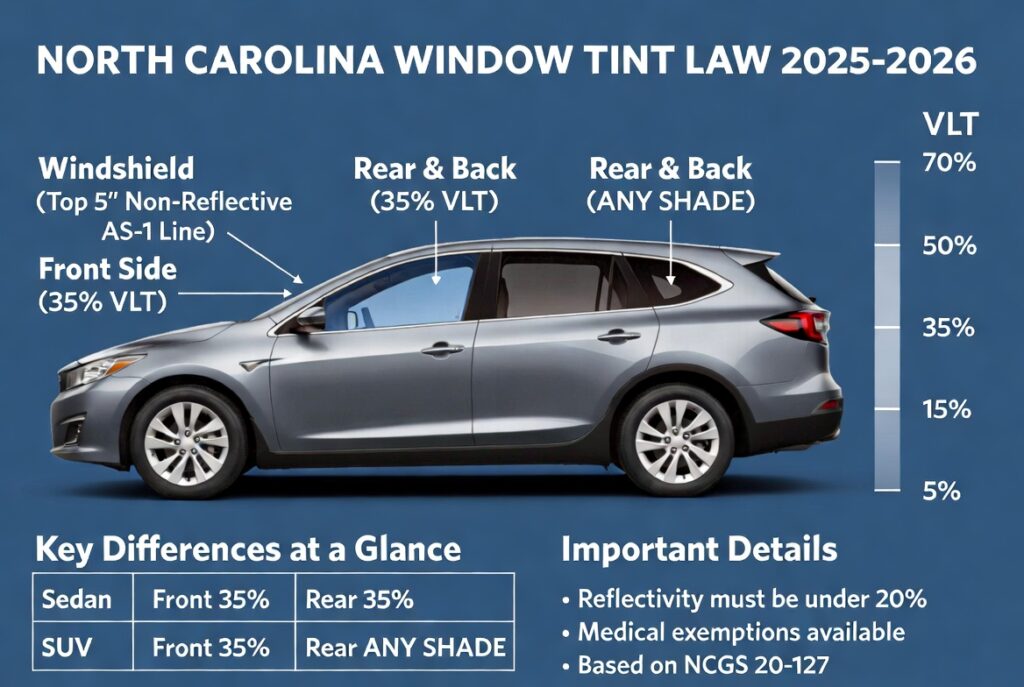
Visible Light Transmission (VLT) is the percentage of outside light that passes through your window glass plus any applied film.
In North Carolina, the law sets a floor, not a ceiling meaning your windows must allow at least a certain amount of light in. The lower the VLT percentage, the darker the tint.
The legal limits for 2026 break down by window position:
- Windshield: Non-reflective tint is only allowed above the manufacturer’s AS-1 line or within the top 5 inches, whichever is longer. The entire windshield may be treated with a clear UV-blocking film, which is explicitly permitted and doesn’t count as dark tint.
- Front Side Windows (driver & passenger): Minimum 35% VLT.
- Rear Side Windows (passenger vehicles): Minimum 35% VLT.
- Rear Side Windows (multipurpose vehicles—SUVs, vans, trucks): No VLT restriction. You can go as dark as you want.
- Rear Window: Same as rear side windows. Passenger vehicles need 35% VLT; multipurpose vehicles have no limit.
- Reflectivity: No window can be more than 20% reflective. Mirror-like finishes are prohibited.
- Prohibited Colors: Red, amber, and yellow tints are completely banned on all windows because they can mimic emergency vehicle lights.
Important tolerance note: State-approved light meters have a 3% margin of error. A reading of 32% VLT or higher is generally considered compliant.
But never rely on the tolerance alone. Factory glass can block 5–10% of light on its own. A film labeled “35%” may actually test at 30% or lower after installation.
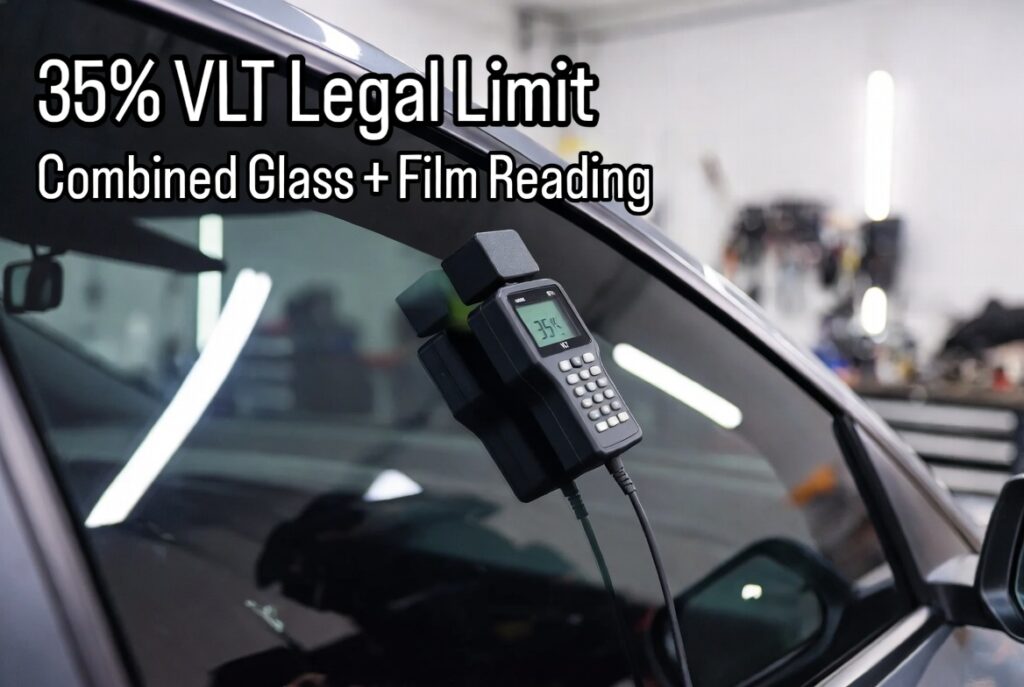
You must measure the combined glass-plus-film VLT, not just the film’s advertised number. A professional installer should provide a post-installation reading with a calibrated meter.
Key Takeaway: Always get a combined VLT reading after installation. A 35% film on factory glass can easily test illegal. Demand documentation.
Sedans vs. SUVs: Why Vehicle Type Matters
North Carolina law draws a legal line between passenger vehicles and multipurpose vehicles. The difference is critical for anyone who wants tinted windows.
| Window Position | Sedan, Coupe, Station Wagon | SUV, Van, Pickup Truck |
| Front Side Windows | 35% VLT minimum | 35% VLT minimum |
| Rear Side Windows | 35% VLT minimum | No restriction |
| Rear Window | 35% VLT minimum | No restriction |
| Windshield Strip | Top 5 in. or AS-1 line | Top 5 in. or AS-1 line |
| Full Windshield UV Film | Allowed (clear only) | Allowed (clear only) |
Some interpretations allow darker rear window tint on passenger cars if the vehicle has dual side mirrors, but law enforcement may not always agree. Maintaining 35% VLT on all windows removes all doubt.
This disparity explains why you’ll see SUVs with near-opaque rear windows cruising without any issue while a similarly tinted sedan risks a ticket. When shopping for a vehicle and planning tint, it’s a factor worth keeping in mind.
The New Roll-Down Rule: What Every Driver Must Know
If you take away just one thing from the North Carolina window tint law changes, make it this: the roll-down rule is now the law of the land.
The statute demands that when a law enforcement officer approaches your vehicle, you and any passenger on the officer’s side must immediately roll down the tinted window.
This obligation exists whether your tint is perfectly legal, borderline, or covered by a medical exemption. There are no exceptions.
Why was this added? Officer safety. Tinted windows prevent police from seeing hands, weapons, or suspicious movements during a stop.
The North Carolina Sheriffs’ Association advocated strongly for this measure, calling it a “common-sense, life-saving protocol.” By lowering the window, you’re giving the officer a clear view into the vehicle, de-escalating tension from the start.
Practical tips to make it habit:
- As soon as you see blue lights or hear a siren, begin lowering the window closest to where the officer will approach (usually the driver’s side).
- Tell passengers calmly: “We need to roll this window down for the officer.”
- After the window comes down, place both hands on the steering wheel. This simple body language signals cooperation.
- Even if your tint is light (like 50% VLT), follow the rule. There’s no wiggle room for “barely tinted.”
Failure to comply can result in a separate citation, additional fines, and possibly escalate what might have been a routine stop.
In a worst-case scenario, an officer who can’t see inside may approach with heightened caution. Rolling down the window is the quickest way to show you respect their safety and the law.
Key Takeaway: The roll-down rule is non-negotiable. It applies to all tinted windows, no matter how light, and even if you have a medical exemption. Train yourself to do it automatically.
Medical Exemptions: When You Need a Darker Tint
Some drivers have legitimate medical conditions lupus, porphyria, severe photosensitivity, melanoma, and other light-aggravated disorders that make darker tint a health necessity.
North Carolina’s NCDMV Medical Review Program handles these exemptions. To qualify, you must submit a signed statement from a licensed physician and the required application forms.
If approved, you’ll receive a permit valid for up to five years, and you must place an official sticker on the lower-left corner of the rear window.
Critical point: Even with a medical exemption, the roll-down rule still applies. When you lower the window, the officer can see inside, satisfying the law’s safety intent.
Keep your exemption documentation in your glove compartment and be prepared to explain the sticker politely.
Penalties and Real Costs of Non-Compliance in 2026
Violating north carolina window tint laws can get expensive quickly. Here’s a breakdown of what you’re facing if your tint is too dark or you fail to roll down a window:
- First-offense tint citation: Civil fine typically around $50, but with court costs the total often lands between $120 and $150.
- Court-ordered tint removal: You might be required to strip the illegal film and provide proof of correction. Professional removal can cost $75 to $200 depending on the number of windows.
- Repeat offenses: Can escalate to a Class 3 misdemeanor, which means higher fines and a possible criminal record.
- Roll-down rule violation: A separate citation with its own fine, often in the $50–$100 range plus court costs.
- Insurance implications: While a single tint ticket rarely spikes your premium, a pattern of non-moving violations can flag your policy for review and potential rate increases.
- Registration hold: In some jurisdictions, unresolved tint violations can lead to a hold on your vehicle registration renewal.
Real-world case study: Michael, a college student in Greenville, had his four-door sedan tinted to 20% VLT because “everyone does it.” After the law changed, he figured no inspection meant no problem.
In March 2026, a highway patrol officer stopped him for speeding and immediately cited the illegal tint. Michael paid $138 in fines and court costs, then spent $175 on professional removal. To stay legal, he later invested $350 in ceramic 35% tint. Total cost of the shortcut? Over $660, plus a few hours lost to court and the shop.
The lesson is simple: compliance costs less than a ticket, removal, and re-tint combined.
Key Takeaway: Illegal tint can easily cost you $500 or more once you add up fines, removal, and reinstallation. Legal tint protects your wallet and your record.
How to Check and Prove Your Tint Is Legal: A Step-by-Step Guide
Since the annual inspection no longer verifies your tint, the burden of proof rests on you. Here’s how to build a bulletproof compliance file:
1. Pick a pro installer who uses a calibrated, state-approved light meter and specializes in North Carolina window tint law.
2. Request a combined VLT reading for every tinted window immediately after installation. The meter must measure glass plus film, not film alone.
3. Get a printed report showing the date, VLT percentage for each window, the installer’s business name, and the meter’s calibration info. Most quality shops provide this standard.
4. Store the receipt and the VLT report in your glove box. If an officer questions your tint, calmly present the documents.
5. Re-test after any windshield or door glass replacement. New factory glass may have different light-blocking properties, which can push your combined VLT below the 32% tolerance.
6. Avoid visual guesswork. A window that looks “light enough” on a cloudy day can test illegal under bright sun. Trust the meter, not your eyes.
Benefits of Legal Tint: Comfort Without the Risk
Staying at 35% VLT doesn’t mean sacrificing performance. Modern ceramic and nano-ceramic films deliver outstanding results:
- Heat rejection: High-end films can block up to 50% of solar heat, keeping your cabin noticeably cooler.
- UV protection: 99% of harmful UV rays are filtered out, protecting your skin and preventing interior fading.
- Glare reduction: Safer driving during sunrise, sunset, and night-time headlight glare.
- Privacy and appearance: A tasteful, uniform tint looks sharp while still allowing law enforcement to see in.
- Fuel savings: Less reliance on air conditioning can improve fuel economy slightly on long summer drives.
According to the International Window Film Association, premium ceramic films are engineered to reject infrared heat far better than basic dyed films at the same VLT.
So a 35% ceramic tint can outperform a 20% cheap dyed tint in terms of comfort and UV blocking keeping you cooler and legal at the same time.
Key Takeaway: Legal ceramic tint at 35% VLT often outperforms darker, cheap dyed film. You get superior heat rejection, UV protection, and zero legal risk.
North Carolina vs. Other States: Travel Smart
If your travels take you across state lines, tint laws can shift dramatically. Here’s a quick comparison to keep you informed:
- South Carolina: Front side windows 27% VLT, darker than NC’s 35%, but out-of-state vehicles are generally judged by their home state’s limits.
- Virginia: 50% VLT on front sides for passenger cars, much stricter than NC.
- Tennessee: 35% VLT front sides, similar to NC. Rear windows have no limit on SUVs/vans.
- Georgia: 32% VLT front sides, slightly darker than NC. Rear windows also 32% on sedans.
- Florida tint laws: 28% VLT front sides, 15% rear sides. Much darker overall, but Florida law can’t override NC’s standards on NC-registered vehicles.
- Texas: More lenient than North Carolina in many cases. For the full breakdown, see our detailed guide to Texas tint laws.
- California: Significantly stricter on front windows. Before you head west, brush up on California tint law to avoid cross-border confusion.
The roll-down rule is unique to North Carolina, so don’t assume other states require it. However, rolling your window down during a stop anywhere is a universally appreciated gesture of cooperation.
Always check the laws of your destination if you’re planning an extended out-of-state trip. The official NCDMV website provides links to state-by-state regulations.
Tint Myths That Can Get You in Trouble
Let’s bust some persistent misconceptions before they cost you.
- Myth: “If my car passed inspection before December 2025, my dark tint is grandfathered.”
Truth: There is no grandfather clause. Every vehicle on the road must meet the 35% VLT standard right now. Old inspection stickers are irrelevant. - Myth: “Factory privacy glass is automatically legal.”
Truth: Factory dyed glass on SUVs and trucks is legal on rear windows only. If you apply aftermarket film on top of it, you must measure the combined VLT. It could easily drop below 35%. - Myth: “Clear ceramic film doesn’t count as tint for the roll-down rule.”
Truth: Any film applied to side windows triggers the roll-down obligation, even if it’s perfectly clear. The rule is about window coverings, not darkness. - Myth: “The new law made it legal to go darker.”
Truth: The law did not touch the 35% limit. It only changed how enforcement works. - Myth: “I don’t need to roll down my window if I have a medical exemption sticker.”
Truth: Exemption or not, the window must come down. The sticker just explains why your tint is darker.
Choosing a Tint Installer You Can Trust
Given the roadside enforcement reality, who you hire matters more than ever. Look for these markers of a quality shop:
- Specializes in legal North Carolina installations and doesn’t push illegal darkness.
- Uses a calibrated, state-approved light meter and provides a compliance report after installation.
- Offers premium ceramic or nano-ceramic films with high heat rejection and UV blocking.
- Provides a warranty on both the film and the VLT compliance assurance.
- Has strong local reviews and can show you a meter reading on a completed vehicle.
A reputable installer will also educate you about the roll-down rule. If they dismiss it or promise “you won’t get caught,” take your business elsewhere. Ask upfront: “Will you give me a printed VLT report after the install?” Their answer tells you everything.
Real Stories from North Carolina Drivers
Hearing how the North Carolina window tint law changes affected actual drivers makes the rules stick.
Case 1: Amanda, Charlotte mom
Amanda drives a 2022 Honda Odyssey. She had her front windows tinted at 25% VLT to reduce glare for her kids. After the law change, she learned about the roll-down rule from a news article.
“I just assumed if I could see out fine, it was legal,” she says. She eventually swapped the film for a high-quality 35% ceramic tint. “Now I don’t flinch when a police car pulls behind me. Peace of mind is worth the $250.”
Case 2: David, Wilmington contractor
David’s work truck had dark tint on all rear windows—legal because it’s a multipurpose vehicle. His front windows, however, were at 18% VLT. He was pulled over and cited within a week of the roll-down rule’s publicity.
“The officer was polite but firm. He told me the inspection change didn’t make dark tint legal. I paid the fine, removed the film, and put on 35%. I don’t have time for court.”
These stories underline a simple truth: compliance is cheaper and less stressful than the alternative.
The Future of Window Tint in North Carolina
Will the law evolve further? Some lawmakers have discussed introducing a state certification program for tint installers to ensure all shops use consistent VLT measurement methods. Others propose stiffer penalties for repeat offenders.
For now, the 2026 landscape is stable: know your VLT, embrace the roll-down rule, and keep documentation handy. Staying informed through official channels like the North Carolina General Assembly’s Statutes page will keep you ahead of any tweaks.
Frequently Asked Questions (FAQ) About North Carolina Window Tint Law
What exactly changed in North Carolina window tint law for 2026?
The two biggest changes are the removal of mandatory tint checks from annual vehicle inspections and the elimination of the $10 tint inspection fee. In their place, a new roll-down rule requires drivers and passengers to lower tinted windows when a law enforcement officer approaches. The 35% VLT darkness limit remains the same.
Is 35% tint still legal in North Carolina?
Yes. 35% VLT net is the minimum allowed for front side windows on all vehicles and for rear windows on passenger cars. Combined glass-plus-film readings of 32% or higher are generally considered compliant due to equipment tolerance.
Do I have to roll down my tinted window even if it’s perfectly legal?
Absolutely. The roll-down rule applies to any vehicle with any applied window film, regardless of VLT or medical exemption. The moment an officer approaches, the window on their side must come down.
Will my tint be checked during the annual inspection now?
No. Tint measurement has been entirely removed from the state safety inspection. However, this doesn’t mean dark tint is allowed it just means enforcement now happens entirely during traffic stops.
Can I install limo-dark tint on my SUV’s back windows?
Yes, if your vehicle is classified as a multipurpose vehicle (SUV, van, or truck). There are no VLT restrictions on rear side windows or the rear window for these vehicles. Front side windows still require 35% VLT.
What happens if I refuse to roll down my window during a stop?
You can receive a separate citation and fine. Non-compliance also raises safety concerns for the officer, which may escalate the interaction. It’s in your best interest to comply immediately.
How do I get a medical exemption for darker tint?
Apply through the NCDMV Medical Review Program with a physician’s documentation. Once approved, you’ll receive a permit and a sticker for your rear window. Remember, even with an exemption, you must still follow the roll-down rule.
Is clear film on the whole windshield legal?
Yes. Clear UV-blocking film applied to the entire windshield is explicitly permitted and does not count as prohibited tint. It’s a great way to reduce heat and UV exposure without affecting visibility.
What’s the best way to prove my tint is legal?
Obtain a post-installation VLT report from a professional installer using a calibrated meter. Keep that report and your receipt in the vehicle. In a traffic stop, present them calmly if the tint is questioned.
Quick Compliance Checklist
Copy or screenshot this list and keep it handy:
- Front side windows at 35% VLT or higher (measured glass + film)
- No tint on windshield below AS-1 line (except clear UV film).
- Reflectivity below 20% on all windows.
- No red, amber, or yellow tint.
- Roll-down habit automatic for any traffic stop.
- Glove box contains printed VLT report and installation receipt.
- Medical exemption sticker and paperwork if darker tint is used.
- Professional re-test after any glass replacement.
Final Key Takeaways
- The North Carolina window tint law changes shifted enforcement from annual inspections to the roadside. The 35% VLT limit is as firm as ever.
- The roll-down rule is now a cornerstone of officer safety; ignoring it invites a separate fine and a more stressful stop.
- SUVs, vans, and trucks enjoy far more flexibility for rear tint than passenger cars.
- Medical exemptions exist but come with strings attached—including the roll-down obligation.
- Documentation is your shield. A printed VLT compliance report can turn a suspicious stop into a quick, calm interaction.
- Quality ceramic 35% tint offers superior comfort and protection, proving that legal doesn’t mean weak.
- Cheap, illegal tint carries a high probability of fines, removal costs, and reinstallation expenses that easily top $500.
Disclaimer: This article is for informational and educational purposes only. It does not constitute legal advice. Window tint laws are subject to interpretation by courts and law enforcement. For official guidance, consult the North Carolina Division of Motor Vehicles, a qualified attorney, or the current version of North Carolina General Statute 20-127. Always verify compliance with a certified professional.

Dirk Wasserthal is the Founder and Lead Writer of LegalDiaries.com, an independent legal information platform. He specializes in Mass Torts, Women’s Rights, and emerging legal issues, delivering clear, well-researched, and trustworthy content across Criminal Law, Family Law, Personal Injury, and more. Dirk’s mission is simple — make the law understandable for everyone.