




Difference between attorney and lawyer is a question that trips up smart people every single day. You might be staring at a legal contract, researching a personal injury claim, or even considering law school. When you type “attorney vs lawyer,” “lawyer vs attorney,” or “what is the difference between a lawyer and an attorney” into Google, you’re asking a question that goes deeper than simple vocabulary. The answer affects who can stand beside you in court, who can give you fully protected legal advice, and ultimately who you can trust with your future.
- Lawyer vs Attorney: Straightforward Definitions You’ll Actually Remember
- Attorney vs Lawyer: Key Differences at a Glance
- Why the Confusion Exists: History, Everyday Use, and What the ABA Says
- Education and Licensing Path: Becoming a Lawyer or Attorney Step-by-Step
- Roles and Duties: What Lawyers and Attorneys Actually Do
- Attorney vs Lawyer Around the World: Why U.S. Distinctions Are Unique
- Related Legal Titles You Should Know (and When They’re Different)
- Specific Comparisons People Frequently Search (Decoded)
- When the Distinction Matters Most for Clients: A Practical Guide
- Career Advice: Becoming a Lawyer or Attorney in 2026
- Common Myths and Misconceptions: Attorney vs Lawyer Edition
- 2026 Relevance: How Technology and Remote Practice Shift the Landscape
- FAQ: Difference Between Attorney and Lawyer (Every Question Answered)
- Conclusion: Focus on Expertise, Not Just Titles
In everyday American conversation, “lawyer” and “attorney” get tossed around as synonyms. But technically and sometimes very practically there’s a line. Understanding the difference between lawyer and attorney in USA isn’t just academic trivia; it’s consumer protection, career guidance, and peace of mind rolled into one.
This guide doesn’t just define terms. It gives you real-world scenarios, verification checklists, a myth-busting section, a 2026 outlook, and a massive FAQ that answers every variation of “is there a difference between a lawyer and an attorney.” Let’s turn confusion into confident clarity.
Lawyer vs Attorney: Straightforward Definitions You’ll Actually Remember
The core distinction is beautifully simple once you see it.
A lawyer is someone who has completed law school and earned a Juris Doctor (J.D.) degree. They have been trained to think like a legal professional in research, writing, analysis, negotiation theory. They know the law inside books and classrooms.
An attorney, short for “attorney at law,” is a lawyer who has passed the state bar exam, cleared a character and fitness review, and been officially licensed to practice law in a specific jurisdiction. An attorney doesn’t just know the law; they have the state’s permission to use it on your behalf in court.
Key takeaway: All attorneys are lawyers, but not all lawyers are attorneys yet. A law school graduate is a lawyer by education. They can’t represent you in court or invoke full attorney-client privilege until they pass the bar and get sworn in. This tiny gap is exactly what “difference between attorney and lawyer” means under the hood.
To lock it in: Think of “lawyer” as the profession’s base camp and “attorney” as the summit with a license to practice. Every summit starts at base camp, but not everyone climbs to the top.
Attorney vs Lawyer: Key Differences at a Glance
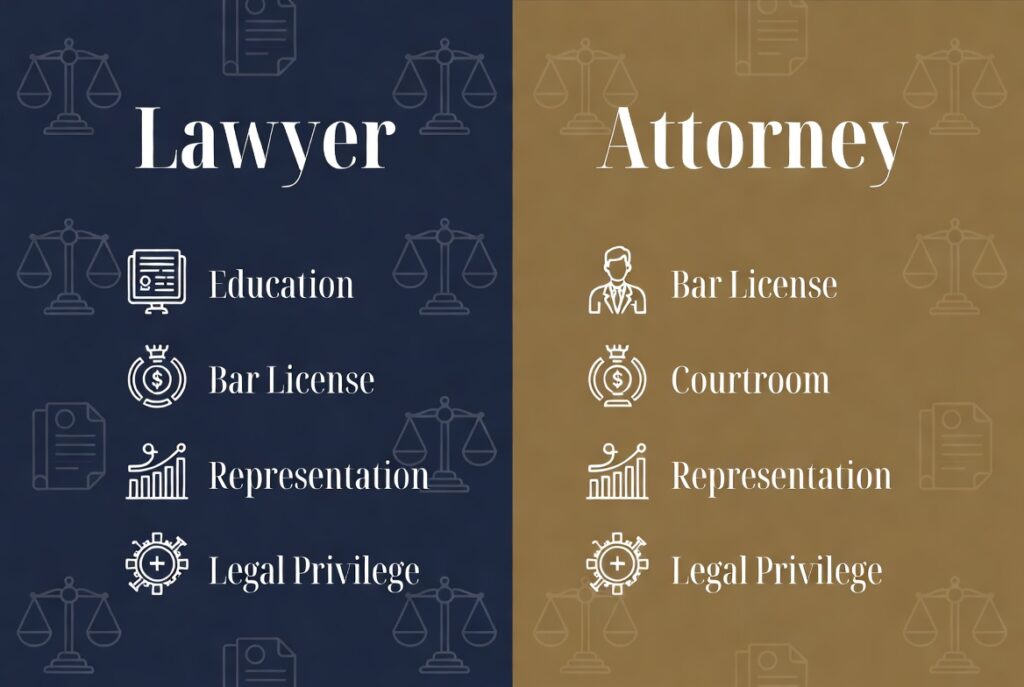
If you’re comparing “attorney vs lawyer” side by side, the table below gives you the instant clarity you need. We’ve expanded it beyond the basics so you can see exactly where the practical impact lives.
| Aspect | Lawyer | Attorney (Licensed) |
| Education | Juris Doctor (J.D.) from an ABA-accredited law school | J.D. plus passed state bar exam |
| Licensing | None required to call oneself a lawyer (education-based title) | Active license required; must meet CLE requirements |
| Court Representation | Typically none; cannot file pleadings or argue in court | Full authority to appear, advocate, and file on client’s behalf |
| Legal Advice & Strategy | May offer academic analysis or work under supervision | Can give formal legal advice and make binding decisions |
| Attorney-Client Privilege | Very limited; generally not protected unless supervised by a licensed attorney | Full protection; communications are confidential and shielded |
| Ethical Obligations | General professional norms, but not bound by state bar rules | Strictly bound by state bar ethics codes, subject to discipline |
| Malpractice Liability | Unlikely to carry malpractice coverage; limited exposure | Can be sued for malpractice; carries professional liability insurance |
| Right to Call Oneself “Attorney at Law” | No | Yes |
| Scope of Work | Legal research, drafting, academic roles, compliance, legal tech | All of lawyer tasks plus litigation, negotiation, client representation |
This chart answers the most common “difference between a lawyer and an attorney” search in one scan. The right column is what you need if a dispute might ever see a courtroom.
Why the Confusion Exists: History, Everyday Use, and What the ABA Says
If the terms are distinct, why does everyone from TV shows to billboards use “lawyer” and “attorney” interchangeably? Blame history, convenience, and the law itself.
“Lawyer” first entered the English language around 1377, from Middle English lawier, simply meaning a person learned in law. “Attorney” has even older roots around 1330 from Old French atorné, meaning one appointed to act for another. So historically, an attorney was an agent with legal power, while a lawyer was the knowledge-holder. When the American legal system evolved, these two concepts merged: a court could only allow someone to act as another’s attorney if they were also learned in law.
Fast forward to today, and the American Bar Association (ABA) treats the terms as functional synonyms once a person is licensed. According to the ABA, a licensed lawyer is an attorney, and vice versa. That’s why you’ll see “car accident lawyer” and “car accident attorney” on the same firm’s website. Both refer to a licensed professional who can take your case to trial.
However, the ABA’s stance doesn’t erase the pre-licensure gap. A recent J.D. graduate at a legal tech startup might rightly call themselves a lawyer. They just can’t offer legal advice or show up in court until they pass the bar. So the confusion isn’t a mistake, it’s a reflection of a system where two words dance around one pivotal milestone: licensure.
Education and Licensing Path: Becoming a Lawyer or Attorney Step-by-Step
People asking “difference between attorney and lawyer” are often standing at a career crossroads or trying to gauge someone’s qualifications. The journey clarifies everything.
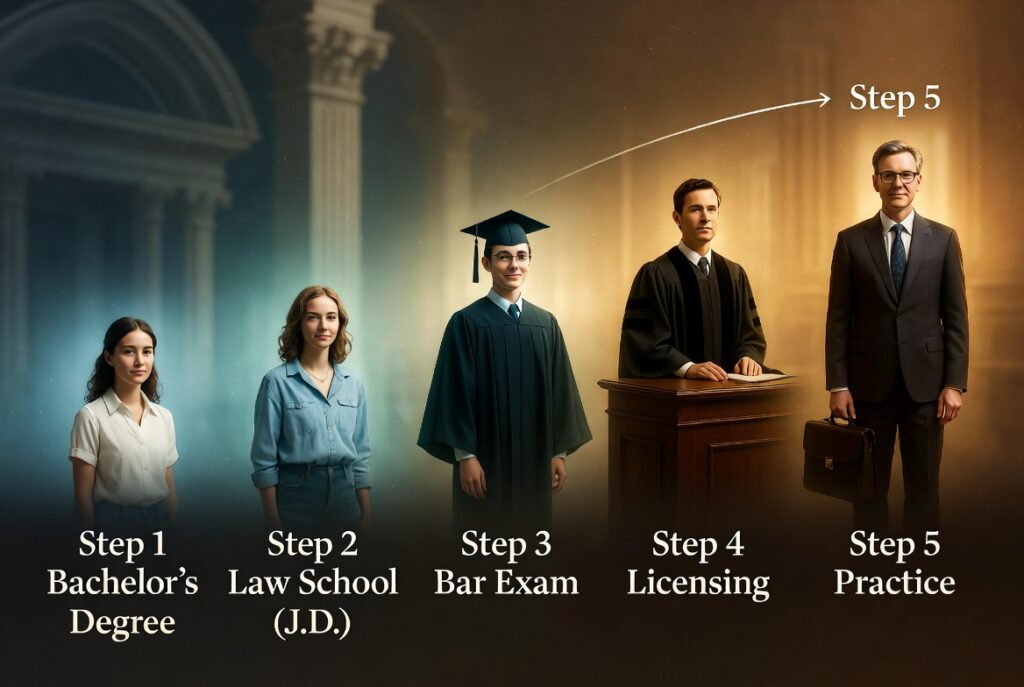
Step 1: Earn a bachelor’s degree (4 years). No required major, but strong reading, writing, and critical thinking matter. Political science, English, history, and criminal justice are common pre-law paths.
Step 2: Take the LSAT and get into law school. The Law School Admission Test measures logical reasoning and reading comprehension. A competitive score opens doors to ABA-accredited schools.
Step 3: Complete the Juris Doctor program (3 years). The first year covers foundational subjects like contracts, torts, civil procedure, and constitutional law. The next two years allow specialization. At graduation, you are officially a lawyer with a J.D.
Step 4: Pass the state bar exam. This is the gate. The bar exam is a grueling two-day (or multi-day) test of state-specific and general legal knowledge. Many states now use the Uniform Bar Exam (UBE), allowing score portability. You must also pass the Multistate Professional Responsibility Exam (MPRE) testing legal ethics.
Step 5: Clear character and fitness review. The state bar digs into your background financial history, criminal record, honesty, and mental fitness. Full disclosure is mandatory.
Step 6: Get sworn in and licensed. Once you take the oath, you become an attorney at law in that jurisdiction. You can now represent clients, charge for legal services, and enjoy full attorney-client privilege.
Pro tip: Some law graduates skip the bar intentionally, working as lawyers in compliance, HR, government policy, or legal technology where a license isn’t required. That’s a perfectly valid career path, and it’s a perfect illustration of the lawyer vs attorney gap.
The 2026 update: The Uniform Bar Exam (UBE) continues to expand, with more states now accepting remote bar exam components. If you’re evaluating a professional’s credentials, you can check their bar status online in under 60 seconds. Almost every state bar association has a free “Attorney Search” directory. For example, the State Bar of California’s attorney lookup makes verification quick and easy. Always verify, never assume.
Roles and Duties: What Lawyers and Attorneys Actually Do
Real life doesn’t fit into tidy boxes. But understanding the typical scope of work helps answer “what is the difference between a lawyer and an attorney” from a practical, hiring perspective.
Lawyers without a license often focus on:
- Legal research and memo writing for firms
- Contract drafting and review (under attorney supervision)
- Policy analysis for nonprofits and corporations
- Teaching and academic writing
- Legal technology design and consulting
- Compliance and risk management roles
Licensed attorneys handle:
- Full client representation from demand letters to trial
- Courtroom advocacy, witness examination, motions, and appeals
- Negotiation of settlements with binding authority
- Formal legal opinions and strategy
- Protection of attorney-client privilege
Case scenario 1—Car accident claim: You’re injured and dealing with an insurance adjuster. A brilliant law school graduate (lawyer) who hasn’t passed the bar can help you research liability and draft a demand letter template. But if the insurer denies your claim, you need a licensed attorney who can file a lawsuit, depose witnesses, and walk into a courtroom. That’s the difference that changes outcomes.
Case scenario 2—Business startup: A legal tech entrepreneur (lawyer) can design a compliance platform and explain legal concepts to investors. They cannot draft your operating agreement and represent that it’s legally sound unless they are a licensed attorney or supervised by one. Once a bar-admitted attorney signs off, you’re protected.
Case scenario 3—Criminal charge: This is black and white. Only a licensed attorney can defend you against criminal charges. The right to counsel means a court-appointed attorney or a privately hired defense attorney never an unlicensed lawyer. If you’re googling “criminal lawyer vs defense attorney,” know this: in the U.S., they’re the same fully licensed professional.
Attorney vs Lawyer Around the World: Why U.S. Distinctions Are Unique
Searches for “difference between lawyer barrister and attorney” or “difference between advocate lawyer and attorney” hint at a global audience. In many countries, the roles split differently.
United Kingdom & Australia:
- Solicitor: Client-facing advisor, handles paperwork, negotiations, and pre-trial work.
- Barrister: Specialist courtroom advocate, often instructed by solicitors for trials.
“Attorney” isn’t a regulated title there; it’s rarely used outside of historical or power-of-attorney contexts.
Canada:
Similar to the U.S., but most provinces have a fused profession. Once licensed, you’re both a barrister and solicitor. The term “attorney” appears mainly in “Attorney General.”
India:
An advocate is a licensed legal professional who can practice before courts. Terms like “lawyer” and “attorney” are used loosely, but “Advocate on Record” has special Supreme Court privileges.
So when someone asks “what’s the difference between a lawyer and an attorney” internationally, the answer depends heavily on jurisdiction. The U.S. distinction J.D. graduate vs. bar-admitted professional is relatively unique and important for anyone navigating American courts.
Related Legal Titles You Should Know (and When They’re Different)
Understanding the “difference between attorney and lawyer” also means knowing neighboring titles.
- Esquire (Esq.): An honorary title used by licensed attorneys in the U.S. If you see “Jane Doe, Esq.”, she’s an attorney. A non-licensed lawyer shouldn’t use it.
- Counsel/Counselor: Often a term for an attorney providing advice, frequently used in-house (corporate counsel) or in court (“Counselor, please approach the bench”). It implies a licensed attorney.
- Prosecutor / District Attorney (DA): Government attorneys who represent the state in criminal cases. They are fully licensed lawyers and attorneys. So the “difference between lawyer and attorney and prosecutor” is that a prosecutor is a specialized type of licensed attorney.
- Public Defender: A court-appointed attorney for criminal defendants who can’t afford one. Licensed and often highly experienced.
- Paralegal / Legal Assistant: Professionals trained in legal work who cannot practice law independently. They support attorneys and are not lawyers or attorneys themselves.
- Notary Public: Not a lawyer. Can witness signatures and administer oaths but cannot give legal advice.
Takeaway: When you see “attorney” in a title District Attorney, Attorney General, Attorney at Law it signals a licensed professional with state-granted power. “Lawyer” is broader.
Specific Comparisons People Frequently Search (Decoded)
Criminal lawyer vs defense attorney: In the U.S., there is no practical difference. Both terms refer to a licensed attorney who defends individuals or entities accused of crimes. If you’re charged with a DUI, hire either just confirm bar admission.
Divorce lawyer vs attorney: Interchangeable. The critical factor is experience in family law, not the label. Ask: “How many contested custody cases have you handled?”
Plane accident attorney vs airplane accident lawyer: Pure word choice. Aviation litigation is hyper-specialized. Look for board certification in aviation law, a proven trial record, and resources to take on airlines. The title “attorney” or “lawyer” won’t tell you that.
Difference between lawyer and attorney in court: Only a licensed attorney may represent clients in court. An unlicensed lawyer cannot argue motions, cross-examine, or file pleadings. If you’re in a courtroom, you want an attorney.
Difference between attorney and lawyer in USA: The licensing gap. U.S. jurisdictions require bar admission for the full practice of law.
When the Distinction Matters Most for Clients: A Practical Guide

Hire a licensed attorney if:
- Your case may go to trial, arbitration, or any adversarial proceeding.
- You need formal legal advice with confidentiality protection.
- You’re signing binding contracts affecting your finances, custody rights, or business structure.
- You face criminal charges or potential loss of liberty.
A lawyer (non-licensed) might be sufficient if:
- You need academic legal research or educational materials.
- You’re developing legal technology and need subject-matter input (under proper boundaries).
- You’re seeking policy analysis or legislative tracking.
Verification Steps: Protect Yourself in 60 Seconds
1. Go to your state bar association’s website (search “[State] bar attorney search”).
2. Enter the person’s name.
3. Confirm their license status is “Active” and note any discipline history.
4. Ask for their bar number directly any legitimate attorney will provide it instantly.
Red flags when hiring:
- Inability or unwillingness to provide a bar number or state of licensure.
- Promises of guaranteed results (ethical rules prohibit this).
- Pressuring you to sign immediately without reading a contract.
- Extremely poor communication or evasive answers about experience.
Attorney-client privilege is the invisible shield. Only a formally established attorney-client relationship with a licensed attorney fully invokes this protection. If you share sensitive details with an unlicensed lawyer, those details might not be protected from disclosure. This alone often answers “is there a difference between a lawyer and an attorney” for people facing divorce or business disputes.
Career Advice: Becoming a Lawyer or Attorney in 2026
The law remains a demanding, intellectually rich, and high-stakes profession. The 2026 landscape adds layers of tech disruption, new license portability options, and a massive access-to-justice gap that creates opportunities.
Skills that will set you apart:
- Data literacy and AI tool competence (e-discovery, predictive analytics, legal research AI).
- Emotional intelligence and cross-cultural communication.
- Entrepreneurial mindset if you plan to hang a shingle.
If you’re serious about starting your own practice after getting licensed, read our guide on how to start a law firm for step-by-step insights on business formation, malpractice insurance, and client acquisition.
Financial realism: Salaries for “attorney vs lawyer” roles converge once you’re licensed. Unlicensed J.D. roles in compliance or legal ops often pay less than associate attorney positions at firms, but they offer work-life balance. According to the Bureau of Labor Statistics, the median pay for attorneys in 2023 was around $145,000, but that varies widely by location, practice area, and firm size.
2026 trend: Law firms increasingly hire “legal knowledge engineers,” “legal data analysts,” and “legal technologists” roles where a J.D. (lawyer) is valued without a bar license. This blurs the line and makes the “difference between lawyer and attorney” more relevant than ever for career planning.
Common Myths and Misconceptions: Attorney vs Lawyer Edition
Myth 1: Any law graduate can represent you in court.
Reality: Only licensed attorneys can. Appearing in court without a license is unauthorized practice of law, a serious offense.
Myth 2: “Attorney” always means more experienced than “lawyer.”
Reality: A newly minted attorney is less experienced than a 20-year legal scholar who never took the bar. Title isn’t a proxy for quality.
Myth 3: The ABA says there’s zero difference.
Reality: The ABA treats the terms as synonyms for licensed professionals, but acknowledges the pre-licensure gap. They’re not interchangeable in every context.
Myth 4: Attorney-client privilege attaches whenever you talk to anyone with a law degree.
Reality: Privilege requires a formal relationship with a licensed attorney. Don’t spill secrets to an unlicensed law grad and assume protection.
Myth 5: “Esquire” means someone is better than a regular attorney.
Reality: It’s an honorific, not a skill rating. Any licensed attorney can use it.
Myth 6: If someone works at a law firm, they must be an attorney.
Reality: Firms employ law clerks, paralegals, and non-licensed lawyers. Always check who is actually handling your case.
2026 Relevance: How Technology and Remote Practice Shift the Landscape
The “difference between attorney and lawyer in 2026” is shaped by a few seismic shifts.
Remote practice and UBE portability: More states adopted the Uniform Bar Exam, and temporary remote practice rules born during the pandemic are becoming permanent in some jurisdictions. An attorney licensed in New York might represent you virtually in a matter where local rules allow. This makes verifying multi-state licensure even more critical.
AI and the unauthorized practice of law: AI-powered legal document tools are blurring boundaries. A lawyer without a license might help develop an AI that drafts contracts, raising questions about where “legal advice” begins. Regulators are watching closely. For you, the consumer, the rule stays the same: only a licensed attorney can give you tailored legal advice you can rely on.
Access to justice innovations: Non-lawyer legal technicians and licensed paralegals in a few states (like Washington and Utah) can offer limited legal services without full attorney licensure. These programs test the edges of the traditional attorney definition. They don’t change the core difference, but they add new titles to the mix.
Bottom line for 2026: The license still rules. Whether you call them a lawyer or an attorney, if they’re representing you in a binding legal matter, they must have an active bar card. Technology doesn’t change, it just makes checking it easier.
FAQ: Difference Between Attorney and Lawyer (Every Question Answered)
Is there a difference between a lawyer and an attorney?
Yes, technically. A lawyer has a law degree. An attorney is a lawyer licensed to practice law and represent clients in court.
What’s the difference between a lawyer and an attorney?
The difference lies in bar admission. Attorneys have passed the bar, met character and fitness requirements, and are authorized to practice. Lawyers may not have.
Are a lawyer and attorney the same thing?
In everyday U.S. usage among licensed professionals, yes. But a law school graduate who hasn’t passed the bar is a lawyer, not an attorney.
Can a lawyer represent me in court?
Only if they are a licensed attorney in that jurisdiction. An unlicensed lawyer cannot appear on your behalf.
What is the difference between a lawyer and an attorney in the United States?
Primarily licensing and court authority. The U.S. system ties the practice of law to state bar admission, making the distinction legally significant.
How do I verify if someone is a licensed attorney?
Search your state bar association’s online directory for instance, the State Bar of California’s attorney search. You’ll find license status, admission date, and any public disciplinary record.
Difference between criminal lawyer and defense attorney?
None in U.S. practice. Both are licensed attorneys who defend criminal charges. The terms are synonymous.
What does the American Bar Association say about the difference between lawyer and attorney?
The American Bar Association (ABA) states that the terms are used interchangeably once a person is licensed to practice law. However, the ABA ethics rules apply to licensed attorneys and those under their supervision.
Attorney vs lawyer salary?
Salaries vary more by role and experience than by title. However, licensed attorney positions in private practice tend to pay higher than J.D.-preferred (non-licensed) roles like compliance analyst or legal operations.
Is there any difference between attorney and lawyer in 2026?
The core legal distinction remains: licensure separates them. Remote practice, UBE portability, and AI tools may expand non-licensed legal careers, but only attorneys can provide full legal services.
Difference between lawyer barrister and attorney?
Barrister is a UK/Commonwealth term for a courtroom specialist. In the U.S., “attorney” covers both advice and advocacy roles. Barristers don’t exist in the American system. Check the Legal Information Institute (LII) at Cornell for more global definitions.
Difference between advocate lawyer and attorney?
In India and some other countries, “advocate” is the licensed court practitioner. In the U.S., attorney and lawyer are the standard terms; “advocate” is a descriptor, not a formal title.
Can I call myself an attorney without a license?
No. Doing so would likely constitute unauthorized practice of law and misrepresentation, subjecting you to serious penalties.
Does a power of attorney make me an attorney?
No. “Attorney-in-fact” under a power of attorney is a separate legal concept, granting a person (who doesn’t have to be a lawyer) authority to act on another’s behalf in specific matters.
Difference between attorney and lawyer and prosecutor?
A prosecutor is a licensed attorney who represents the government in criminal cases. All prosecutors are lawyers and attorneys, but not all attorneys are prosecutors.
If I only need a document reviewed, can a lawyer do it?
If they are supervised by a licensed attorney or provide purely non-legal editorial assistance, possibly. But for a binding legal review, you need a licensed attorney to ensure accuracy and privilege.
Conclusion: Focus on Expertise, Not Just Titles
The difference between attorney and lawyer isn’t a dusty academic point, it’s a filter for who you let into the most critical moments of your life. When the stakes involve your freedom, your family, or your financial future, the word “attorney” signals a state-backed license to advocate, protect, and fight.
But don’t let titles alone guide you. Experience, specialization, communication style, and a clean disciplinary record matter far more than whether someone’s business card says “lawyer” or “attorney.” Ask pointed questions: “How many cases like mine have you handled to resolution?” “Are you licensed in this state?” “Will you personally handle my matter or delegate it?”
If you’re facing a legal challenge whether it’s a car accident, a custody dispute, or a business breakup take the 60 seconds to verify credentials through your state bar. That small step can save you from the heartbreak of discovering too late that your representative had no right to stand up for you in court.
For state-specific legal guidance on other common questions, explore resources like our detailed guides on Florida tint laws and Texas tint laws a reminder that even seemingly small regulations can land you in legal trouble without proper advice. But always, for your unique situation, consult a licensed attorney in your jurisdiction.
Disclaimer: This article is for general informational and educational purposes only and does not constitute legal advice. No attorney-client relationship is created by reading this content. Always seek the advice of a qualified, licensed attorney for any legal decisions.

Dirk Wasserthal is the Founder and Lead Writer of LegalDiaries.com, an independent legal information platform. He specializes in Mass Torts, Women’s Rights, and emerging legal issues, delivering clear, well-researched, and trustworthy content across Criminal Law, Family Law, Personal Injury, and more. Dirk’s mission is simple — make the law understandable for everyone.