


Quick Answer
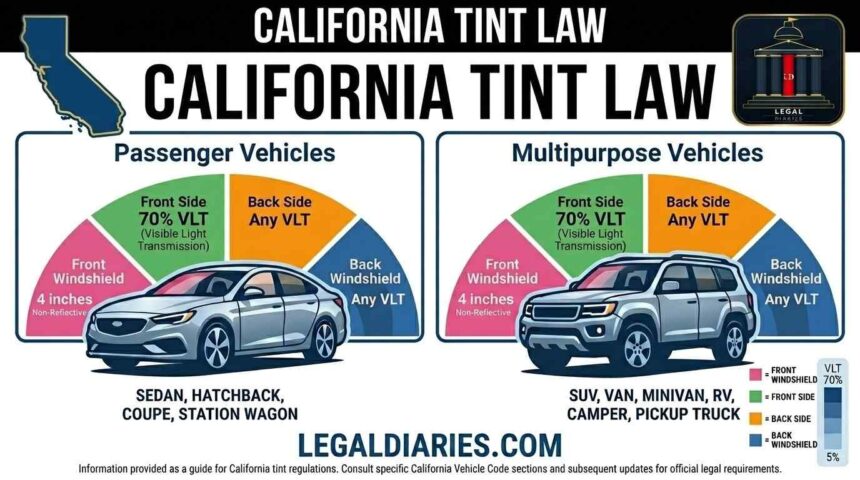
California tint law requires front side windows to let in at least 70% of light (70% VLT). Back side windows and the rear window can be any darkness. The windshield can only have non-reflective tint on the top 4 inches. This law comes from California Vehicle Code Section 26708. First-time violations usually get a $25 fix-it ticket, though court fees can push that up to $197.
California tint law sets strict limits on how dark you can make your car windows. Front side windows must let in at least 70% of visible light. Back windows and the rear windshield can be as dark as you want, but you need dual side mirrors if you tint the rear window.
- What Is VLT and Why It Controls Everything
- California Window Tint Law by Window Type
- California Windshield Tint Law
- California Front Side Window Tint Law (Driver and Passenger)
- California Rear Window Tint Law
- Sedan vs. SUV and Van Tint Rules
- What Is the Darkest Legal Tint in California?
- Tint Color and Reflection Rules
- Tint Certificates and Stickers You Need
- Fines and Penalties for Illegal Tint
- How Police Check Your Window Tint
- California Tint Law Medical Exemption
- Illegal Tint and Car Accident Liability
- Best Legal Tint Types for California Cars
- California Headlight and Tail Light Tint Law
- Frequently Asked Questions
- Q1. What is the darkest legal tint in California?
- Q2. Is 35% tint legal in California?
- Q3. How much is a window tint ticket in California?
- Q4. Can I get a medical exemption for darker tint in California?
- Q5. Does California tint law apply the same way to SUVs and trucks?
- Q6. Is tint applied in another state legal once I bring my car to California?
- Q7. Can illegal tint affect my car insurance claim?
- Q8. Does California tint law apply to Tesla and other cars with dark factory glass?
- Q9. Is headlight or tail light tint legal in California?
- Q10. Has California tint law changed for 2025 or 2026?
- Conclusion
This rule applies whether you call it California window tint law, California car tint law, or simply the state’s tinted windows law. Different drivers search for it different ways, but the underlying California Vehicle Code is the same.
Getting this wrong is not a small problem. Illegal tint can lead to a fix-it ticket, a court date, and in some accident cases, it can even make you fully liable for damages. This guide breaks down California tint law in plain English so you can stay legal, avoid fines, and pick the right tint for your car.
We cover the exact percentages for every window, the darkest legal tint you can buy, medical exemptions, fines, the California DMV tint law process, and how police actually check your tint on the road.
What Is VLT and Why It Controls Everything
VLT stands for Visible Light Transmission. It is the percentage of light that passes through your window, counting both the glass and any film on it together.
A higher VLT number means a lighter tint. A lower VLT number means a darker tint. A 70% VLT lets in a lot of light. A 5% VLT is almost black.
Here is the part most drivers get wrong. California measures VLT on the glass and the film combined, not the film alone. Most factory car glass already blocks some light, usually letting through 75% to 85% VLT.
Example: If your factory glass lets through 80% of light and you add a 20% VLT film, the combined VLT drops below the legal 70% limit on front windows. That is an illegal install, even though the film package said “20%.”
This is why a film rated at 88% VLT or higher is often needed on front windows. Once it combines with tinted factory glass, the total still needs to land at or above 70%.
Quick VLT Reference Chart
| VLT % | Darkness Level | Common Name |
| 5% | Almost black | Limo tint |
| 20% | Very dark | Privacy tint |
| 35% | Medium dark | Standard dark tint |
| 50% | Medium | Moderate tint |
| 70% | Light | Minimum for front windows |
| 88%+ | Nearly clear | Compliant film for tinted factory glass |
California Window Tint Law by Window Type
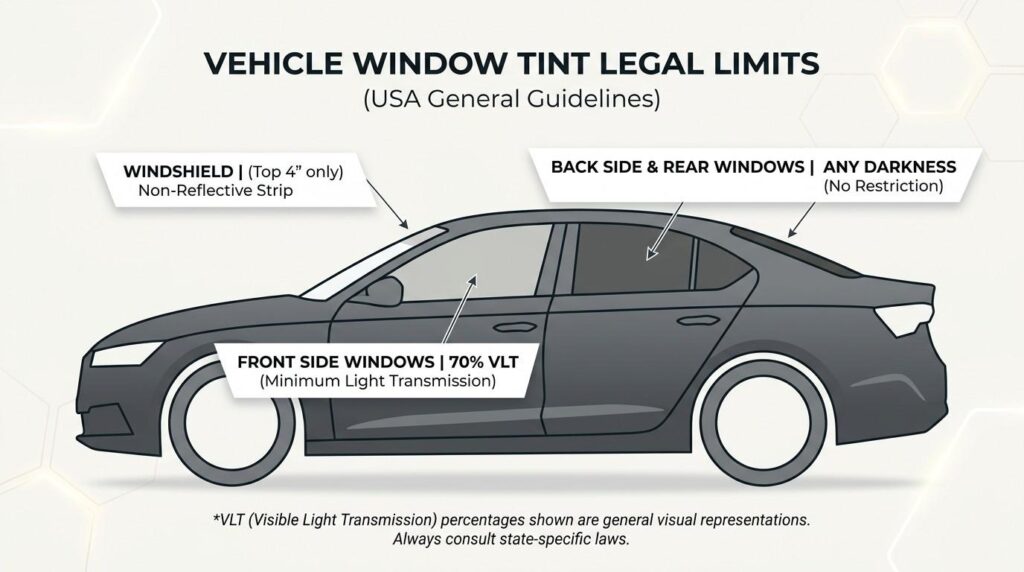
California window tint law does not treat every window the same way. The state breaks its tinted windows law down by window position, so the front windshield, front side windows, and rear windows each follow a different rule.
California Windshield Tint Law
You can only add non-reflective tint to the top 4 inches of your windshield, above the AS-1 line set by the manufacturer. Everything below that line must stay clear.
- Must be non-reflective
- Cannot be colored (red, amber, or blue are banned everywhere on the car)
- Cannot block sensors or cameras mounted near the windshield
California Front Side Window Tint Law (Driver and Passenger)
Under California front window tint law, front side windows must allow at least 70% of light through, counting the glass and film together. This is the rule that trips up most drivers, because factory tint already eats into that 70%.
If your factory glass is clear, you can use a film rated close to 70% VLT. If your factory glass already has some tint, you will likely need a clearer film, often in the 80% to 90% VLT range, to stay legal.
California Rear Window Tint Law
Good news here. Under California’s rear window tint law, back side windows and the rear window can be any darkness you want, including 5% VLT limo tint.
One condition: if you tint your rear window, your car needs dual side mirrors (one on each side). Almost every modern car already has this, so it rarely causes a problem.
Sedan vs. SUV and Van Tint Rules
A common myth is that SUVs and vans get darker tint allowances than sedans. That is not true in California.
Every passenger vehicle type, including sedans, SUVs, trucks, vans, hatchbacks, and convertibles, follows the exact same VLT rules. The window position matters, not the body style.
| Vehicle Type | Front Side Windows | Back Side & Rear |
| Sedan / Coupe | 70% VLT minimum | Any darkness |
| SUV / Van / Truck | 70% VLT minimum | Any darkness |
| Convertible | 70% VLT minimum | Any darkness |
| Commercial Vehicle | 70% VLT minimum | Any darkness |
The only real difference between vehicle types comes down to how many side mirrors they have and whether the rear window tint condition (dual mirrors) is already met. Most vans and SUVs already meet this by default.
What Is the Darkest Legal Tint in California?
This is one of the most common questions about California car window tint law, and the answer depends entirely on which window you are asking about.
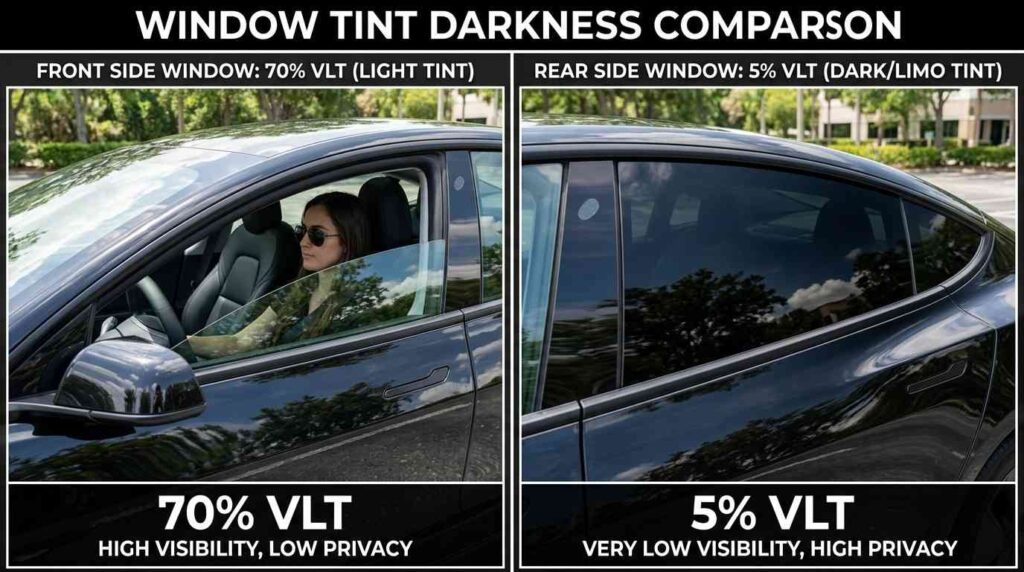
- Front side windows: 70% VLT is the darkest you can legally go (this is the lightest tint of any window on your car).
- Back side windows and rear window: 5% VLT, also called limo tint, is legal as long as you have dual side mirrors.
- Windshield: only the top 4 inches can be tinted, and it must be non-reflective.
So if someone asks “is 35% tint legal in California,” the answer is yes on the rear windows, but no on the front side windows. Front windows always need to stay at 70% VLT or lighter.
Heads up: Tint often looks 5% to 15% darker once it is actually applied, compared to the number printed on the film roll. Always ask your installer to measure the final combined VLT with a meter before you leave the shop.
Tint Color and Reflection Rules
Darkness is not the only thing California checks. Color and shine matter too.
Banned Tint Colors
Red, amber, and blue tint films are illegal on any window in California. These colors can be confused with emergency vehicle lights, so the state bans them outright.
Reflectivity Rules
Your tint cannot be more reflective than the car’s standard factory glass. Mirrored or metallic-looking film is a common reason drivers get pulled over, even if the VLT percentage is technically legal.
- Allowed: black, gray, smoke, and other neutral, non-reflective colors
- Not allowed: red, amber, blue, or any mirrored or metallic finish
Tint Certificates and Stickers You Need
This part gets skipped a lot, but it matters. The California DMV tint law requires paperwork to back up your tint job, not just a legal VLT reading.
- Manufacturer certification: companies that sell window film in California must certify that the film meets state law.
- Driver’s certificate: you are required to carry proof that your film is certified, in case an officer asks.
- Installer sticker: the shop that installs your tint should give you a sticker or certificate with their name and address.
Buying a used car? Do not assume the existing tint is legal. Ask the seller for documentation, or get the windows measured before you drive off. You could be held responsible for tint a previous owner installed.
Fines and Penalties for Illegal Tint
Most illegal tint stops do not end in a harsh punishment. Under California tint law for 2025 and 2026, this is treated as a correctable offense, also called a fix-it ticket.
| Offense | Base Fine | Total With Court Fees |
| First offense | $25 | Up to $197 |
| Second offense and beyond | $197 | $197 or more |
If you ignore the ticket or do not fix the tint in time, the fines can grow. Repeated violations may also affect your vehicle registration renewal.
How to Get a Fix-It Ticket Dismissed
- Remove or replace the illegal tint so it meets the legal VLT.
- Take your car to a police station or have an officer sign off that the violation is fixed.
- Get a certificate of correction from the officer.
- Submit the certificate to the court before your deadline, usually within the time printed on your ticket.
Skip any of these steps and the ticket can turn into a real fine instead of a warning.
How Police Check Your Window Tint
California Highway Patrol officers and local police use a handheld tool called a tint meter, sometimes called a photometer, to measure your VLT on the spot.
These devices give an exact reading, and the result can be used as evidence if your ticket goes to court.
- Officers often check tint during routine traffic stops
- CHP also runs dedicated safety checkpoints that test tint along with other equipment
- If the reading is below the legal limit, you will likely get a fix-it ticket on the spot
Ignorance is not a legal defense here. Even if your installer told you the film was legal, you are the one responsible for keeping your car compliant.
California Tint Law Medical Exemption
Some drivers have medical conditions that make sunlight dangerous. The California window tint medical exemption law allows a tint exemption for these cases under Vehicle Code Section 26708(b)(10).
Who Qualifies
- Lupus
- Melanoma or a history of skin cancer
- Photosensitivity disorders
- Other diagnosed conditions where sunlight exposure causes harm
How to Apply
- Get a signed letter from a licensed physician or optometrist confirming your condition.
- Submit the letter through the DMV medical exemption process.
- Once approved, you can apply darker film to your front side windows, often in the 20% to 35% VLT range.
Even with a medical exemption, the film still has to be clear and colorless. It cannot be mirrored or tinted with a banned color. The DMV approves only the minimum darkness needed for your condition, not unlimited darkness.
Illegal Tint and Car Accident Liability
This is the part most drivers never think about until it is too late. Illegal window tint does not just risk a ticket. It can affect who is blamed in a car accident.
If your front windows are tinted darker than legal and you get into a crash, an insurance company or court may argue that your reduced visibility contributed to the accident. In some cases, this has been used to assign full fault to the driver with illegal tint, even when the other driver caused the crash.
Illegal tint can also give an insurance company a reason to delay or deny part of a claim, since it points to a vehicle code violation at the time of the crash.
Bottom line: staying within legal VLT limits protects more than your wallet. It protects you in the event something goes wrong on the road.
Best Legal Tint Types for California Cars
Picking the right film matters as much as picking the right percentage. Some film types make it easier to stay compliant while still blocking heat and UV rays.
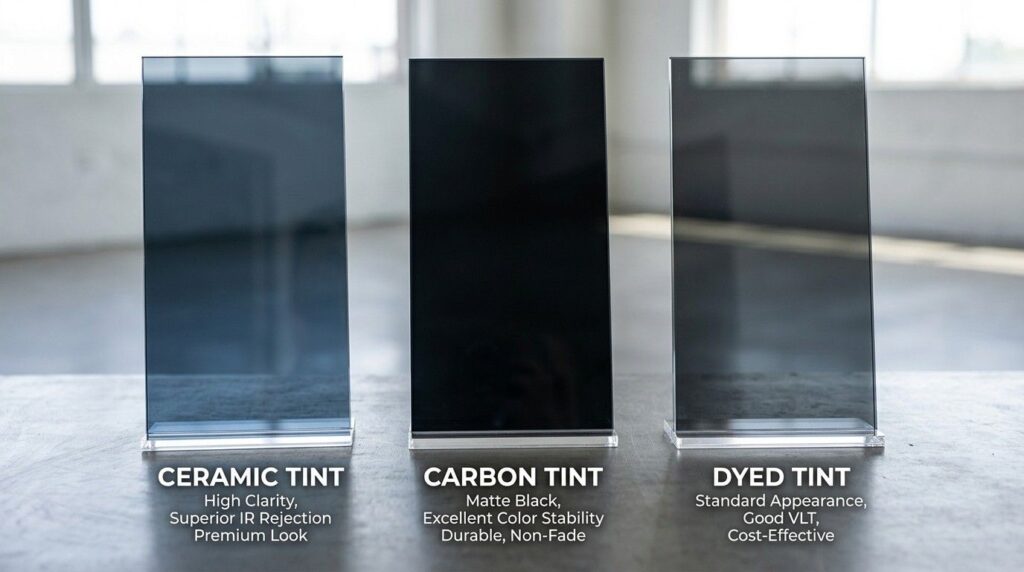
Ceramic Tint
Ceramic film blocks heat and UV light without using metal particles, so it will not trigger reflectivity violations. It is the top pick for front windows because high-quality ceramic film can hit 80% to 90% VLT while still cutting heat.
Carbon Tint
Carbon film is a solid mid-range option. It is non-reflective and blocks some heat, though it does not perform quite as well as ceramic for UV protection.
What to Avoid
- Metallic or mirrored films, even if labeled as a legal VLT percentage
- Cheap dyed film with no documentation or certification
- Any film rated below what your factory glass needs to hit 70% combined VLT on front windows
Always ask your installer to test the combined VLT with a meter before they finish the job, not just hand you a spec sheet.
California Headlight and Tail Light Tint Law
Window tint is not the only film California regulates. The California headlight tint law and California law on tinted tail lights cover a separate part of the vehicle code, and the rules are stricter than most drivers expect.
Headlight Tint Rules
Headlights must stay clear and colorless. California does not allow smoked, colored, or darkened film over headlight housings. The light they put out must stay white or a legally approved shade, with no covering that reduces brightness.
Tail Light Tint Rules
Tail light tint law works the same way. Tail lights must stay red and fully visible. Smoked or blacked-out tail light covers are illegal because they cut down how well other drivers can see your brake lights and turn signals.
- Headlights and tail lights must remain at their original brightness
- Smoke film, colored overlays, and dark covers are not permitted on any vehicle light
- Officers can issue a fix-it ticket for light tint the same way they do for illegal window tint
If you want a darker look for your lights, talk to a shop about DOT-approved overlays that do not reduce visibility or brightness below the legal standard. Anything that dims or recolors the light itself is a violation.
Frequently Asked Questions
Q1. What is the darkest legal tint in California?
Front side windows must stay at 70% VLT or lighter. Back side windows and the rear window can go as dark as 5% VLT, known as limo tint, as long as you have dual side mirrors.
Q2. Is 35% tint legal in California?
Yes on back side windows and the rear window. No on front side windows, which must stay at 70% VLT or higher.
Q3. How much is a window tint ticket in California?
A first offense usually starts at $25, but court fees can push the total close to $197. A second offense can cost $197 or more.
Q4. Can I get a medical exemption for darker tint in California?
Yes. Drivers with conditions like lupus, melanoma, or photosensitivity disorders can apply through the DMV with a signed letter from a physician or optometrist.
Q5. Does California tint law apply the same way to SUVs and trucks?
Yes. Sedans, SUVs, trucks, vans, and convertibles all follow the same VLT rules. Front side windows need 70% VLT minimum, and back windows can be any darkness.
Q6. Is tint applied in another state legal once I bring my car to California?
No. California applies its own VLT limits regardless of where the tint was installed. Have your tint checked once you register or drive your car in the state. Especially if coming from Florida tint laws or Texas tint laws.
Q7. Can illegal tint affect my car insurance claim?
It can. Insurers may use illegal tint as a factor in fault determination or as grounds to question a claim, especially in accidents involving visibility.
Q8. Does California tint law apply to Tesla and other cars with dark factory glass?
Yes. Even with darker factory glass, the combined VLT on front windows still must reach 70%. Always have an installer measure the existing VLT before adding any film.
Q9. Is headlight or tail light tint legal in California?
No. California headlight tint law and tail light tint law both require lights to stay clear, full brightness, and their original color. Smoked or colored covers are illegal.
Q10. Has California tint law changed for 2025 or 2026?
The core VLT limits have stayed the same for 2025 and 2026: 70% on front side windows and any darkness on rear windows. Always check the California DMV for the latest updates before you tint your car. For more on California laws, see our guide on jaywalking.
Conclusion
California tint law, whether you know it as California window tint law or simply the state’s car tint law, comes down to one number that matters most: 70% VLT on front side windows. Back windows and the rear windshield can be as dark as you like, down to 5% VLT, as long as your car has dual side mirrors.
Staying within these limits keeps you out of court, keeps your insurance claim clean if you are ever in an accident, and keeps your car looking sharp without the risk of a fix-it ticket. These rules have held steady for 2025 and into 2026, but it is always smart to check the California DMV tint law page before your next install.
Before you book an installer, ask them to confirm the combined VLT for your exact car, not just the film’s rating on the box. A few minutes of checking now saves you a ticket, a court date, and a possible liability headache later.

Dirk Wasserthal is the Founder and Lead Writer of LegalDiaries.com, an independent legal information platform. He specializes in Mass Torts, Women’s Rights, and emerging legal issues, delivering clear, well-researched, and trustworthy content across Criminal Law, Family Law, Personal Injury, and more. Dirk’s mission is simple — make the law understandable for everyone.